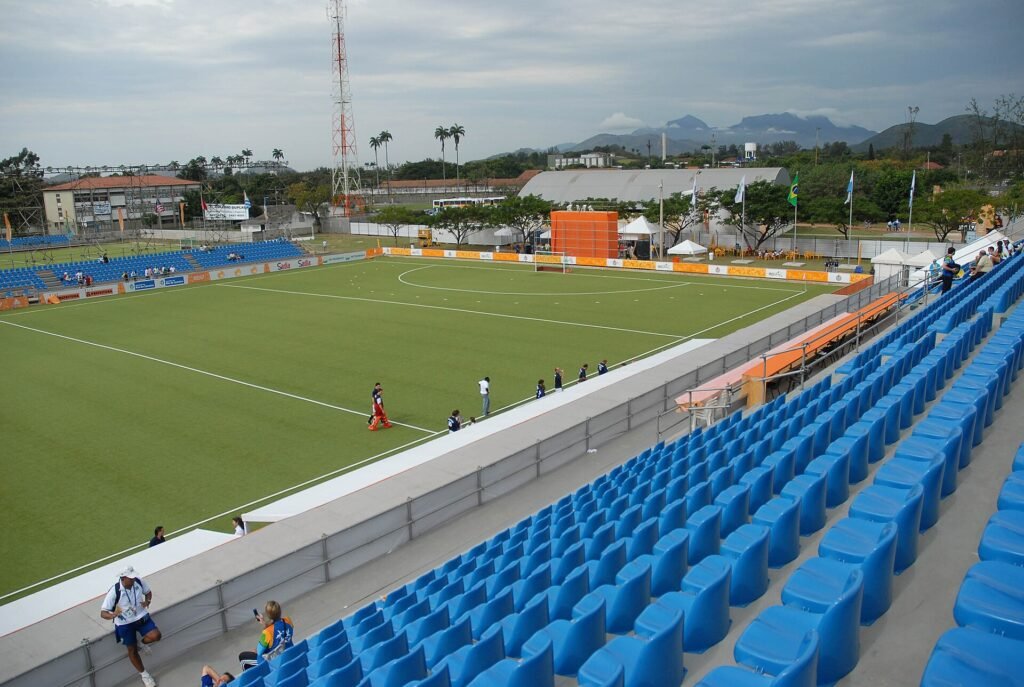
Field hockey is a team sport in which two teams of 11 players use curved sticks to hit a ball into the opponent’s goal. A match is played on a pitch of 91.4 by 55 meters in four quarters of 15 minutes. The International Hockey Federation (FIH) governs the sport, which has been in the Olympic Games since 1908 for men and 1980 for women.
History of field hockey
Hockey-like games are very old. Drawings in an Egyptian tomb about 4,000 years old may show one, though that reading is uncertain, and another reference traces the sport to about 500 BC in ancient Greece and Egypt. The modern game took shape in England, where the Hockey Association was formed in 1886 by seven London clubs and representatives of Trinity College, Cambridge. In the 1870s the Teddington club had already limited each side to eleven players.
The FIH was founded in Paris on 7 January 1924 by Paul Leautey, who became its first president. Its seven founding members were Austria, Belgium, Czechoslovakia, France, Hungary, Spain and Switzerland. The federation moved its headquarters from Brussels to Lausanne, Switzerland, in 2005.
Men’s hockey first appeared at the 1908 London Games, won by Great Britain, competing as England. There was no tournament in 1912, and Great Britain won again in 1920 at Antwerp. Hockey was dropped in 1924 because international structures were lacking, and it returned in 1928 at Amsterdam, where India won the first of its gold medals.
Women’s hockey was introduced at the 1980 Moscow Games, and Zimbabwe won the first women’s title. The story of how women’s events entered the Olympic program is told more broadly under gender in sport.
Rules and how field hockey is played
Each team has 11 players on the pitch, ten field players and a goalkeeper, with five substitutes on the bench. Substitutions are unlimited and can be made on the fly. As in association football, the aim is to put the ball in the opponent’s goal, and the team with more goals wins.
A match has four 15-minute quarters, with two-minute breaks after the first and third quarters and a 15-minute half-time. Only the flat face of the stick may be used to play the ball. The goal is 3.66 meters wide and 2.14 meters high.
A penalty corner is awarded for certain fouls in the shooting circle. Up to five defenders, including the goalkeeper, may defend the goal, and no attacker may be inside the circle when the ball is pushed out. The first shot on goal must not rise above 460 millimeters, which is the height of the backboard.
Sanctions follow a card system. A green card gives a two-minute suspension, a yellow card usually at least five minutes, and a red card is a permanent exclusion. Since March 2013, tied classification matches have been decided by a penalty shoot-out.
Equipment and venues
A field hockey stick weighs no more than 737 grams, and modern sticks are built from glass, carbon and aramid fibers. Sticks run roughly 80 to 95 centimeters long. The ball weighs 156 to 163 grams, and players also wear a mouthguard and shin guards. Goalkeepers wear a helmet, a throat collar, body armor, kickers and leg guards, plus a jersey of a different color.
Top-level hockey is played on artificial turf. The first Olympic tournament on synthetic turf was at Montreal in 1976, when New Zealand won the men’s title.
The pitch is marked with lines, including a 23-meter line that sits 22.90 meters from each end line. The way players run, turn and strike the ball is a topic in the biomechanics of movement.
Governing bodies and major competitions
The FIH is the international governing body for outdoor 11-a-side hockey, indoor hockey, Hockey5s, beach hockey and para hockey. It has 140 member associations and five continental federations: African, Asian, European, Oceania and Pan American. Rules of this kind are set by federations in the way described under sports governance.
The FIH publishes the Rules of Hockey in new editions. The 2026 edition of the outdoor rules applied until the 2027 edition took effect at international level on 1 November 2026. The new edition does not change the core of the game and focuses on clarity and consistency, including a restructured list of personal penalties. Revised para hockey rules took effect on 1 June 2026 to align them with the outdoor rules.
The main events are the Olympic Games and the men’s and women’s World Cups, which are held every four years. The 2023 men’s World Cup was won by Germany and the 2022 women’s World Cup by the Netherlands. The FIH Pro League, played each year since 2019 except 2020, is contested by the nine top-ranked men’s and women’s teams.
Records and notable moments
India holds the most Olympic men’s gold medals, with eight, and 13 medals overall. India won in 1928, in every Games from 1932 to 1956, in 1964 and in 1980. Pakistan won golds in 1960, 1968 and 1984. The Netherlands and Germany each have three men’s golds.
In the women’s tournament the Netherlands has the most golds, with five, and ten medals overall.
The size of the Olympic fields has changed. Men’s tournaments ranged from three teams in 1932 to 16 teams in 1960, 1968 and 1972, and have had 12 teams each time since 1992. Women’s fields grew from six teams in 1980 to 12 teams from 2012.
Global reach of field hockey
The Olympic results show a wide spread. Golds have gone to India and Pakistan in Asia, to New Zealand in Oceania, to the Netherlands and Germany in Europe, and to Zimbabwe in Africa in the first women’s event.
The FIH counts 140 member associations in five continental federations. Hockey5s, indoor hockey and beach hockey are separate disciplines it also governs, and para hockey extends the sport to players with disabilities.
More in Sports Coaching and Performance
Key facts
- The Hockey Association was formed in England in 1886, and the International Hockey Federation was founded in Paris on 7 January 1924.1
- A team has 11 players on the pitch, and a match has four 15-minute quarters on a pitch of 91.4 by 55 meters.3
- Men's hockey made its Olympic debut in 1908 and women's hockey in 1980.4
- India has won the most men's Olympic golds, with eight.4
Related concepts
Quick checkHow long is a field hockey match?Show answer
A match has four quarters of 15 minutes, with two-minute breaks after the first and third quarters and a 15-minute half-time.
Sources
- Wikipedia, International Hockey Federation, https://en.wikipedia.org/wiki/International_Hockey_Federation
- International Hockey Federation, Rules of Hockey, https://www.fih.hockey/about-fih/official-documents/rules-of-hockey
- International Olympic Committee, Field hockey rules: how to play, https://olympics.com/en/news/field-hockey-rules-how-to-play
- Wikipedia, Field hockey at the Summer Olympics, https://en.wikipedia.org/wiki/Field_hockey_at_the_Summer_Olympics
- Wikipedia, History of field hockey, https://en.wikipedia.org/wiki/History_of_field_hockey
- Wikipedia, Field hockey, https://en.wikipedia.org/wiki/Field_hockey
Editorially reviewed by Specialty Digest Editorial TeamLast reviewed November 4, 2026Researched and drafted with AI assistanceReport an issue