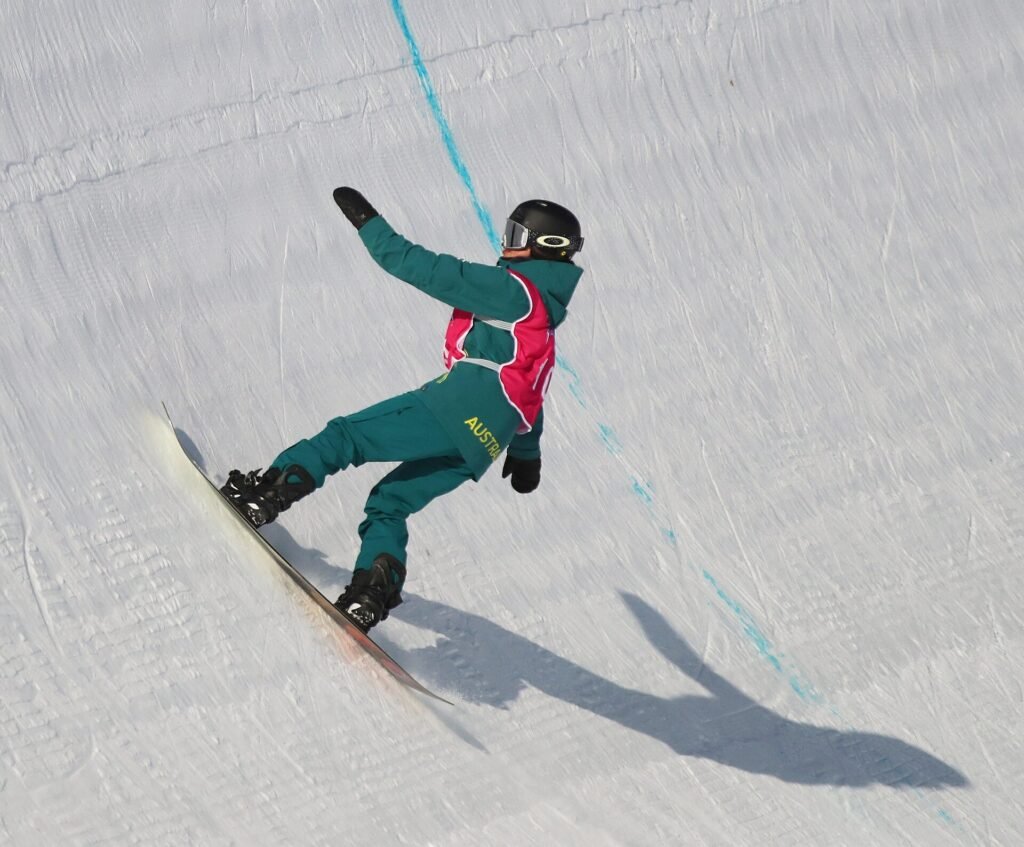
Snowboarding is a winter sport in which a rider stands sideways on a single board and slides down snow-covered slopes, courses and constructed features. It began in the United States in the 1960s and made its Olympic debut at the 1998 Winter Games in Nagano, Japan. Today it is governed internationally by the same federation that governs skiing.
History of snowboarding
The first board that was marketed to the public was the Snurfer. In the mid-1960s Sherman Poppen bound a pair of children’s skis together for his daughters, and he later sold the idea as the Snurfer. Snurfing contests were held from the late 1960s to the mid-1980s, and Poppen trademarked the name when other companies began selling their own versions.
In the 1970s snowboarders began to show up on slopes, but many ski resorts did not welcome them or allow them on lifts. Most resorts changed their policy during the 1990s, according to the International Olympic Committee. In 1995 the American television network ESPN founded the X Games to showcase extreme sports, and the Olympics then added more of these sports to attract the same younger audience.
Snowboarders formed their own International Snowboarding Federation in 1990. The International Ski Federation opposed adding the sport to the Winter Olympics, and the IOC compromise made snowboarding a discipline of skiing under FIS governance. Most snowboarders opposed that arrangement, and the ISF’s bid for recognition as an international sports federation was rejected.
Rules and how snowboarding is played
Snowboarding has two broad families of events. In racing events, riders compete against the clock or against each other down a course, and in freestyle events, judges score the tricks that riders perform on a halfpipe or on a course of jumps and rails.
The Olympic program uses five disciplines. In parallel giant slalom two riders race down two parallel tracks at once, and their qualifying times are combined. In snowboard cross, groups of four race head-to-head on a course with jumps, moguls and wide curves.
In halfpipe, riders perform stunts on a semi-cylindrical slope and are scored on the breadth and difficulty of their jumps. In slopestyle, riders tackle rails and jumps and are judged on the variety, originality and quality of their tricks. In big air, riders launch off a ramp and perform aerial tricks.
Equipment and venues
The modern snowboard evolved from the Snurfer, a single board for riding down snow-covered slopes. Venues for modern events are built for each discipline: a halfpipe has a semi-cylindrical shape, slopestyle courses have rails and jumps, and big air uses a large ramp.
At the 1998 Games the events were held at two venues in Yamanouchi, Japan: Mt. Yakebitai at Shiga Kogen hosted the giant slalom, and Kanbayashi Sports Park hosted the halfpipe. At the 2026 Games the snowboard events took place at Livigno, in the Valtellina region of Italy.
Governing bodies and major competitions
The IOC recognizes FIS as the governing body for six disciplines, including snowboarding. The Olympic Winter Games are the sport’s main stage, and FIS also holds a Snowboard World Championships, whose 2025 edition counted toward qualification for the 2026 Games.
Qualification for Milano Cortina ran from 1 July 2024 to 18 January 2026. The Games offered 238 quota places, split equally between 119 men and 119 women, and a national Olympic committee could receive up to 26 quotas, which is 13 men and 13 women. Each country could enter up to four athletes per event and gender, and the host nation automatically received eight places, one in each event and gender.
Per gender, parallel giant slalom and snowboard cross had 32 places each, halfpipe had 25, and slopestyle and big air had 30 each. Each national Olympic committee could enter up to three teams in the mixed team snowboard cross.
Records and notable moments
Snowboarding debuted at the Nagano Games from 8 to 12 February 1998, with four medal events: men’s and women’s giant slalom, and men’s and women’s halfpipe. The gold medals went to Ross Rebagliati of Canada and Karine Ruby of France in the giant slalom, and to Gian Simmen of Switzerland and Nicola Thost of Germany in the halfpipe. Thomas Prugger of Italy and Ueli Kestenholz of Switzerland took the men’s giant slalom silver and bronze, and Daniel Franck of Norway and Ross Powers of the United States took the men’s halfpipe silver and bronze. In the women’s events, Heidi Renoth of Germany and Brigitte Köck of Austria were second and third in the giant slalom, and Stine Brun Kjeldaas of Norway and Shannon Dunn of the United States were second and third in the halfpipe.
A total of 125 athletes, 69 men and 56 women, from 22 national Olympic committees took part in 1998. The men’s giant slalom had 34 athletes from 14 committees, the men’s halfpipe 36 from 12, the women’s giant slalom 31 from 14 and the women’s halfpipe 26 from 11. Terje Håkonsen of Norway, a leading halfpipe rider, considered boycotting the Games in protest at that arrangement, and he was the only athlete who ultimately did so.
The program has grown since then. The mixed team snowboard cross, the most recent addition, was introduced at the Beijing Games in 2022, and Milano Cortina offered 11 snowboard medal events in 2026: men’s and women’s big air, halfpipe, slopestyle, parallel giant slalom and snowboard cross, plus the mixed team event.
Global reach
From 22 national Olympic committees in 1998, snowboarding grew into a sport with 11 medal events. The numbers for 2026 show that each country can enter up to 26 snowboarders, so many nations can send athletes to the Games.
The sport’s path, from an American toy of the 1960s to a sport welcomed at ski resorts by the 1990s and on the Olympic program in 1998, took about three decades.
More in Sports Coaching and Performance
Key facts
- Sherman Poppen bound children's skis together in the mid-1960s and sold the idea as the Snurfer.2
- Snowboarding made its Olympic debut at Nagano on 8 to 12 February 1998 with four medal events, two giant slalom and two halfpipe.1
- At Nagano 125 athletes from 22 national Olympic committees took part.1
- Milano Cortina 2026 had 11 snowboard medal events at Livigno, including a mixed team snowboard cross first held in 2022.3
- The 2026 Olympic snowboard program had 238 quota places, 119 for men and 119 for women.4
Related concepts
Quick checkWhen did snowboarding become an Olympic sport?Show answer
Snowboarding made its Olympic debut at the 1998 Winter Games in Nagano, Japan, with giant slalom and halfpipe events for men and women.
Sources
- Olympedia, Snowboarding at the 1998 Winter Olympics, https://www.olympedia.org/editions/46/sports/SBD
- History.com, How snowboarding became a mainstream Olympic event, https://www.history.com/articles/how-snowboarding-became-a-mainstream-olympic-event
- Milano Cortina 2026, Snowboard, https://milanocortina2026.olympics.com/en/snowboard
- Olympics.com, Snowboard: how to qualify for the Milano Cortina 2026 Olympic Winter Games, https://olympics.com/en/news/snowboard-how-to-qualify-milano-cortina-2026-winter-olympic-games
- International Ski and Snowboard Federation, FIS general factsheet, https://assets.fis-ski.com/f/252177/5a319e1453/fis-factsheet-general.pdf
Editorially reviewed by Specialty Digest Editorial TeamLast reviewed November 4, 2026Researched and drafted with AI assistanceReport an issue