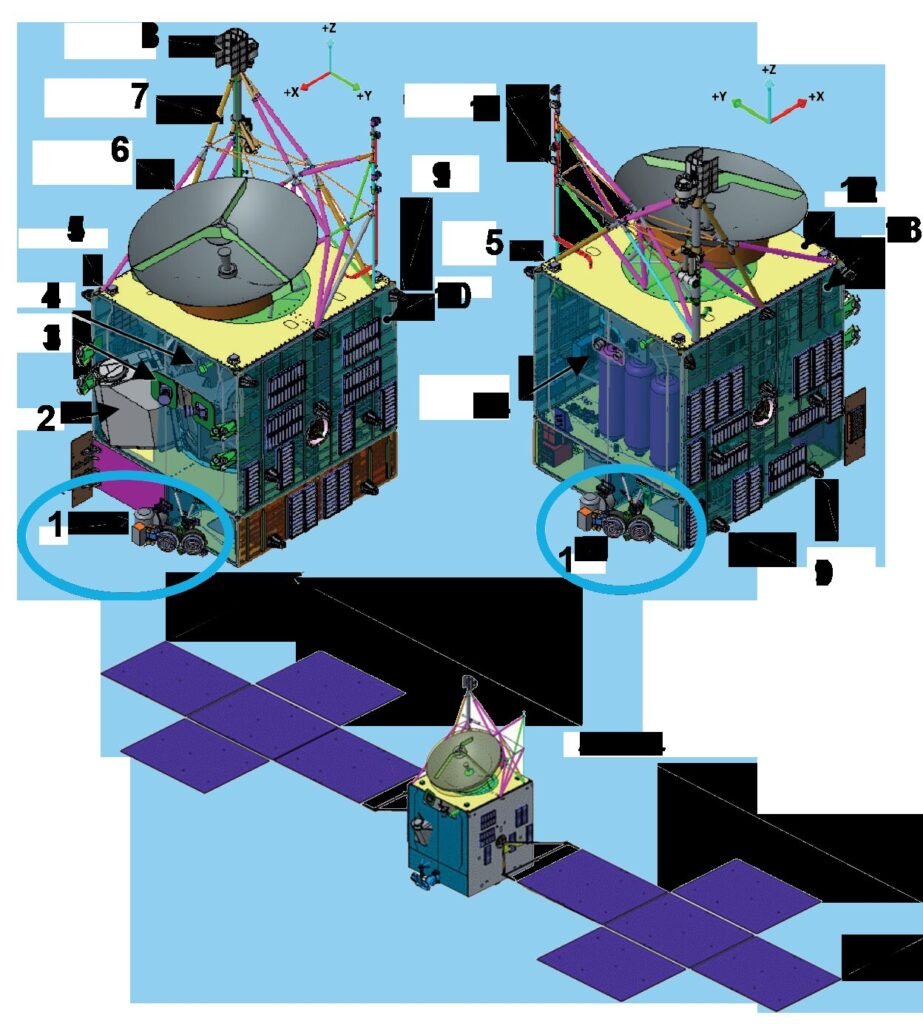
NASA’s Psyche spacecraft is on its way to a metal-rich asteroid in the main asteroid belt, and in May 2026 it passed Mars to pick up speed. According to Arizona State University (ASU), which leads the mission’s imaging team, the spacecraft came within about 4,609 kilometers of Mars on May 15 and is now on course to reach the asteroid Psyche in summer 2029. This article on Psyche mission explains the flyby, the target and the instruments.
What happened at Mars?
ASU reports that Psyche made its closest approach to Mars on May 15, 2026, passing about 4,609 kilometers (2,864 miles) above the surface. The flyby was a gravity assist, a maneuver in which a spacecraft uses a planet’s gravity to change speed and direction without burning fuel. Don Han, the mission’s navigation lead at NASA’s Jet Propulsion Laboratory, said Mars gave the spacecraft a boost of 1,000 miles per hour. By our own arithmetic, that is about 1,609 kilometers per hour. The flyby also shifted the spacecraft’s orbital plane by about 1 degree relative to the Sun.
What is the asteroid Psyche?
Psyche orbits in the main asteroid belt between Mars and Jupiter and is about 280 kilometers (173 miles) across at its widest point. Scientists think it may be the partial core of a planetesimal, an early building block of a planet. Lindy Elkins-Tanton, the mission’s principal investigator at the University of California, Berkeley, described it as possibly the metallic core of an ancient planetesimal. The word possibly matters: the mission exists to test that idea, and the answer is not known. Our article on copper and world metal supply covers metals that people mine on Earth.
When will Psyche arrive?
Han said the spacecraft is now on course for arrival at the asteroid in summer 2029. The ASU article gives summer 2029 in one place and August 2029 in another, so we use summer 2029 and treat the month as approximate. The spacecraft travels with solar-electric propulsion, a gentle engine powered by electricity from solar panels. After arrival it will enter orbit around the asteroid.
What will it do at the asteroid?
ASU says the spacecraft will fly a series of circular orbits, moving lower and then higher in altitude, to map the asteroid. It carries three kinds of instruments:
- Imagers: a multispectral imager, which was used for the Mars photos
- Magnetometers: instruments that measure magnetic fields, which may have detected Mars’s bow shock during the flyby
- Gamma-ray and neutron spectrometer: an instrument that measures the elements in the surface
Jim Bell of ASU, the imager instrument lead, described the flyby as a chance to calibrate and characterize the performance of the cameras. A bow shock is the boundary where a planet’s magnetic or atmospheric environment slows the solar wind. That definition is general, and ASU says only that the magnetometers may have detected it.
Why use a flyby to calibrate instruments?
The cameras and magnetometers must work correctly when the spacecraft reaches the asteroid, so engineers use known targets to check them. Mars is a well-studied planet, which makes it a useful test subject. This is a general rationale, and the quotation from Bell is the part ASU attributes directly. The article we used does not give specific results from the calibration.
How does Psyche compare with other missions?
Missions to small bodies and to the Sun use the same techniques of gravity assists and long planning. Our article on Europa Clipper covers NASA’s mission to an icy moon, and our article on Parker Solar Probe covers the closest approach to the Sun. The comparison is ours, not ASU’s, and the missions have different goals.
Why would a metal asteroid matter to science?
If Psyche is the exposed core of a body that once melted and separated into layers, it would offer a direct look at the kind of material that lies deep inside planets, including Earth, which no drill can reach. That is the general scientific motivation and is not a finding. ASU describes the target as thought to be the partial core of a planetesimal, and the spacecraft must reach it before anyone can say whether the idea holds. The mission is about understanding how planets form, not about mining the asteroid.
How to read the numbers
The flyby distance is measured above the surface, not from the center of Mars. The 1 degree plane change is small in angle but meaningful for trajectory, because the spacecraft is traveling a very long path. The 280 kilometer width is the widest dimension, and the asteroid is not a sphere, so its average size would be smaller. The conversion factors (a kilometer is about 0.62 miles) are general and not from ASU. The arrival time is the least certain number, since schedules for deep space missions can change.
Glossary
- Asteroid belt: the region between Mars and Jupiter where many asteroids orbit
- Planetesimal: a small body that formed early and helped build planets
- Gravity assist: using a planet’s gravity to change a spacecraft’s path or speed
- Solar-electric propulsion: an engine that uses solar power to push out charged particles
- Spectrometer: an instrument that identifies materials from the radiation they emit
The asteroid belt, planetesimal, solar-electric propulsion and spectrometer definitions are general explanations and are not quoted from ASU.
What is not covered here?
The ASU article does not give the launch date, the asteroid’s mass or the findings from the Mars photos. We did not open NASA’s own mission pages for this piece, so those details are left out. Readers should consult NASA and the Psyche mission team for updates.
Key facts at a glance
- Mars flyby: May 15, 2026, about 4,609 kilometers above the surface
- Speed boost: about 1,000 miles per hour
- Asteroid width: about 280 kilometers
- Planned arrival: summer 2029
- Instruments: imagers, magnetometers and a gamma-ray and neutron spectrometer
Frequently asked questions
What is Psyche made of?
Scientists think it may be a partial metallic core of a planetesimal. The mission aims to find out.
Did the spacecraft use fuel at Mars?
No. ASU says Mars gave the boost without onboard propellant.
When does it arrive?
Summer 2029, according to the mission’s navigation lead.
More in Science
- This Day in History, November 4: Howard Carter Finds the Steps to Tutankhamun's Tomb
- Arctic Sea Ice Minimum 2026: NASA and NSIDC Report the 10th-Lowest on Record
- Antarctic Sea Ice 2026: Third-Lowest Maximum in the 48-Year Satellite Record
- September 2026 Was the Second-Warmest September on Record, Copernicus Reports