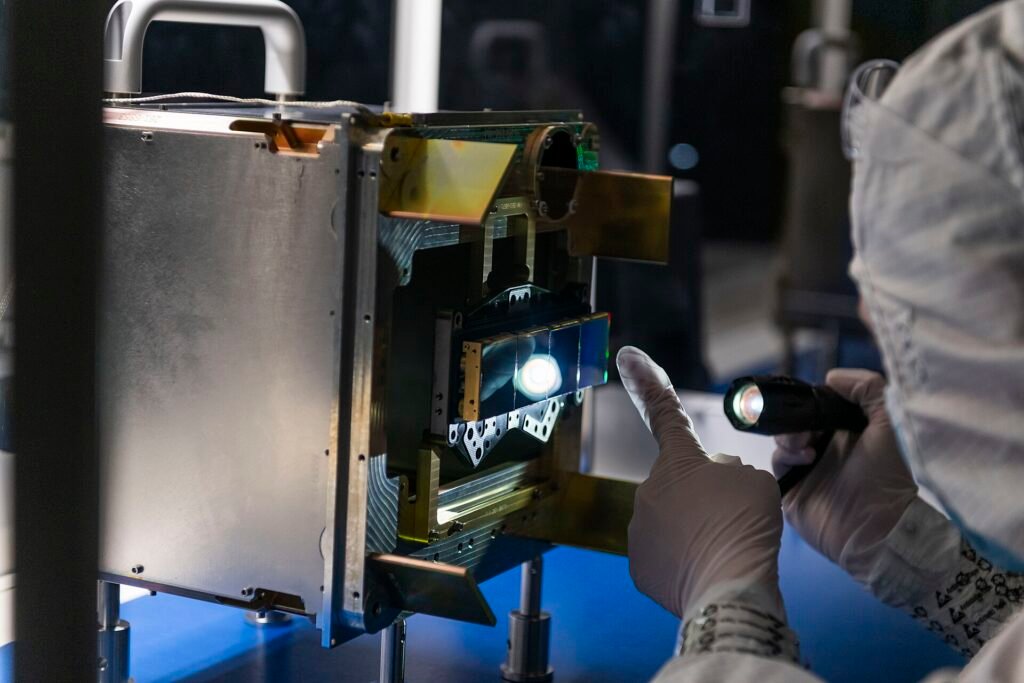
NASA has published new details about the sunshade of NEO Surveyor, an infrared space telescope built to search for near-Earth asteroids and comets. This article summarizes NASA’s mission blog from October 26, 2026, and explains what the sunshade does, how it is built and how the telescope is meant to measure the size of the objects it finds. It adds only labeled arithmetic and general definitions.
What is NEO Surveyor?
NASA describes NEO Surveyor as an infrared space telescope that searches for near-Earth asteroids and comets. The agency says its data will help scientists better understand the number and nature of potentially hazardous near-Earth objects. The blog post we used does not state a launch date, so we do not give one here. Readers should check NASA for the current schedule.
What does the sunshade do?
The sunshade blocks sunlight glare and keeps the telescope cool. That matters for an infrared instrument, because heat from the spacecraft itself can swamp the faint signals it is trying to detect. That reasoning is a general point about infrared astronomy and is not a quotation from NASA’s post. NASA also says the same structure carries solar cells, so it doubles as a power source.
How is the sunshade built?
NASA gives these details:
- Two flat panels joined at a 23.5-degree angle
- 864 interconnected solar cells covering the panels
- Up to 2 kilowatts of power, which charges the onboard batteries
- A height of 20 feet (6 meters)
- A width of 8 feet (2.4 meters) at its base
The telescope aperture is 20 inches (50 centimeters) wide. By our own arithmetic, the sunshade is about 12 times taller than the telescope aperture is wide, since 20 feet is 240 inches and 240 divided by 20 is 12. That comparison is ours and is not a NASA figure.
How will it measure asteroid size?
NASA says a pair of infrared detector arrays, each producing a 16-megapixel sky mosaic, will image objects in two infrared bands. Comparing the two bands gives each object’s temperature, and the temperature yields an estimate of its size. The telescope is also designed to find hard-to-spot objects, including some in the Sun’s direction, where ground-based optical telescopes struggle.
A general note helps explain why infrared works for this. A dark asteroid reflects little visible light but still warms in sunlight and glows in the infrared. Because of that, infrared brightness can reveal a size that visible brightness alone might hide. This is a general explanation and is not drawn from the NASA post.
Why does the Sun’s direction matter?
Objects that approach from the direction of the Sun are hidden in its glare for ground-based telescopes that rely on visible light. NASA says NEO Surveyor is meant to find some of those objects. The blog post does not say how many it expects to detect, so we leave out any targets or counts.
How to read the specifications
Three kinds of statement appear in NASA’s post. The dimensions, the number of solar cells and the detector format describe the hardware. The statements about what the telescope will find describe design goals, not results, because the mission has not yet surveyed the sky. The power figure of up to 2 kilowatts is a maximum, not a constant output. Readers should keep those categories separate, since a goal is not an achievement and a maximum is not an average.
It also helps to compare scale. A 20-inch aperture is small next to large ground-based observatories, but a space telescope sits above the atmosphere, and an infrared telescope there can work without the atmospheric glow that limits infrared observing from the ground. That comparison is a general point about astronomy and is not drawn from NASA’s blog. NASA’s post focuses on the structure that keeps the instrument cold and powered.
Why a cold telescope matters
Any warm object glows in the infrared, including the telescope’s own mirror and frame. To detect a faint asteroid, the instrument must be much colder than the thing it observes. NASA says the sunshade keeps the telescope cool, which is why its size and angle receive so much attention. The two-panel shape and the 23.5-degree angle described in the post are part of that thermal design, though the post does not explain the geometry in detail.
How does it relate to other planetary defense work?
Finding objects is the first step in planetary defense, and studying them closely is the second. Our article on ESA’s Hera mission covers a spacecraft that will study the aftermath of an asteroid impact test. Our report on NASA’s Psyche mission describes a probe heading to a metal asteroid. Our guide to the interstellar object 3I/ATLAS shows how astronomers track a very different kind of visitor. Together, they show that detection, characterization and deflection research are separate jobs.
Our article on the James Webb Space Telescope explains another infrared observatory, though Webb studies distant targets and NEO Surveyor is built for nearby ones.
Glossary
- Near-Earth object: an asteroid or comet whose orbit brings it close to Earth’s path
- Infrared: light with longer wavelengths than visible light, often detected as heat
- Aperture: the diameter of a telescope’s main opening, which sets how much light it collects
- Sunshade: a structure that blocks sunlight to keep an instrument cool
- Detector array: a grid of sensors that records an image
These definitions are general explanations and are not quoted from NASA.
What is not covered here?
NASA’s post does not give a launch date, an orbit, the number of objects the mission hopes to find or the cost. We have not filled those gaps from memory. For current plans, readers should consult NASA’s NEO Surveyor pages.
Key facts at a glance
- Type: infrared space telescope for near-Earth objects
- Aperture: 20 inches (50 centimeters)
- Sunshade: two panels, 23.5-degree angle, 864 solar cells
- Sunshade power: up to 2 kilowatts
- Detectors: two arrays, each making a 16-megapixel mosaic
Frequently asked questions
Why does a telescope need a sunshade?
NASA says it blocks glare and keeps the telescope cool.
How does it estimate size?
By imaging in two infrared bands, comparing them to get temperature, and using the temperature to estimate size.
When does it launch?
The NASA post we used does not say.
More in Science