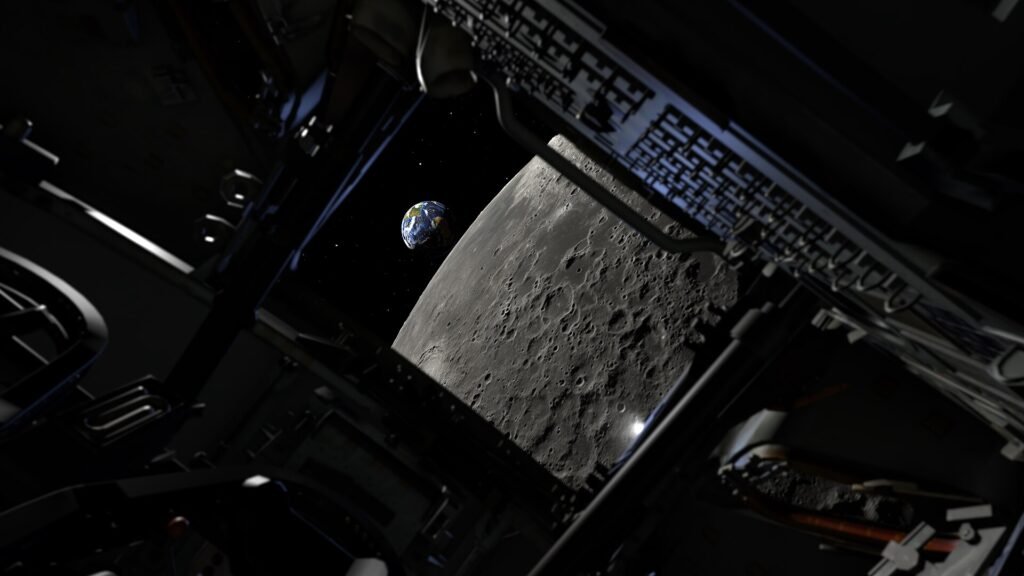
NASA has awarded a contract worth about $38 million to Modulate Space Corporation to develop key elements of a 5G communications system for the surface of the Moon. The award, announced on September 30, 2026, is managed by NASA’s Glenn Research Center. This article on 5G communications on the Moon summarizes what NASA says the contract covers, how the work is scheduled and why a surface network matters for a planned lunar outpost.
What did NASA award?
The contract is titled 5G System and Lunar Surface Communications Evaluation and Radio Propagation Measurements. NASA describes it as firm-fixed-price, which means the price is set in advance and does not change with the contractor’s costs. The customer is NASA’s Glenn Research Center in Cleveland. The value is approximately $38 million. NASA identifies the release as C26-014, dated September 30, 2026.
What will the contractor build?
NASA says the effort develops key elements of a 5G communications system for the lunar surface, with built-in Wi-Fi 6. The work has two areas and is meant to support future Moon Base surface operations. NASA will acquire hardware, firmware and software technology to advance an integrated lunar communications system, and it will gain insight into the system architecture and operational performance. NASA also says the design can evolve for future lunar surface communications.
What is the schedule?
The release lists two work areas with dates:
- 5G Network-in-a-Box Development and Lab Demonstration: October 1, 2026 through January 31, 2028
- Lunar 5G and Wi-Fi Integrated Surface Network and Flight Demonstration on the Lunar Surface: Monday, November 30, through December 31, 2028 as printed
November 30 falls on a Monday in 2026, not in 2028, so the year printed for the second item may be a typo. We follow the release’s text and flag the inconsistency. By our own arithmetic, the first phase spans 16 months, and the flight demonstration window is about one month.
What is a network-in-a-box?
NASA uses the phrase for the first phase, which ends in a laboratory demonstration. In general, a network-in-a-box is a compact bundle of radio and computing hardware that provides cellular service without relying on outside infrastructure. That definition is general and is not quoted from NASA. For a place with no existing towers, a self-contained unit is a sensible starting point. The release does not give the size or power needs of the unit.
Why use 5G on the Moon?
The release does not explain NASA’s reasons in detail. In general terms, commercial wireless standards are widely used, so adapting them can reduce development effort and allow many devices to share a network. Our explainer on 5G and how it differs from 4G describes the technology for readers who want the basics. Lunar conditions add challenges, such as temperature swings, dust and long distances between devices. NASA frames the work as an evaluation and a set of radio propagation measurements, which suggests it wants data on how signals behave on the surface.
How to read the announcement
A contract award is an agreement to do work, not proof that the technology works. The first phase is a laboratory demonstration on Earth. The second is a flight demonstration on the lunar surface, which depends on a ride to the Moon that the release does not describe. The dollar value is an approximate figure for the whole contract, not a breakdown by phase. Readers should treat the dates as plans and wait for results before concluding that a lunar 5G network exists.
What does Wi-Fi 6 add?
NASA says the system has built-in Wi-Fi 6. Wi-Fi 6 is a version of the local wireless standard designed for many devices at short range. Pairing it with 5G suggests a design with wide-area links for rovers and short-range links around a base, though NASA does not spell that out. This is our general reading, and the release only says the system includes Wi-Fi 6.
What should readers watch for next?
The first test of the plan is the laboratory demonstration, which NASA schedules to finish by early 2028. The release does not name a lander for the flight demonstration. Readers should watch for that choice and for any change to the dates, because lunar delivery schedules often move. The typo-like year in the second phase is a reminder to check NASA for corrections.
How does it connect to other coverage?
A surface network is part of the infrastructure for a lunar outpost. Our article on the three new Moon Base science investigations covers instruments that will need to send data home, and our report on Artemis III covers a 2027 test of lunar landers. Our summary of the NASA ISAM State of Play covers technologies for building in space. Communications, science and construction each depend on the others.
Glossary
- 5G: the fifth generation of cellular network technology
- Wi-Fi 6: a recent version of the Wi-Fi standard for many connected devices
- Firm-fixed-price contract: a contract with a set price regardless of the contractor’s costs
- Radio propagation: how radio signals travel through an environment
- Flight demonstration: a test of technology in real flight conditions
These definitions are general explanations and are not quoted from NASA.
What is not covered here?
NASA’s release does not give the range of the network, its data rates, the number of devices it will serve or who will deliver the equipment to the Moon. We have not added those details.
Key facts at a glance
- Contractor: Modulate Space Corporation
- Value: approximately $38 million, firm-fixed-price
- Managing center: NASA Glenn Research Center
- Phase one: October 1, 2026 to January 31, 2028
- Phase two: flight demonstration, dated November 30 to December 31 in the release
Frequently asked questions
Is there 5G on the Moon now?
No. The contract develops and tests the system.
How much is the contract?
Approximately $38 million.
Why is the date inconsistent?
The release prints November 30 as a Monday in 2028, but that date is a Monday in 2026, so the year may be a typo.
More in Technology
- NASA Plume-Surface Tests: How Engine Exhaust Throws Lunar Dust, Soil and Rocks
- New Mars Helicopter Blade Design Targets Flights of Nearly 19 Kilometers, NASA Says
- NASA's CASALS Lidar Fills Gaps in 3D Maps of Earth's Surface
- Starliner Update: NASA and Boeing Plan an Uncrewed Flight and Crew Return by 2028