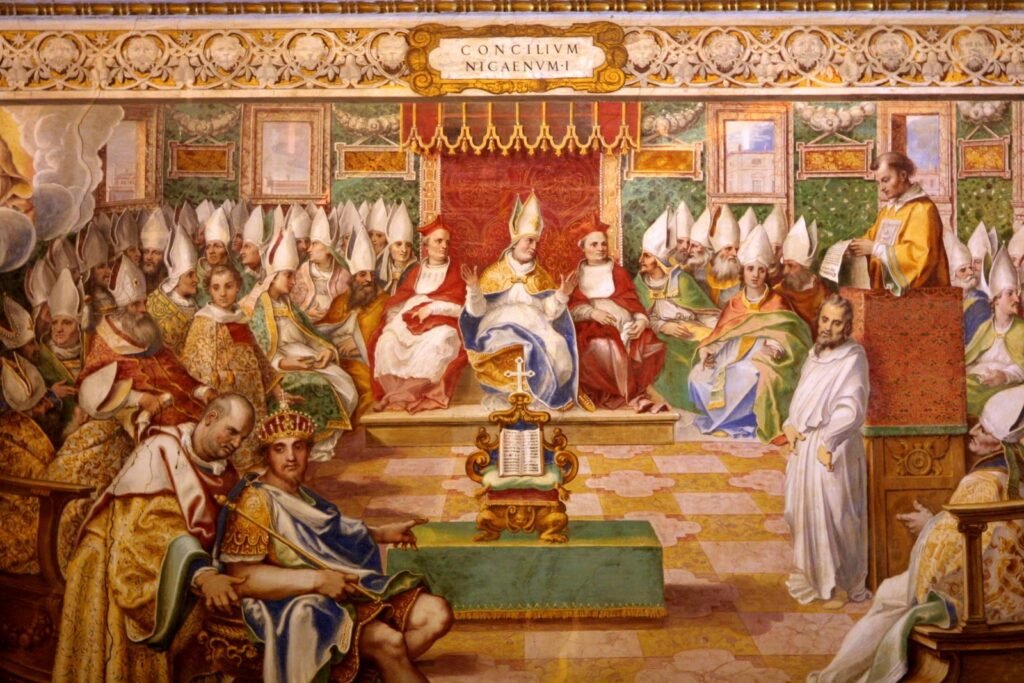
The Council of Nicaea, also called the First Council of Nicaea, was a gathering of Christian bishops held in 325 at the city of Nicaea, called by the Roman emperor Constantine. It condemned the teaching of the priest Arius about the nature of Jesus, produced the first version of the Nicene Creed and settled a dispute over how to date Easter. Churches later counted it as the first of the ecumenical, or empire-wide, councils.
Background to the Council of Nicaea
The dispute began in Alexandria, Egypt. Arius, a priest, taught that the Son of God was created and therefore not equal to the Father. His bishop, Alexander of Alexandria, disagreed. Around 320 or 321 Alexander gathered more than a hundred bishops from Egypt and Libya, and they condemned Arius, according to the Catholic Encyclopedia. Arius was driven out, went to Palestine and then Nicomedia, and kept finding supporters. The quarrel spread across the eastern half of the Roman Empire.
Constantine, who favored Christianity after the earlier Edict of Milan, had just defeated his rival Licinius and become sole emperor. He first wrote to both sides urging them to settle a matter he saw as minor. When that failed, he invited bishops from across the empire to meet. OrthodoxWiki notes that he moved the meeting to Nicaea, close to his headquarters at Nicomedia, so that he could attend. He saw the council as a way to bring unity to the empire.
What happened at the Council of Nicaea
Tradition dates the opening to May 20, 325. The Catholic Encyclopedia suggests that the more formal sessions began in mid-June after the emperor arrived, and that they ended around August 25, although early sources do not agree on exact dates. Constantine opened the meeting and urged the bishops to seek peace. Hosius of Cordoba, the emperor’s adviser on church affairs, is generally believed to have led the discussions.
Attendance is also uncertain. Eusebius of Caesarea, who was there, spoke of more than 250 bishops. Athanasius, then a young deacon from Alexandria, gave 300 in one account and 318 in another. Modern lists of named participants reach only a little over 230. Most of the bishops came from the Greek-speaking east.
The central debate was how to describe the relationship between the Father and the Son. According to OrthodoxWiki, an Arian statement of belief was rejected at once, and a baptismal statement of faith from Palestine became a starting point for the council’s text. The bishops added the Greek word homoousios, meaning “of the same substance,” to say that the Son shares the Father’s nature. They also attached anathemas, formal condemnations of phrases such as “there was a time when He was not.” This kind of formal statement of belief is called a creed, and it became a standard test of agreement in matters of theology.
Nearly every bishop signed. Only two, Theonas of Marmarica and Secundus of Ptolemais, refused, and both were exiled along with Arius. His writings were ordered burned, and the sources place his exile in Illyria, a region on the Adriatic coast.
Other decisions
The council also dealt with Easter. Christians had used different methods to set its date. The bishops endorsed the Alexandrian method, which calculated the date independently of the Jewish Passover. It also addressed the Meletian schism, a split in the Egyptian church.
The Catholic Encyclopedia reports twenty canons, or rules of church discipline, that survive from the council. They cover the ordination of clergy, the readmission of Christians who had weakened under persecution, a ban on clergy lending at interest, and the custom of praying standing on Sundays and during the Easter season.
Aftermath and significance of the Council of Nicaea
Nicaea did not end the controversy. New statements of belief appeared soon after, many of them aimed at newer forms of Arianism. The creed that most churches recite today is a longer text that the Council of Chalcedon in 451 attributed to the Council of Constantinople in 381. It expanded the section on the Holy Spirit and dropped the original anathemas, along with phrases such as “of the substance of the Father.” Historians still debate exactly how that longer form came about.
The Catholic Encyclopedia notes that the Nicene-Constantinopolitan Creed is shared by Catholic, Eastern and most Protestant churches. A later dispute over one added phrase in the West, “and the Son,” became part of the long road to the Great Schism between Eastern and Western Christianity.
The council also set a precedent. A Roman emperor convened it, and bishops from across the empire agreed on a binding statement of belief. Later ecumenical councils followed that pattern. OrthodoxWiki says Nicaea set the pattern for all of them. Scholars still discuss how much Constantine shaped the result, although the Catholic Encyclopedia says he left the direction of the theological debate to church leaders.
FAQs
Did the Council of Nicaea choose the books of the Bible?
No. The surviving canons deal with church discipline, not with a list of biblical books.
How many bishops attended?
Sources give figures from more than 250 to 318. The number 318 is the one traditionally repeated, but named lists are shorter.
Who presided over the council?
Constantine opened it and acted as honorary president. Hosius of Cordoba is generally thought to have directed the debates.
What happened to Arius?
The council condemned his teaching and exiled him, and his books were burned.
More in Religion & Belief
Key facts
- Emperor Constantine called the council, which met at Nicaea in 325 and is traditionally dated from May 20.1
- Estimates of attendance range from more than 250 bishops to the traditional figure of 318.1
- The council condemned Arius and added homoousios, "of the same substance," to its statement of faith.12
- Only Theonas of Marmarica and Secundus of Ptolemais refused to sign; they were exiled with Arius.2
- Twenty canons survive, and the Alexandrian method of dating Easter was endorsed.12
- The creed used today is the longer form tied to the Council of Constantinople in 381.3
Related concepts
Quick checkWhat was the main outcome of the Council of Nicaea?Show answer
The council condemned the teaching of Arius, produced the first version of the Nicene Creed with the key term homoousios, and endorsed a common method for dating Easter.
Sources
- Catholic Encyclopedia (1911), The First Council of Nicaea, https://www.newadvent.org/cathen/11044a.htm
- OrthodoxWiki, First Ecumenical Council, https://orthodoxwiki.org/First_Ecumenical_Council
- Catholic Encyclopedia (1911), The Nicene Creed, https://www.newadvent.org/cathen/11049a.htm
- World History Encyclopedia, Constantine I, https://www.worldhistory.org/Constantine_I/
Editorially reviewed by Specialty Digest Editorial TeamLast reviewed November 4, 2026Researched and drafted with AI assistanceReport an issue