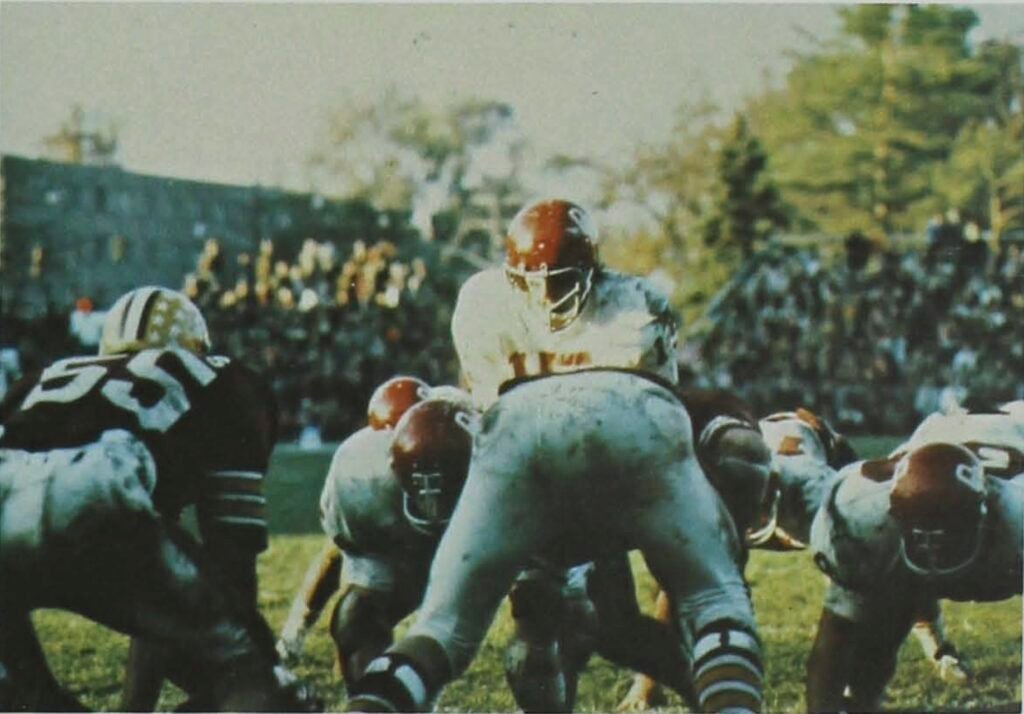
American football is a contact team sport in which two teams contest possession of an oval ball on a rectangular field and score by carrying, passing or kicking it into or through scoring zones. The offense gets four downs to gain 10 yards, and a touchdown is worth six points. It grew out of rugby and soccer in the 19th century, and it is most closely tied to the United States.
History of American football
The Pro Football Hall of Fame dates the first intercollegiate game to November 6, 1869, when Rutgers beat Princeton 6 to 4. Each side fielded 25 players, and the game used modified rules from the London Football Association. Players could kick the ball and also bat it with their hands, so it looked more like association football than the modern sport.
Over the next seven years, rugby gained favor with the major eastern schools, and modern football grew out of it. In 1876 the Massasoit convention produced the first rules for American football, and Walter Camp, later called the father of American football, became involved with the game that year.
Scoring values changed repeatedly. A touchdown rose from four points to five in 1898 and to six in 1912, while a field goal fell from five points to four in 1904 and to three in 1909. The forward pass was legalized in 1906, and the first authenticated completion came on October 27 that year, from George Parratt to Dan Riley in Massillon, Ohio.
Professionalism arrived in the 1890s. In 1892 Pudge Heffelfinger was paid $500 by the Allegheny Athletic Association, which made him the first person known to be paid to play. A first known professional contract followed in 1893, and in 1897 the Latrobe Athletic Association played the first full season with only professionals.
Rules and how American football is played
An offense has four downs to gain 10 yards. Gaining the required distance earns a new set of four downs. A down is one play’s period of action, from when the ball is put in play until it is declared dead.
NFL Football Operations lists the scoring values. A touchdown is worth six points, a field goal three, and a safety two for the defense. After a touchdown a team can try a one-point placekick, snapped from the 15-yard line, which makes it a kick of roughly 33 yards. A conversion can also be worth two points.
Play starts from the line of scrimmage, an imaginary line running from sideline to sideline through the forward point of the ball. Both teams line up on opposite sides of it and cannot cross it until the snap.
Professional and college games last 60 minutes, played as two 30-minute halves, and the clock stops at the end of the first and third quarters. Scholastic halves are 24 minutes. This entry does not give the number of players on the field because no opened source stated it.
Equipment and venues
The field of the 1869 game measured 360 by 225 feet, with goals 24 feet wide. Holding or tripping opponents was banned, and the first team to score six games, or points, won.
A football field is 120 yards long including two 10-yard end zones, which leaves 100 yards of playing field between the goal lines. It is 53 and one-third yards wide, so each NFL end zone measures 10 yards by 53 and one-third yards.
Yard lines are painted every five yards, and hash marks mark every one yard, set 70 feet 9 inches from each sideline. Goal posts have stood on the goal lines since 1933, and the hash marks were moved to 15 yards from the sidelines in 1935.
Governing bodies and major competitions
The National Football League (NFL) grew from a meeting in Canton, Ohio, on August 20, 1920, attended by the Akron Pros, Canton Bulldogs, Cleveland Indians and Dayton Triangles. The first Canton meeting was followed by one on September 17, 1920 that named the group the American Professional Football Association and elected Jim Thorpe president. On June 24, 1922 it was renamed the National Football League, with 18 teams.
Founding teams at that second meeting came from Ohio, Indiana, New York and Illinois, and included Akron, Canton, Cleveland, Dayton, Hammond, Muncie, Rochester, Rock Island, Decatur and Racine. Four more clubs, from Buffalo, Chicago, Columbus and Detroit, joined later in 1920.
The NFL set its first roster limit, 16 players, in 1925. A fourth official, the field judge, was added in 1929, and a 15-yard penalty for roughing the passer was introduced in 1938. The sport’s international federation is the International Federation of American Football (IFAF), whose president has said that Olympic inclusion of flag football will accelerate the game’s growth.
Notable moments in American football history
In 1899 Chris O’Brien’s neighborhood team began a lineage that became the Arizona Cardinals, the oldest continuing operation in pro football. In 1933 the NFL legalized forward passes from anywhere behind the line of scrimmage.
On January 15, 1939 the New York Giants beat the Pro All-Stars 13 to 10 in the first Pro Bowl. That season NBC broadcast the Brooklyn Dodgers and Philadelphia Eagles game from Ebbets Field, the first NFL game shown on television, which reached roughly 1,000 sets in New York. NFL attendance also passed one million for the first time that year, reaching 1,071,200.
American football around the world
Flag football, a short, fast, non-contact and gender-equal version of the sport, will make its Olympic debut at Los Angeles 2028. It will be the first time American football appears on the Olympic program, following a vote at an IOC Session in Mumbai, India.
The NFL says an estimated 20 million people in more than 100 countries play flag football. NFL Commissioner Roger Goodell said the decision will inspire millions of young people around the world to play the game, and these are league-reported figures rather than an independent count.
More in Sports Coaching and Performance
Key facts
- The first intercollegiate football game was played on November 6, 1869, and Rutgers beat Princeton 6 to 4.12
- The Massasoit convention produced the first American football rules in 1876, and the forward pass was legalized in 1906.13
- An offense has four downs to gain 10 yards, and a touchdown is worth six points.5
- The NFL was named on June 24, 1922, after beginning as the American Professional Football Association in 1920.4
- A football field is 120 yards long including two 10-yard end zones and 53 and one-third yards wide.6
Related concepts
Quick checkWhen was the first American college football game played?Show answer
Rutgers beat Princeton 6 to 4 on November 6, 1869, in a game that looked more like soccer than modern American football.
Sources
- Pro Football Hall of Fame, 1869 and 1869 to 1939 history pages, https://www.profootballhof.com/football-history/football-history/1869-1939/1869
- Rutgers University, The Birthplace of College Football, https://www.rutgers.edu/news/birthplace-college-football
- Pro Football Hall of Fame, 1906, https://www.profootballhof.com/football-history/football-history/1869-1939/1906
- Pro Football Hall of Fame, 1920, https://www.profootballhof.com/football-history/football-history/1869-1939/1920
- NFL Football Operations, Football terms, https://operations.nfl.com/rules-officiating/nfl-football-basics/football-terms
- Britannica, American football: The play of the game, https://www.britannica.com/sports/American-football/The-play-of-the-game
- Pro Football Hall of Fame, 1939, https://www.profootballhof.com/football-history/football-history/1869-1939/1939
- NFL, Global American football family reacts to confirmation of flag football's inclusion in the Olympic Games Los Angeles 2028, https://www.nfl.com/news/global-american-football-family-reacts-to-confirmation-of-flag-football-s-inclus
Editorially reviewed by Specialty Digest Editorial TeamLast reviewed November 4, 2026Researched and drafted with AI assistanceReport an issue