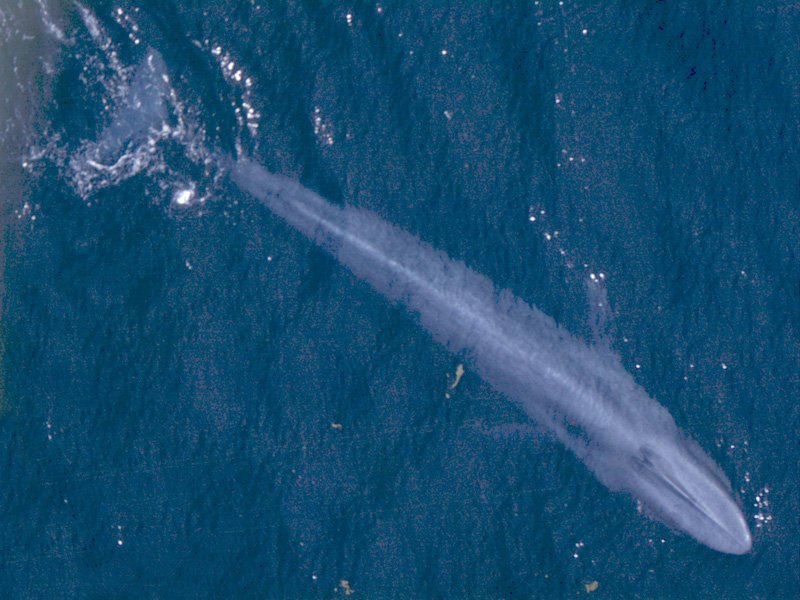
The blue whale (Balaenoptera musculus) is a marine mammal and the largest animal known to have ever lived. NOAA Fisheries reports that the biggest individuals reach about 110 feet in length and more than 330,000 pounds. Blue whales live in every ocean except the Arctic, feed almost entirely on krill, and are listed as an endangered species by both the IUCN and the United States.
Description
A blue whale has a long, slender body with a mottled blue-gray color that looks light blue underwater, which gives the species its name. The mottling pattern varies from animal to animal, so researchers use photographs of it to identify individuals. That lets scientists follow the same whale across years and oceans.
Blue whales belong to the rorquals, a group of baleen whales, and are the largest of them. Baleen plates hang from the roof of the mouth and work like a sieve, trapping small prey while water drains out.
Size depends on where a whale lives. In the North Atlantic and North Pacific, blue whales grow to about 90 feet and more than 100,000 pounds. Antarctic blue whales are generally larger, reaching about 110 feet and more than 330,000 pounds. Other published maximums are similar, with New York’s wildlife agency citing about 105 feet and more than 165 tons. As in many baleen whales, females are generally larger than males.
NOAA Fisheries recognizes five subspecies. They include the Antarctic blue whale, the pygmy blue whale (Balaenoptera musculus brevicauda), which lives mainly north of the Antarctic Convergence, and an unnamed subspecies in the southeastern Pacific.
Habitat and range
Blue whales occur in all oceans except the Arctic, according to NOAA Fisheries. Most spend summers feeding in cold polar waters and move toward the tropics in winter, although some evidence suggests that whales in certain areas may not migrate at all. Their movements follow food, so they gather where krill are concentrated.
Regional pictures differ. In the North Atlantic the range extends from the subtropics to the Greenland Sea. Eastern North Pacific blue whales are believed to spend winters off Mexico and Central America and to feed in summer off the U.S. West Coast. Mothers with young calves are regularly seen in the Gulf of California from December through March, which suggests an important calving and nursing area.
The northern Indian Ocean holds a resident population, with records from the Gulf of Aden across the Arabian Sea to the Bay of Bengal. In the Southern Hemisphere, Antarctic blue whales stay mainly south of the Antarctic Convergence near the ice edge in summer, while pygmy blue whales are most abundant off Australia, Madagascar and New Zealand. The IUCN describes the species as using both coastal and open-ocean marine habitats.
Behavior and diet
Blue whales feed almost exclusively on krill, tiny shrimp-like animals. Fish and copepods, which are tiny crustaceans, may occasionally be eaten. To feed, a whale swims toward a dense school of krill with its mouth open, closes it, and inflates its throat pleats. It then pushes the water out with its tongue while the baleen plates keep the krill inside. Some of the biggest individuals may eat up to 6 tons of krill in a day. Because krill sit near the base of the marine food chain, the largest animal on Earth depends on some of the smallest.
Blue whales are more often found alone or in pairs than in large groups. They cruise at about 5 miles an hour while feeding and traveling but can exceed 20 miles an hour in short bursts. They are among the loudest animals on the planet, producing pulses, groans and moans. NOAA says that in the right ocean conditions these sounds may be heard by other whales up to 1,000 miles away. Scientists think the calls support communication and perhaps navigation in dark water.
Reproduction is hard to study, so figures are estimates. Gestation lasts about 10 to 12 months, and calves are probably weaned at 6 to 7 months. Sexual maturity is thought to arrive at 5 to 15 years of age, and mothers calve every 2 to 3 years on average, mostly in winter. Lifespan is estimated at 80 to 90 years, and researchers estimate age by counting layers in the wax-like earplugs of dead whales.
Conservation status
The IUCN Red List lists the blue whale as Endangered, based on an assessment completed in March 2018. The same assessment estimated 5,000 to 15,000 mature individuals and described the population trend as increasing. Those numbers are estimates for the whole species.
Commercial whaling in the early 1900s sharply reduced blue whale numbers. NOAA Fisheries says today’s population is a small fraction of what it was before, although numbers are increasing globally. In the United States the blue whale is listed as endangered under the Endangered Species Act and is protected and considered depleted under the Marine Mammal Protection Act. NOAA’s recovery plan sets an interim goal of moving the species from endangered to threatened. This work falls within endangered species management and the wider field of conservation biology.
The main current threats are vessel strikes and entanglement in fishing gear, NOAA reports. Ocean noise, habitat degradation, pollution and climate change are less well understood concerns, and the IUCN also names fishing and harvesting of aquatic resources and climate-related habitat shifts. The risk from ships is highest near ports and in busy shipping lanes. NOAA advises boaters to stay at least 100 yards from large whales and to keep speeds at 10 knots or less where whales may be present.
FAQs
How big is a blue whale? Antarctic blue whales can reach about 110 feet and more than 330,000 pounds, according to NOAA Fisheries. Whales in the North Atlantic and North Pacific are smaller.
What do blue whales eat? Almost entirely krill, which they strain from seawater with baleen plates. The largest individuals may eat up to 6 tons in a day.
How long do blue whales live? Their lifespan is estimated at 80 to 90 years.
Are blue whales endangered? Yes. The IUCN lists them as Endangered and the United States lists them as endangered. Their numbers are increasing but remain a small fraction of the pre-whaling population.
More in Biology
Key facts
- Antarctic blue whales reach about 110 feet and more than 330,000 pounds.1
- Blue whales live in all oceans except the Arctic.1
- Their diet is almost entirely krill, with up to 6 tons eaten in a day by the largest individuals.1
- Lifespan is estimated at 80 to 90 years.13
- The IUCN lists the species as Endangered, with 5,000 to 15,000 mature individuals and an increasing trend.2
- Vessel strikes and fishing-gear entanglement are the main current threats.1
Quick checkWhat do blue whales eat?Show answer
Almost entirely krill, which they filter from seawater with baleen plates.
Sources
- NOAA Fisheries, Blue Whale, https://www.fisheries.noaa.gov/species/blue-whale
- IUCN Red List of Threatened Species, Balaenoptera musculus (Blue Whale), https://www.iucnredlist.org/species/2477/156923585
- New York State Department of Environmental Conservation, Blue Whale species status assessment, https://extapps.dec.ny.gov/fs/programs/dfw/SWAP2025/Mammals-Marine/Blue%20whale.pdf
Editorially reviewed by Specialty Digest Editorial TeamLast reviewed November 4, 2026Researched and drafted with AI assistanceReport an issue