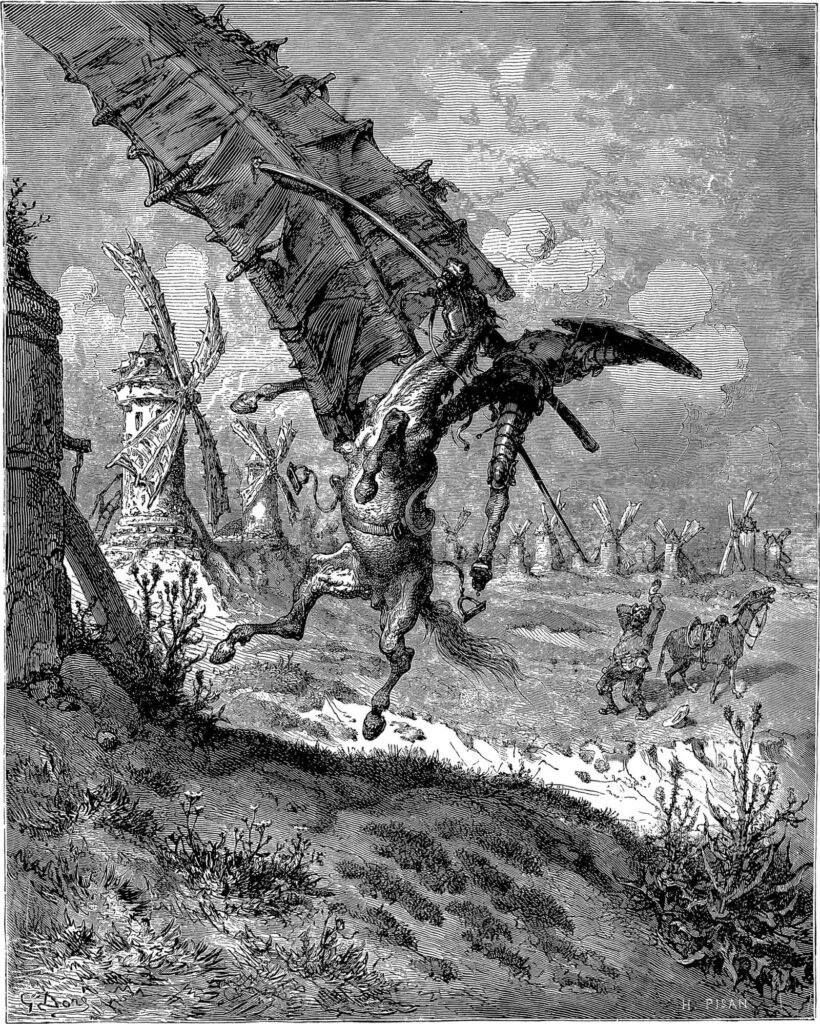
Don Quixote is a Spanish novel by Miguel de Cervantes, published in two parts in 1605 and 1615. Its full title is The Ingenious Gentleman Don Quixote of La Mancha. It follows a middle-aged man who reads so many tales of knights that he loses his judgment and sets out to revive chivalry, accompanied by a farmer turned squire named Sancho Panza. The book is often described as the first modern novel, and it remains one of the most translated and most imitated works of Western literature.
Overview of Don Quixote
The hero begins as Alonso Quijano, a minor country gentleman in La Mancha, a region of central Spain. He spends so much time with chivalric romances, the adventure stories about knights, giants and enchanted castles that were hugely popular in the 1500s, that he decides to become a knight-errant himself. He renames himself Don Quixote, recruits Sancho Panza as his squire, and rides out to right wrongs. Because he reads the world through his books, he mistakes windmills for giants and inns for castles.
Cervantes lived a life nearly as eventful as his hero’s imaginary one. He sailed to Italy in 1569, joined the army of the Holy League in 1571, and was wounded at the Battle of Lepanto, where gunshots cost him the use of his left hand. Returning to Spain in 1575, he was captured by Algerian pirates and spent years in captivity. Later he worked as a collector of supplies and taxes in Andalusia, and he was jailed in Seville in 1597. According to the biography by the scholar Jean Canavaggio, very little is known about his life between 1597 and 1604, the years just before Part One appeared.
Part One was licensed by the crown in September 1604. It came off the presses of Juan de Cuesta in Madrid at the end of that year and is dated 1605. Its success was immediate. By March 1605 two unauthorized editions had appeared in Lisbon, a second Madrid edition was being printed, and the first shipments of the book were registered in Seville for the Americas. By June, Don Quixote and Sancho were turning up in festival parades and masquerades in Valladolid.
Part Two followed a decade later. In 1614, while Cervantes was still writing it, a rival volume appeared in Tarragona under the name Alonso Fernández de Avellaneda. The name was a mask, and scholars have never agreed on who stood behind it. Cervantes answered inside his own book. His Don Quixote glances at the false sequel and finds it foolish, and he meets a character borrowed from Avellaneda who confirms that the other Don Quixote was an impostor. Cervantes’s genuine Part Two reached readers in late November 1615. Canavaggio argues that it carried the novel to perfection.
Themes in Don Quixote
The most obvious theme is the clash between illusion and reality. Don Quixote sees a noble quest where others see a farm, and the novel never settles cleanly on who is right. Sometimes the people who mock him are cruel or foolish, and sometimes his faith in honor shames them. The book uses satire to poke fun at the formulaic romances of chivalry, yet it never becomes only a joke. Cervantes treats his hero’s idealism with affection even while showing its cost.
A second theme is the contrast between two ways of seeing life. Don Quixote is driven by ideals, books and honor. Sancho is practical, hungry and suspicious of grand talk. Readers often note that they influence each other as the story goes on. This pairing of a dreamer and a realist, talking constantly as they travel, set a pattern that later writers copied for centuries.
The novel is also deeply interested in stories themselves. Several tales are folded into the main plot, and one of them shows the influence of Policisne de Boecia, a romance of chivalry printed in 1602. The Avellaneda episode is the clearest case of the book looking at itself: Cervantes writes a fictional hero who picks up a real rival book. A work that draws attention to its own fiction is now called metafiction. The book is therefore as much about the act of telling a narrative as it is about knights.
Finally, the novel looks closely at ordinary Spanish society around 1600. Innkeepers, goatherds, priests, nobles, soldiers, prisoners and servants all share the road. That broad social view helps explain why readers often call the book realistic even though its hero is deluded.
Reception and influence of Don Quixote
The book was a success in Cervantes’s own lifetime and far beyond Spain. In February 1615, French gentlemen traveling with an ambassador visited Cardinal Sandoval y Rojas, Cervantes’s protector, and praised his work as admired in France and neighboring kingdoms. A censor of Part Two, Francisco Márquez Torres, recorded that when they asked about the author, he had to answer that Cervantes was old, a soldier, a gentleman and poor.
Cervantes died in April 1616, the same year as William Shakespeare. He received the last sacraments on April 18, and within days he finished his final work, Persiles and Sigismunda, which was published after his death in 1617. Canavaggio describes him as the classic writer par excellence, one whose appeal outlasts changing tastes.
The influence of Don Quixote on later fiction is hard to overstate. The idea of a character shaped by the books he reads, the traveling pair of opposites, the mixing of comedy and tragedy, and the playful use of a narrator who comments on the story all echo through the novel’s later history. The English word quixotic, meaning idealistic to the point of impracticality, comes from the hero’s name. Translators, illustrators, composers and filmmakers have returned to the story repeatedly, and Project Gutenberg offers John Ormsby’s public domain English translation for free.
FAQs
When was Don Quixote published? Part One appeared in 1605 and Part Two in 1615, both in Spain.
Who wrote Don Quixote? Miguel de Cervantes, a Spanish soldier, tax collector and writer who died in 1616.
What is Don Quixote about? It tells of a gentleman who reads too many chivalric romances and sets out as a knight, with his squire Sancho Panza.
Why is Don Quixote called the first modern novel? Many critics point to its lifelike characters, its mix of comedy and seriousness, and its awareness of its own storytelling.
More in Literature
Key facts
- Don Quixote was written by Miguel de Cervantes and published in two parts, in 1605 and 1615.12
- Part One was licensed in September 1604 and printed in Madrid by Juan de Cuesta.1
- A false sequel by "Alonso Fernández de Avellaneda" appeared in 1614, and its author has never been identified.1
- Part Two reached readers in late November 1615.1
- Cervantes lost the use of his left hand at the Battle of Lepanto in 1571.1
- Cervantes died in April 1616.1
Related concepts
In the news
Quick checkWho wrote Don Quixote, and when did Part Two appear?Show answer
Miguel de Cervantes wrote it, and Part Two appeared in late November 1615.
Sources
- Jean Canavaggio, Biografia de Miguel de Cervantes Saavedra, Biblioteca Virtual Miguel de Cervantes, https://www.cervantesvirtual.com/portales/miguel_de_cervantes/autor_biografia/
- Project Gutenberg, Don Quixote by Miguel de Cervantes Saavedra (ebook 996), https://www.gutenberg.org/ebooks/996
Editorially reviewed by Specialty Digest Editorial TeamLast reviewed November 4, 2026Researched and drafted with AI assistanceReport an issue