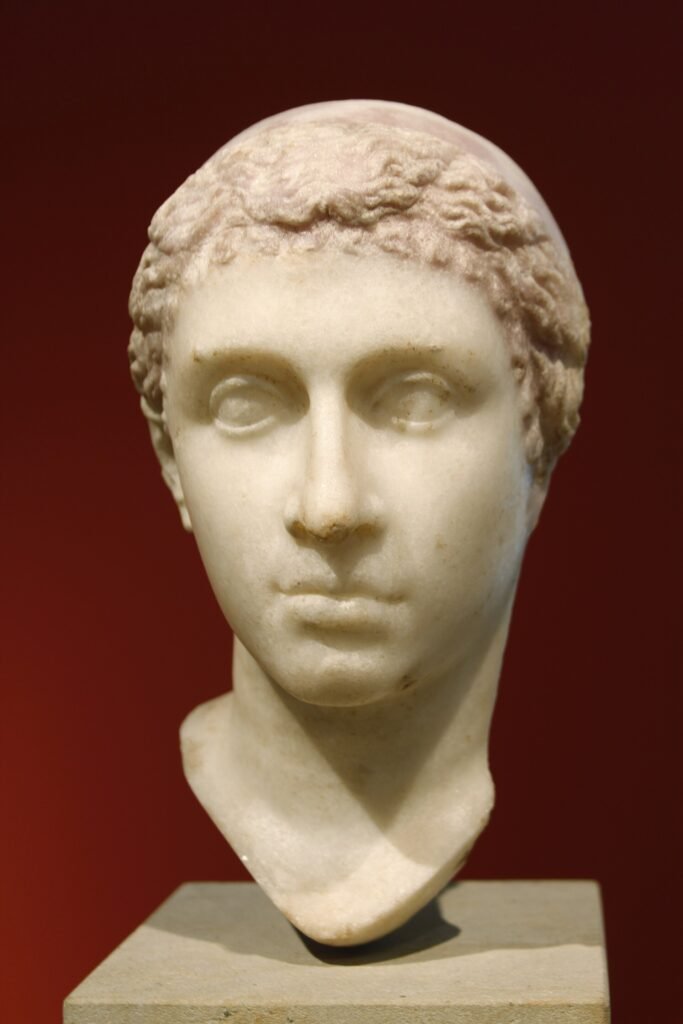
Cleopatra VII was the last active ruler of Ptolemaic Egypt, reigning from 51 BCE until her death in 30 BCE. Born into the Macedonian Greek dynasty founded by one of the generals of Alexander the Great, she presented herself as an Egyptian queen, and her alliances with the Roman leaders Julius Caesar and Mark Antony shaped the end of Egyptian independence. After her death, Egypt became a province of Rome.
Early life of Cleopatra
Cleopatra was born in late 70 or early 69 BCE, according to the Livius.org chronology, and the World History Encyclopedia gives 69 BCE. She belonged to the Ptolemaic dynasty, which had ruled Egypt since the death of Alexander the Great. The Ptolemies were Macedonian Greeks who often resisted learning Egyptian culture, but Cleopatra became an exception.
The World History Encyclopedia says she was fluent in Egyptian as well as Greek. Plutarch, the Greek biographer who wrote about a century and a half later, adds that she could speak with many peoples without an interpreter, naming Ethiopians, Hebrews, Arabians, Syrians, Medes and Parthians. He notes that earlier Ptolemies had not even tried to learn the Egyptian language.
Her father, Ptolemy XII Auletes, died in 51 BCE when she was about eighteen. In keeping with tradition, a woman needed a male consort to rule, so her twelve-year-old brother, Ptolemy XIII, was nominally married to her. She soon left his name off official documents, and the two became rivals.
Career and major work of Cleopatra
In 48 BCE her advisers, led by Pothinus, forced her out in favor of Ptolemy XIII. That same year the Roman general Pompey fled to Egypt after losing to Julius Caesar and was murdered on the shore at Alexandria. Caesar arrived in pursuit and ordered Cleopatra and her brother to disband their armies. War broke out, and Ptolemy XIII was killed in January 47 BCE, leaving Cleopatra as the dominant ruler. A younger brother, Ptolemy XIV, was named co-ruler.
Cleopatra had a son in June 47 BCE whom she named Caesarion, and Caesar was said to be the father. She and Ptolemy XIV visited Rome in 46 BCE. After Caesar was assassinated in March 44 BCE, she returned to Egypt. Ptolemy XIV died soon afterward, and Caesarion was recognized as king.
In 41 BCE she met Mark Antony at Tarsus, where Plutarch describes her arrival by river in a barge with purple sails and silver oars. Antony needed money and support for a war against the Parthian Empire, and she needed Roman backing. They had twin children in 40 BCE, Alexander Helios and Cleopatra Selene, followed by a son, Ptolemy Philadelphus. In 37 BCE Antony granted her control of several territories in the eastern Mediterranean. In 34 BCE, after his campaign in Armenia, she was hailed as the new Isis and as queen of kings, according to Livius.org. Antony divorced Octavia, the sister of Octavian, in 32 BCE.
Ideas and contributions of Cleopatra
Cleopatra’s political aim was to keep Egypt prosperous and independent in a world increasingly dominated by Rome. The World History Encyclopedia points out that she was a capable monarch who faced economic troubles inherited from earlier rulers, including a period of poor harvests. Livius.org notes that after Caesar’s death she supported the faction led by his heirs, and that she presented herself in Egypt as the goddess Isis.
She used both Greek and Egyptian traditions. In Alexandria she ruled as a Hellenistic monarch, and in the countryside she presented herself in the manner of the pharaohs, a strategy that helped her keep support across her kingdom.
Defeat and death of Cleopatra
Relations between Antony and Octavian, Caesar’s heir, collapsed completely, and war broke out between them. In 31 BCE Octavian defeated their fleet at the Battle of Actium. Antony and Cleopatra retreated to Alexandria, and the following year both died by suicide. The World History Encyclopedia says Egypt was annexed by Rome after her death.
The best-known story of her death, told by Plutarch, is that an asp, a venomous snake, was smuggled to her in a basket of figs. Plutarch himself introduces this with the phrase it is said, which signals that even in his time the details were uncertain. Livius.org records that her daughter, Cleopatra Selene, later married King Juba II of Mauretania.
Legacy of Cleopatra
Cleopatra has become one of the most recognized women of the ancient world. She appears in later literature, art and film, and her name has long stood for political skill, luxury and intrigue. The ancient evidence, however, is fragmentary and mostly written by Romans. The Ptolemaic line ended with her, and the World History Encyclopedia says Octavian went on to found the Roman Empire and treated her as a minor chapter in Rome’s past.
Controversies and criticism of Cleopatra
Much of what is said about her comes from authors who wrote under or after Octavian, who became Augustus. The World History Encyclopedia says the rewriting of history began almost at once after Actium, with the battle itself recast as a major victory for Octavian. As a result, her political decisions are often described in terms of romance rather than statecraft, and Roman writers framed her as a dangerous foreign queen.
Historians also debate details of her life, including her exact birth date, how many languages she spoke and the manner of her death. Sources also differ on her ancestry. The World History Encyclopedia describes her as ethnically Macedonian Greek, while Livius.org lists her mother as an Egyptian woman from a priestly family of Memphis. Our knowledge of her appearance rests only on portraits on coins and in sculpture.
More in History
Key facts
- Cleopatra VII was born in 70 or 69 BCE and reigned from 51 BCE until her death in 30 BCE.1
- She belonged to the Macedonian Greek Ptolemaic dynasty but was fluent in Egyptian.1
- Her son Caesarion was born on 23 June 47 BCE, and Julius Caesar was said to be the father.2
- She met Mark Antony at Tarsus in 41 BCE.2
- After Octavian defeated Antony at Actium in 31 BCE, both died by suicide and Egypt became a Roman province.1
Related concepts
Quick checkHow did Cleopatra die?Show answer
Ancient writers say she died by suicide in 30 BCE after Octavian took Egypt. Plutarch tells a version involving a venomous asp, but he notes that the details were uncertain.
Sources
- World History Encyclopedia, Cleopatra VII: The Last Great Pharaoh of Ancient Egypt, https://www.worldhistory.org/Cleopatra_VII/
- Livius.org, Cleopatra VII, https://www.livius.org/articles/person/cleopatra-vii/
- Plutarch, Life of Antony, translated by Bernadotte Perrin (Loeb Classical Library), LacusCurtius, https://penelope.uchicago.edu/Thayer/E/Roman/Texts/Plutarch/Lives/Antony*.html
Editorially reviewed by Specialty Digest Editorial TeamLast reviewed November 4, 2026Researched and drafted with AI assistanceReport an issue