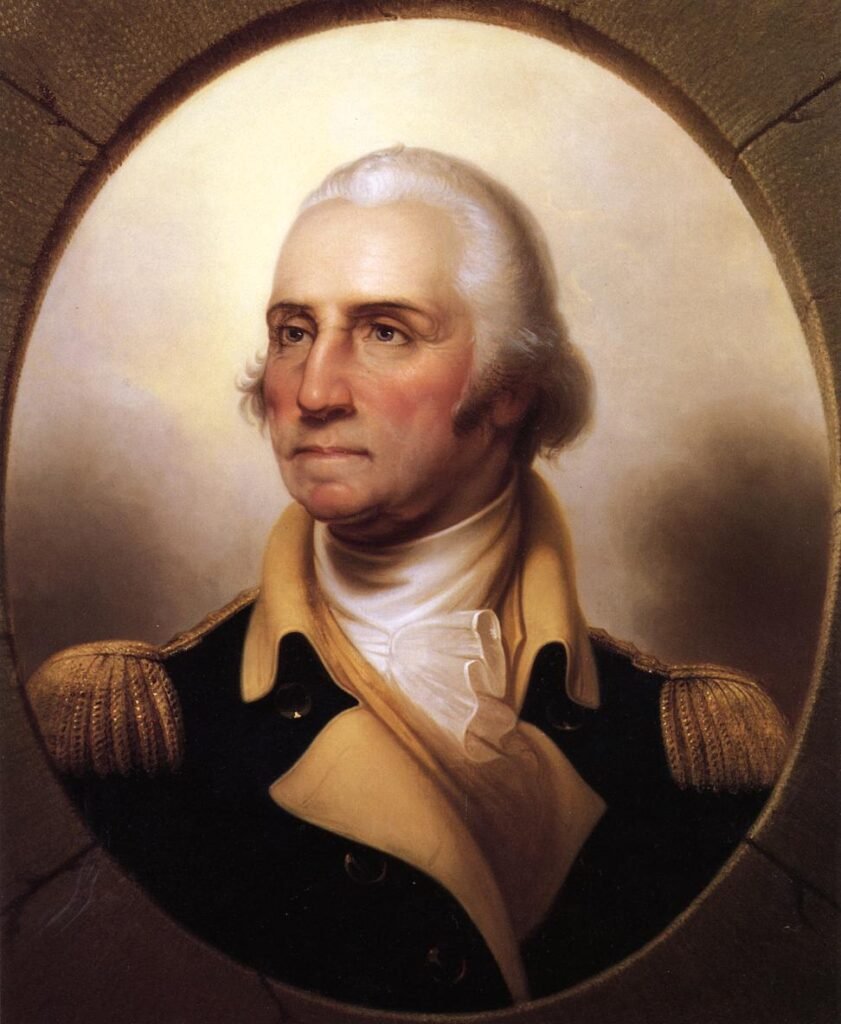
George Washington (1732 to 1799) was the commander of the Continental Army during the American Revolutionary War and the first president of the United States, serving from 1789 to 1797. He also presided over the Constitutional Convention of 1787. He is often called the Father of His Country, and he died at Mount Vernon, Virginia, on 14 December 1799.
Early life of George Washington
Washington was born on 22 February 1732 at Popes Creek plantation in Westmoreland County, Virginia, the eldest of six children of Augustine and Mary Ball Washington. His father, a leading planter, died when George was eleven, and most of the property passed to his older half brothers. Little is known about his childhood, which Mount Vernon calls the most poorly understood part of his life. He never attended college. Private tutors and possibly a local school taught him reading, writing, geometry and trigonometry, which prepared him for a first career as a surveyor.
In 1748 he joined a survey party in the Shenandoah Valley, and the next year he received his surveyor’s license and a post as surveyor of Culpeper County. In 1751 he went with his half brother Lawrence to Barbados, where he caught smallpox and recovered. Lawrence died in 1752, and Washington leased the family estate of Mount Vernon from his brother’s widow and became its legal owner after her death in 1761.
Career and major work of George Washington
In 1753 the governor of Virginia sent Washington to demand that the French leave the Ohio Country, and his published account of the 900-mile trip established an international reputation for him by the age of 22. He was commissioned a lieutenant colonel in the Virginia Regiment in 1754. His force ambushed a French party on 28 May 1754, and the French attacked and forced his surrender at Fort Necessity on 3 July. The clash helped to spark the Seven Years’ War. He later commanded the Virginia Regiment as a colonel, served in the House of Burgesses from 1758 and married the wealthy widow Martha Dandridge Custis in January 1759.
The Second Continental Congress named him commander in chief of the Continental Army on 14 June 1775. He took charge of a loose group of militias outside Boston, and the British left the city on 17 March 1776. After losses around New York, he crossed the Delaware River on the night of 25 December 1776 and defeated a garrison at Trenton, then won again at Princeton. The army spent the winter of 1777 and 1778 at Valley Forge, where it was retrained, and in October 1781 a combined French and American force trapped Lord Cornwallis at Yorktown, who surrendered on 19 October.
Washington resigned his commission in December 1783 and returned to Mount Vernon. In 1787 he agreed to preside over the convention in Philadelphia that drafted the new Constitution. Electors chose him unanimously as the first president in 1789, and he was sworn in on 30 April 1789 at Federal Hall in New York City.
Ideas and contributions of George Washington
As president Washington shaped the office, because the Constitution gave few details about how it would work. He preferred the plain title Mr. President and held himself above the party quarrels in his cabinet, where Treasury Secretary Alexander Hamilton and Secretary of State Thomas Jefferson clashed over finance. The new capital on the Potomac was part of a compromise in 1790 that settled one of those disputes.
In 1794 farmers in western Pennsylvania rose against a federal excise tax on liquor in the Whiskey Rebellion. Washington raised a force of about 13,000 militia that ended the revolt without a battle, which strengthened the authority of the federal government. During the wars that followed the French Revolution, he kept the United States neutral.
He chose not to seek a third term, and every later president followed that precedent until Franklin D. Roosevelt. In his Farewell Address on 19 September 1796 he warned about the dangers of political parties. He left office on 4 March 1797 and returned to Mount Vernon.
Legacy of George Washington
Washington remains one of the most revered figures in American history. He helped set the habits of the office in the United States, and the national capital bears his name. He also presided over the convention that created the American federal system, a core example of federalism.
He fell ill on the evening of 12 December 1799 after a day spent supervising farm work in the rain. Doctors bled him four times, and he died at about ten that night on 14 December, at the age of 67. His death was mourned in the United States and across the Western world.
Slavery and criticism
Washington held enslaved people throughout his adult life. At age eleven he inherited ten enslaved people from his father, and his marriage to Martha Custis brought control of an estate that included 84 more. According to one count, 577 enslaved people lived and worked at Mount Vernon over his lifetime. They often had inadequate food and cramped housing and lived under the watch of overseers, and he sold or whipped some who tried to escape.
His views on slavery changed over time, and by the time of the Revolution he is said to have found it abhorrent. Even so, he did little to work toward abolition and continued to buy and rent enslaved people until his death. Mount Vernon records that, unable to end slavery during his lifetime, he chose in his will to free the 123 enslaved people he owned outright, with emancipation to follow after the death of his wife Martha.
His decisions in the French and Indian War have also been questioned, because his ambush on 28 May 1754 killed the French commander Joseph Coulon de Jumonville and led to the surrender at Fort Necessity. The Jay Treaty of 1794 and his neutrality policy increased partisan conflict in his second term.
More in History
Key facts
- Washington was born on 22 February 1732 in Westmoreland County, Virginia, and died on 14 December 1799.12
- The Continental Congress named him commander in chief on 14 June 1775.2
- Cornwallis surrendered to him at Yorktown on 19 October 1781.2
- He was inaugurated as the first president on 30 April 1789.2
- His Farewell Address was delivered on 19 September 1796.2
- His will freed the 123 enslaved people he owned outright.1
Related concepts
In the news
- BusinessMagnesium Compounds in 2025: USGS Shows China Mines 60 Percent of Magnesite
- HealthThe Gut Microbiome: What the Human Microbiome Project Found
- BusinessWorld in a Day: Monday, November 2, 2026
- HistoryThis Day in History, October 24: The United Nations Comes Into Being
- BusinessWorld in a Day: Monday, October 5, 2026
Quick checkWhy did Washington leave office after two terms?Show answer
He chose not to seek a third term. This set a precedent that every later president followed until Franklin D. Roosevelt.
Sources
- George Washington's Mount Vernon, George Washington's Life, https://www.mountvernon.org/george-washington/biography
- World History Encyclopedia, George Washington: Father of His Country, https://www.worldhistory.org/George_Washington/
Editorially reviewed by Specialty Digest Editorial TeamLast reviewed November 4, 2026Researched and drafted with AI assistanceReport an issue