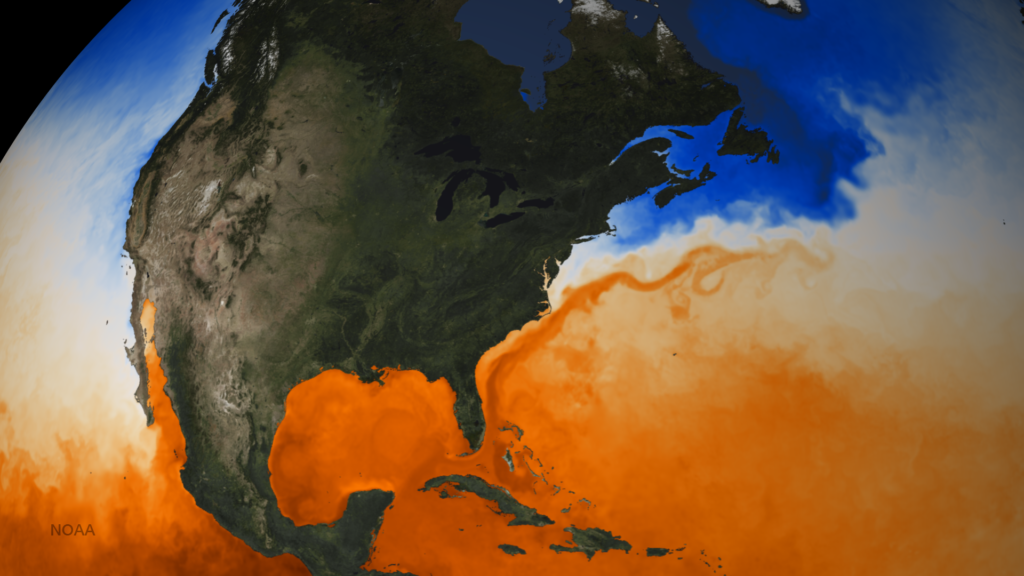
An ocean current is a continuous, directed movement of seawater generated by forces including wind, differences in water density driven by temperature and salinity, the gravitational pull of the moon and sun, and the rotation of the earth. Currents operate at scales ranging from small coastal flows to massive basin-wide systems that transport enormous volumes of water, heat, and dissolved nutrients across thousands of kilometers.
Because currents redistribute heat from the tropics toward the poles, they play a central role in regulating regional and global climate, influencing weather patterns, fisheries productivity, and the distribution of marine life. Understanding current systems has also long been essential for navigation, shipping routes, and search and rescue operations at sea.
Surface Currents and Wind-Driven Circulation
Surface currents are driven primarily by persistent wind patterns acting on the uppermost layers of the ocean, with the Coriolis effect, caused by the earth’s rotation, deflecting moving water into large rotating systems called gyres. The five major subtropical gyres, found in the North and South Atlantic, North and South Pacific, and Indian Ocean, dominate surface circulation across most of the world’s oceans.
Within these gyres, currents such as the Gulf Stream in the North Atlantic and the Kuroshio Current in the North Pacific move warm tropical water poleward at the western edges of ocean basins, while cooler currents typically return equatorward along the eastern edges, creating a roughly circular overall flow pattern.
Deep Water Circulation and Thermohaline Processes
Below the wind-driven surface layer, deep ocean currents are governed primarily by differences in water density, which depends on temperature and salinity, a process often called thermohaline circulation. Cold, salty water in polar regions becomes dense enough to sink, forming deep water masses that slowly spread across ocean basins before eventually rising back toward the surface elsewhere.
This deep circulation, sometimes visualized as a global conveyor belt, operates on timescales of centuries to millennia, far slower than surface currents, yet it plays an outsized role in long-term climate regulation by storing and redistributing vast quantities of heat and carbon dioxide absorbed from the atmosphere.
Coastal and Boundary Currents
Boundary currents running along continental margins differ markedly depending on whether they occur on the western or eastern edge of an ocean basin. Western boundary currents, such as the Gulf Stream, tend to be narrow, fast, and deep, while eastern boundary currents, such as the California Current, are typically broader, slower, and shallower.
Many eastern boundary regions also experience coastal upwelling, where wind patterns push surface water offshore and draw cold, nutrient-rich water up from depth, supporting some of the most productive fisheries in the world along coastlines such as Peru, California, and northwest Africa.
Role in Climate Regulation
Ocean currents absorb and transport a substantial share of the excess heat trapped by greenhouse gases, moderating surface temperatures and buffering the pace of atmospheric warming, though this comes at the cost of rising ocean heat content and associated impacts such as sea level rise and marine heatwaves.
Currents also influence atmospheric circulation patterns, including the formation and strength of phenomena such as El Nino and La Nina, which originate from shifts in Pacific Ocean current and temperature patterns and go on to affect weather far beyond the ocean itself.
Impacts on Marine Ecosystems and Fisheries
Currents transport plankton, fish larvae, and other marine organisms across vast distances, shaping the distribution and connectivity of marine populations and determining which coastal regions support rich fishing grounds. Changes in current strength or position can therefore have major consequences for commercially important fish stocks.
Current systems also influence the dispersal of pollutants, including oil spills and marine debris, since material released into a current can travel far from its original source, complicating both environmental monitoring and cleanup efforts following major spill events.
Monitoring and Measurement Technologies
Scientists track ocean currents using a combination of satellite altimetry, which measures subtle variations in sea surface height associated with current flow, and networks of free-drifting floats and moored instruments that directly measure water velocity, temperature, and salinity at various depths.
The Argo program, an international array of thousands of autonomous profiling floats, has dramatically expanded the ability of researchers to monitor ocean circulation and heat content in near real time, providing crucial data for climate models and operational forecasting.
Concerns About Changing Circulation Patterns
Some researchers have raised concerns that the Atlantic Meridional Overturning Circulation, a major component of thermohaline circulation that includes the Gulf Stream system, could weaken as freshwater from melting ice sheets dilutes the salty water needed to drive deep sinking in the North Atlantic.
A significant slowdown of this circulation could have far-reaching consequences for regional climate, particularly in Western Europe, underscoring why continued monitoring of ocean current systems remains a priority for climate scientists tracking the broader effects of global warming.
FAQ
What causes ocean currents?
Ocean currents are driven by a combination of wind patterns, differences in water density caused by temperature and salinity variations, the earth’s rotation, and tidal forces from the moon and sun.
What is the difference between surface currents and deep currents?
Surface currents are primarily wind-driven and operate in the upper ocean layer, while deep currents are driven mainly by density differences and move much more slowly, often taking centuries to circulate through the global ocean.
Why are ocean currents important for climate?
Currents redistribute heat from the tropics toward the poles, moderating regional climates and influencing weather patterns, while also absorbing and storing a large share of the heat and carbon dioxide trapped by greenhouse gases.
More in Oceans
In the news
Editorially reviewed by Specialty Digest Editorial TeamLast reviewed November 4, 2026Researched and drafted with AI assistanceReport an issue