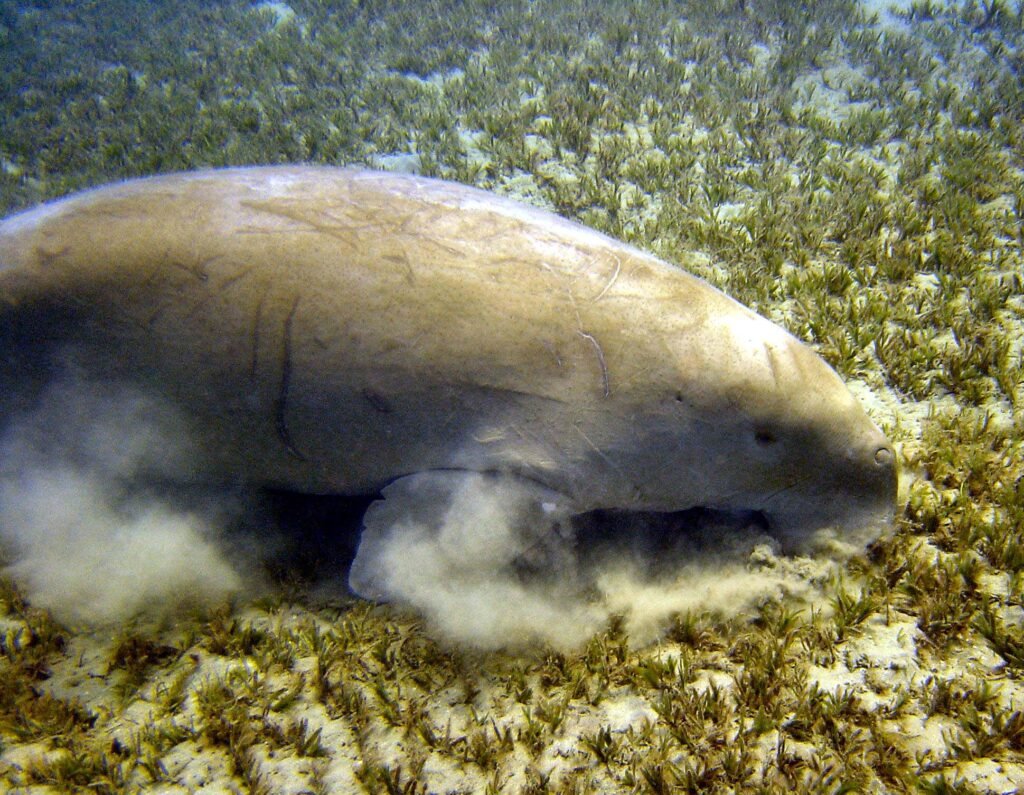
A seagrass meadow is a dense underwater grassland formed by flowering marine plants that grow rooted in sediment along shallow coastlines in temperate and tropical waters worldwide. Unlike seaweed, which is a type of algae, seagrasses are true vascular plants with roots, stems, and leaves, descended from land plants that returned to the sea tens of millions of years ago.
Seagrass meadows rank among the most productive and ecologically valuable marine habitats on earth, providing nursery grounds for juvenile fish, stabilizing sediment, improving water clarity, and storing substantial amounts of carbon in their root systems and the sediment beneath them, a function that has drawn increasing scientific and policy attention in recent years.
Species and Global Distribution
Roughly seventy species of seagrass are currently recognized, ranging from the narrow-bladed eelgrass common in temperate coastal waters to the broader turtle grass found throughout tropical Caribbean and Indo-Pacific shallows. Despite this modest number of species compared to terrestrial flowering plants, seagrasses have colonized coastlines on every continent except Antarctica.
Meadows typically form in shallow, sheltered waters where sunlight can penetrate to the seafloor, since seagrasses depend on photosynthesis and cannot survive in turbid or overly deep water. This light requirement makes them particularly sensitive indicators of coastal water quality.
Ecological Functions and Nursery Habitat
Dense seagrass blades create a sheltered, structurally complex habitat that supports far more biodiversity than the open sand or mud that would otherwise characterize these shallow coastal zones. Juvenile fish and invertebrates, including many commercially important species, use seagrass meadows as nursery habitat, finding food and refuge from predators among the blades before moving to other habitats as adults.
Seagrass root systems also stabilize loose sediment, reducing coastal erosion and improving water clarity by trapping suspended particles, which in turn benefits neighboring habitats such as coral reefs that depend on clear water for their own photosynthetic symbionts.
Carbon Storage and Blue Carbon
Seagrass meadows are now recognized as one of the most efficient natural carbon sinks on the planet, capturing carbon dioxide through photosynthesis and burying it in anoxic sediments where decomposition is extremely slow, allowing carbon to accumulate over centuries. This capacity has made seagrass a centerpiece of so-called blue carbon strategies, which focus on coastal and marine ecosystems for climate mitigation.
Per unit area, some studies suggest seagrass meadows can sequester carbon at rates exceeding those of many terrestrial forests, though the total global area of seagrass habitat is far smaller than forested land, limiting its overall contribution relative to terrestrial carbon sinks.
Threats From Coastal Development and Pollution
Seagrass meadows worldwide have declined significantly over recent decades, driven primarily by coastal development, nutrient runoff from agriculture and wastewater that fuels algal overgrowth, and physical damage from dredging, boat anchors, and bottom trawling. Because seagrasses require clear water for photosynthesis, even moderate increases in turbidity or nutrient-driven algal blooms can trigger widespread die-offs.
Climate-related stressors, including marine heatwaves and ocean warming, have caused additional large-scale seagrass losses in several regions, sometimes compounding the effects of local pollution and physical disturbance to push meadows past a tipping point from which recovery is difficult.
Restoration Efforts and Techniques
Seagrass restoration has advanced considerably in recent decades, employing techniques ranging from transplanting seagrass shoots harvested from healthy donor meadows to broadcasting seeds across suitable habitat and improving water quality to create favorable conditions for natural recolonization. Large-scale restoration projects have achieved meaningful success in some regions, including notable seagrass recovery efforts along the eastern coast of the United States.
Restoration success depends heavily on first addressing the underlying causes of decline, since replanting seagrass into water that remains too turbid or nutrient-polluted typically fails, making water quality improvement a prerequisite for durable recovery rather than an optional complement to planting efforts.
Monitoring and Research Methods
Researchers monitor seagrass meadows through a combination of diver surveys, aerial and satellite imagery, and increasingly, underwater drone and sonar mapping, which can track changes in meadow extent and density over time across areas too large for comprehensive diver-based survey alone.
Long-term monitoring programs in regions such as Florida Bay and the Mediterranean have generated some of the most detailed datasets available on seagrass dynamics, providing crucial baseline information against which future changes and restoration outcomes can be measured.
Policy Protections and Conservation Status
Many countries have established legal protections for seagrass habitat, recognizing its value for fisheries, coastal protection, and carbon storage, though enforcement and funding for monitoring often lag behind the scale of ongoing losses. International frameworks increasingly reference blue carbon ecosystems, including seagrass, within broader climate and biodiversity commitments.
Conservation organizations have also promoted community-based stewardship models, engaging local fishing communities directly in meadow monitoring and restoration, an approach that has shown particular promise in regions where government monitoring capacity remains limited.
Researchers continue to refine satellite-based mapping techniques capable of distinguishing seagrass from other submerged vegetation, a methodological advance that is gradually improving global estimates of total meadow extent and the rate at which it is changing over time.
FAQ
Is seagrass the same as seaweed?
No, seagrass is a flowering vascular plant with true roots and leaves, while seaweed is a type of algae lacking these structures, despite both growing in similar shallow marine environments.
Why is seagrass important for carbon storage?
Seagrass meadows bury carbon in oxygen-poor sediment where it can remain locked away for centuries, making them an efficient natural carbon sink often included in blue carbon climate strategies.
What is the biggest threat to seagrass meadows?
Coastal development and nutrient pollution that reduces water clarity are generally considered the leading threats, often compounded by physical damage from boating and climate-related marine heatwaves.
More in Oceans
Editorially reviewed by Specialty Digest Editorial TeamLast reviewed November 4, 2026Researched and drafted with AI assistanceReport an issue