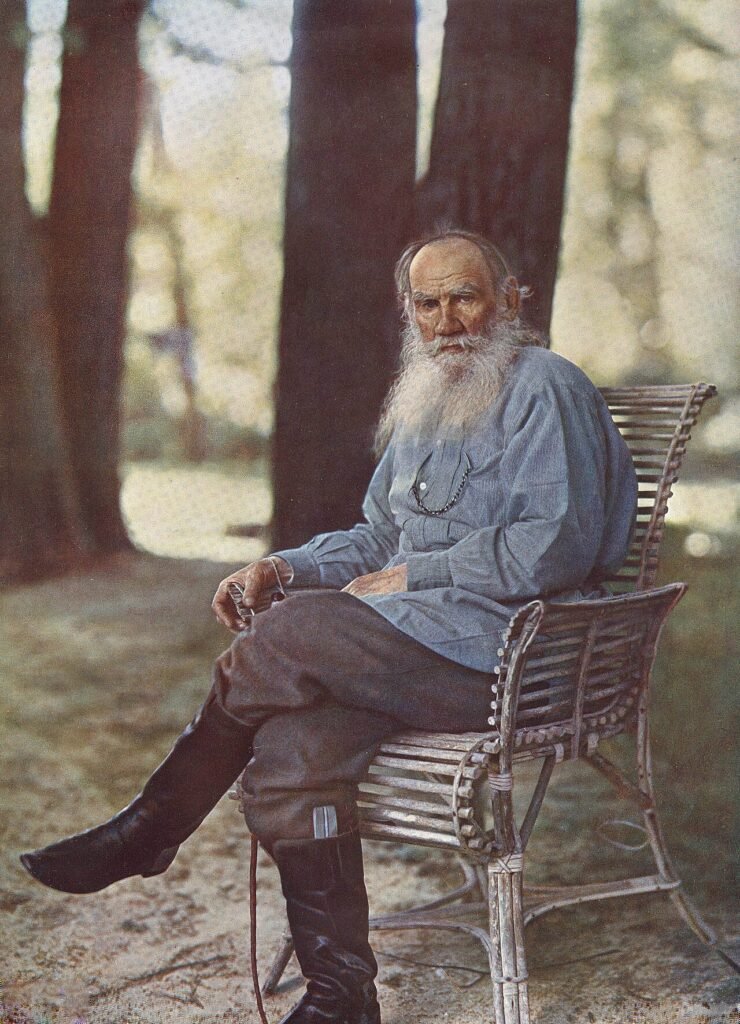
Leo Tolstoy (1828 to 1910) was a Russian novelist and moral thinker, the author of War and Peace and Anna Karenina, two of the best-known novels in world literature. He was born into the landed nobility, wrote about war, family and faith, and in later life became a widely known critic of violence and of the Russian state and church. He died on 7 November 1910 (20 November in the modern calendar) at the railway station of Astapovo.
Early life of Leo Tolstoy
Lev Nikolayevich Tolstoy was born on 28 August 1828 in the Julian calendar then used in Russia, which is 9 September in the modern Gregorian calendar. He was born at the estate of Yasnaya Polyana in Tula province, the fourth child of Count Nikolai Tolstoy and Countess Maria Tolstaya, who came from the princely Volkonsky family. His maternal grandfather had built up the estate.
His mother died in August 1830, when he was not yet two years old, and he grew up in the care of his father and, after his father died in 1837, of relatives. He later described her as a spiritual ideal, and she became the basis for the character Princess Marya in War and Peace. He took his first lessons at home from a German tutor named Friedrich Rössel, who later appeared in Childhood as the character Karl Ivanovich. In 1844 he began studying law and oriental languages at Kazan University, but he left in the middle of his studies and returned to the estate. In 1847 he inherited Yasnaya Polyana, and by family custom the estate passed to the youngest son.
In the early 1850s he began military service and spent several years in the Caucasus and in Crimea, according to the Yasnaya Polyana museum. His first published works, including the autobiographical story Childhood, belong to this period, and his Sevastopol sketches drew on his experience of the Crimean War.
Career and major works
Tolstoy returned to Yasnaya Polyana in 1856. In 1859 he opened a school for peasant children in one wing of the house and taught there himself, following the principle that pupils should have full freedom and no compulsion. On 23 September 1862 he married Sofia Andreyevna Behrs, the daughter of a Moscow physician. She was 18 and he was 34, and in the 48 years of their marriage they had 13 children.
War and Peace, a vast novel of Russian families during the Napoleonic wars, appeared between 1865 and 1869. Anna Karenina, which follows a married woman’s doomed love affair alongside the quieter story of the landowner Levin, was published in installments in the 1870s. Both books combine intimate family scenes with sweeping history, and both are regarded as peaks of the nineteenth-century novel.
In the late 1870s Tolstoy went through a moral and religious crisis, which he described in his book Confession, published in 1882. After it he wrote mainly on faith, ethics and society, and he produced shorter fiction such as The Death of Ivan Ilyich and the late novel Resurrection, published in 1899. His final novel, Hadji Murat, appeared after his death.
Ideas and contributions
Tolstoy argued that people should follow the teachings of Jesus on love and nonviolence rather than the demands of the state, the army or the established church. He rejected private property, lived simply on his estate, and gave up many of his earlier habits. His educational ideas, tested in the village school he founded, rested on freedom for children and respect for their curiosity. In 1892 he prepared a plan for dividing his property between his wife and children after he had renounced ownership himself.
His ideas on nonviolent resistance had an international reach. His book The Kingdom of God Is Within You, published in 1894, set out his case against violence, and Mohandas Gandhi corresponded with him and later credited him as a major influence. This line of thought passed from Tolstoy to Gandhi and on to later movements for civil rights. In literature, his realistic attention to ordinary detail and inner thoughts shaped how later novelists wrote about consciousness and everyday life.
Death of Tolstoy
On the night of 28 October 1910, Tolstoy secretly left Yasnaya Polyana, accompanied by his physician Dushan Makovitsky. He was 82. He fell ill on the way and had to leave the train at the small station of Astapovo, where he died of pneumonia on 7 November.
Legacy of Leo Tolstoy
Yasnaya Polyana became a museum in 1921, and in 2011 Tolstoy’s personal library was added to UNESCO’s Memory of the World register. His novels are translated into dozens of languages and have been adapted for film, television and the stage many times. He was nominated for the Nobel Prize in Literature every year from 1902 to 1906 but never received it, and he was also nominated for the Nobel Peace Prize.
During the Second World War German troops occupied Yasnaya Polyana from 29 October to 15 December 1941. Museum staff had already evacuated many objects, and although the invaders set fire to Tolstoy’s house as they left, the blaze was put out and restoration began at once. The State Tolstoy Museum in Moscow and the Yasnaya Polyana museum both preserve his manuscripts and publish a long-running scholarly edition of his writings in ninety volumes.
Controversies and criticism
His later writings brought him into conflict with the authorities. In 1901 the Holy Synod of the Russian Orthodox Church issued a statement declaring that he had placed himself outside the church, which is commonly described as his excommunication, and his works on politics and religion were often censored.
His family life was also strained. Disagreements with Sofia over property, copyright and the direction of his teaching grew deep in his final years, and his secret departure from home in 1910 is usually linked to these conflicts.
More in Literature
Key facts
- Tolstoy was born on 28 August 1828 (Julian calendar) at Yasnaya Polyana, the fourth child of Count Nikolai and Countess Maria Tolstoy.1
- He married Sofia Andreyevna Behrs on 23 September 1862, and they had 13 children over 48 years of marriage.1
- He opened a school for peasant children at Yasnaya Polyana in 1859.1
- He left home secretly on 28 October 1910 and died of pneumonia at Astapovo on 7 November 1910.1
- Yasnaya Polyana became a museum in 1921, and his library joined UNESCO's Memory of the World register in 2011.1
Related concepts
Quick checkWhere and how did Leo Tolstoy die?Show answer
He died of pneumonia at the small railway station of Astapovo on 7 November 1910 (Julian calendar), after secretly leaving his estate Yasnaya Polyana at the age of 82.
Sources
- Yasnaya Polyana State Memorial and Nature Preserve Museum, history of the estate (1828 to 1941 timeline, in Russian), https://ypmuseum.ru
- tolstoy.ru, Biography chronology of Lev Tolstoy (State Tolstoy Museum and Yasnaya Polyana, in Russian), https://tolstoy.ru/life/biography/
Editorially reviewed by Specialty Digest Editorial TeamLast reviewed November 4, 2026Researched and drafted with AI assistanceReport an issue