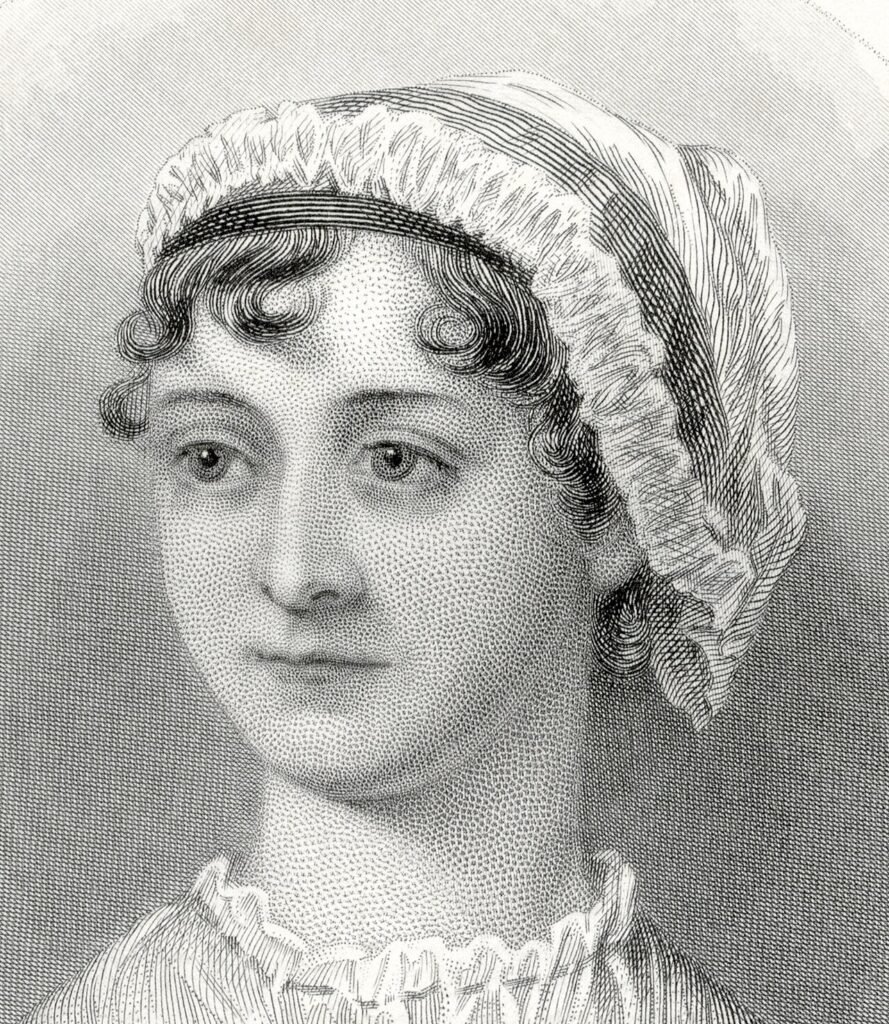
Jane Austen (1775 to 1817) was an English novelist known for six novels that examine love, money, class and manners in the lives of women in rural England around the turn of the nineteenth century. Her books include Pride and Prejudice, Sense and Sensibility, Emma and Persuasion, and they are admired for their wit, irony and psychological insight. She published anonymously during her lifetime and died at Winchester on 18 July 1817, aged 41.
Early life of Jane Austen
Jane Austen was born on 16 December 1775 at Steventon Rectory in Hampshire, the seventh of eight children of Reverend George Austen and his wife Cassandra. She had six brothers and one sister, also named Cassandra, who became her closest friend. Jane Austen’s House, the museum in her former home, records that she attended schools in Oxford, Southampton and Reading with her sister, and that she nearly died of typhus in 1783.
She was educated largely at home, using her father’s extensive library, and her brothers gave her unusual access to the wider world. Two of them served in the Royal Navy during the Napoleonic Wars, and another, Henry, later worked as a banker in London, where Jane visited, attended the theater and corrected proofs of her novels. The Austen family also gave her a view of the life of the landed gentry through her brother Edward, who was adopted by wealthy cousins.
From 1787 she wrote comic stories, sketches and short plays that are now called her teenage writings or juvenilia. They include Love and Friendship, written in 1790, and the short letter-novel Lady Susan, written in 1794.
Career and major works
Austen never married. In December 1795 she danced and flirted with Tom Lefroy, a young lawyer visiting relatives near Steventon, and on 2 December 1802 she accepted a proposal from Harris Bigg-Wither, the wealthy brother of her friends, before changing her mind the next day and declining it. She remained with her family, and her writing became the center of her life.
In the mid-1790s Austen drafted versions of the novels that would become Sense and Sensibility, then titled Elinor and Marianne, and Pride and Prejudice, first called First Impressions. In 1797 her father offered First Impressions to a publisher, who rejected it by return of post. She also wrote a novel called Susan, which was sold to a publisher for 10 pounds in 1803 but never printed. It later became Northanger Abbey.
The family moved to lodgings in Bath in 1801. Her father died suddenly in January 1805, and the Austen women were left dependent on her brothers for support. In July 1809 Jane, her sister and her mother moved to a cottage at Chawton, Hampshire, which her brother Edward offered them rent free. The next eight years were her most productive.
Sense and Sensibility was published in 1811 with the author named only as a Lady. Pride and Prejudice followed in 1813 and Mansfield Park in 1814. Emma was published in December 1815, though its title page is dated 1816, and she dedicated it to the Prince Regent. Her brother Henry bought back the manuscript of Susan in 1816. She wrote Persuasion in 1815 and 1816 and started a final novel, Sanditon, in January 1817 but completed only twelve chapters.
Ideas and contributions
Austen is important for her realism. She wrote about ordinary people in ordinary situations, usually in the families of the country gentry and clergy, and she showed how marriage, property and reputation shaped women’s choices. Jane Austen’s House notes that these focused, realistic characters and events influenced the development of the modern novel.
She also used a narrative method known as free indirect style. In this technique the narrator slips into a character’s point of view without quotation marks, so that readers experience events through the character’s thoughts and feelings. Her dry humor and use of irony let her criticize snobbery and self-deception while still treating her characters with sympathy.
Death of Jane Austen
Austen became seriously ill in 1816 but kept writing. By April 1817 her illness confined her to bed, and on 27 April she wrote a short will leaving nearly everything to her sister Cassandra. On 24 May she left Chawton for Winchester to receive medical treatment, and she died there on 18 July 1817. She was buried in Winchester Cathedral on 24 July.
Northanger Abbey and Persuasion were published together in December 1817, and for the first time the books named Jane Austen as the author.
Legacy of Jane Austen
Her nephew James Edward Austen-Leigh published A Memoir of Jane Austen in 1869, which became the first biography and helped fix the popular image of her as a quiet country writer. Her novels have been translated into dozens of languages, inspired countless sequels and are regularly adapted for film, television and theater.
Jane Austen’s House opened to the public in 1949 in the Chawton cottage where she lived and wrote. The Jane Austen Society of North America also supports readers and scholars of her work, and her manuscripts and letters survive in several libraries, including the British Library.
Controversies and criticism
Details of her death remain uncertain. Many biographers have followed a 1964 diagnosis of Addison’s disease made long after her death, but her final illness has also been described as Hodgkin’s lymphoma, and the evidence cannot settle the question.
Her reputation has also been debated. Some nineteenth-century readers saw her as a narrow domestic writer, and critics today disagree about how far her novels engage with the wider issues of her era, such as war, empire and class. These debates have kept her work central to literary study, and each generation of readers finds new questions in the same six novels.
More in Literature
Key facts
- Jane Austen was born on 16 December 1775 at Steventon Rectory in Hampshire, the seventh of eight children.1
- Sense and Sensibility appeared in 1811 and Pride and Prejudice in 1813, both without her name on the title page.1
- She moved to Chawton cottage with her mother and sister on 7 July 1809.1
- She died at Winchester on 18 July 1817, aged 41, and was buried in Winchester Cathedral on 24 July.1
- Northanger Abbey and Persuasion were published in December 1817, the first books to name her as the author.1
Related concepts
Quick checkWhich novels did Jane Austen publish?Show answer
Sense and Sensibility (1811), Pride and Prejudice (1813), Mansfield Park (1814) and Emma (1815), with Northanger Abbey and Persuasion published after her death in December 1817.
Sources
- Jane Austen's House, A Timeline of Jane Austen's Life and Works, https://janeaustens.house/jane-austen/timeline/
- Jane Austen's House, About Jane Austen, https://janeaustens.house/jane-austen/
- Jane Austen Society of North America, Jane Austen: A Brief Biography, https://www.jasna.org/austen/
Editorially reviewed by Specialty Digest Editorial TeamLast reviewed November 4, 2026Researched and drafted with AI assistanceReport an issue