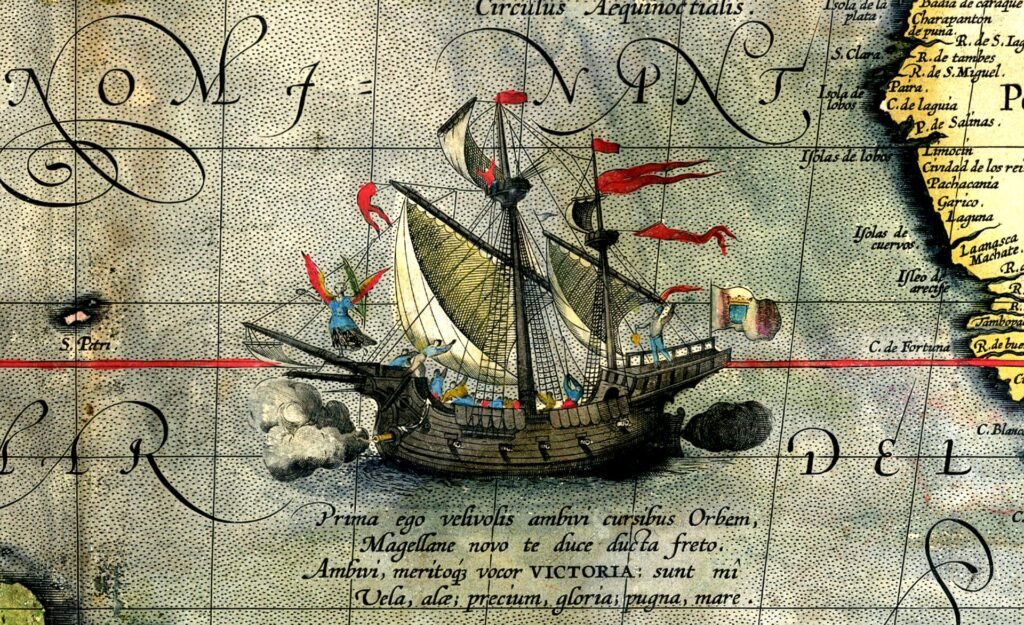
The Magellan-Elcano circumnavigation was the Spanish expedition of 1519 to 1522 that completed the first voyage around the world. The Portuguese navigator Ferdinand Magellan, sailing for Spain, led it until he was killed in the Philippines in April 1521, and the Spanish navigator Juan Sebastián Elcano brought the only surviving ship, the Victoria, back to Spain on 6 September 1522.
Background to the Magellan-Elcano expedition
Spain and Portugal had divided the non-European world between them in the Treaty of Tordesillas of 1494. Portugal received the routes around Africa and Spain received the Americas. Portuguese ships reached India in 1498 and the Spice Islands, now the Maluku Islands of Indonesia, in 1512, so Portugal controlled the eastern route to the spices that European merchants prized.
Spain wanted a western route to Asia. Vasco Núñez de Balboa had sighted the Pacific Ocean from Panama in 1513, but no European knew how wide it was. Magellan had served Portugal in India, East Africa, Malacca and Morocco, and he moved to Seville in 1517 after his career stalled at the Portuguese court. He told King Charles I of Spain, soon to become Emperor Charles V, that the Spice Islands lay in Spain’s half of the world and could be reached by sailing west. Charles approved the plan in March 1518.
The fleet was known as the Armada de Molucca and had five ships: the Trinidad, San Antonio, Concepción, Victoria and Santiago. Sources disagree on the number of men. The Naval Museum in Madrid says 247 boarded, while the World History Encyclopedia gives 260 to 270. The Venetian scholar Antonio Pigafetta sailed with the fleet and wrote the main surviving account, because the official logbook was lost.
Course of the voyage
The fleet left Seville on 10 August 1519 and put to sea from Sanlúcar de Barrameda on 20 September. After a stop in the Canary Islands, Magellan steered a southern course to avoid Portuguese ships that were reported to be hunting him. In December 1519 the ships reached what is now the bay of Rio de Janeiro and then followed the South American coast southward, searching for a passage to the Pacific.
The expedition stopped at San Julián Bay in Patagonia on 31 March 1520 for the southern winter. In the first days of April, three Spanish captains seized ships in a mutiny. Magellan regained control by force, the mutiny leader Luis de Mendoza was killed, and Gaspar de Quesada was beheaded after a trial. The Santiago was wrecked while scouting ahead in a storm, though its crew survived.
The remaining ships passed through the strait that now bears Magellan’s name between 21 October and 28 November 1520. During the passage the San Antonio deserted and sailed home to Seville, taking a large share of the fleet’s supplies. The three remaining ships entered the Pacific on 28 November 1520.
The Pacific crossing lasted 98 days, and the ships reached Guam on 6 March 1521. Food and water spoiled, and about 30 men died of scurvy. On 7 April the fleet reached the Philippines. On 27 April 1521 Magellan was killed on Mactan Island, where he had joined a fight between rival local chiefs.
After his death the survivors chose new leaders. The Concepción was burned because too few men remained to sail it. On 8 November 1521 the Trinidad and Victoria reached Tidore in the Spice Islands and loaded cloves and other spices. The Victoria sailed west on 21 December 1521 under Elcano, crossed the Indian Ocean, rounded the Cape of Good Hope and stopped at the Cape Verde Islands in July 1522. There the crew learned that their carefully kept calendar was one day behind the local date, an effect of sailing westward around the globe.
Aftermath of the circumnavigation
The Victoria reached Spain on 6 September 1522 and anchored at the quay in Seville on 8 September, according to Pigafetta’s journal as quoted by the Naval Museum in Madrid. Only 18 men were aboard, out of about 60 who had left the Spice Islands. They were weak, barefoot and in tattered clothes, and they walked in procession to give thanks at the shrines of Seville.
The Trinidad had stayed behind for repairs. It tried to return across the Pacific in April 1522 but turned back, was captured by a Portuguese fleet and was later wrecked in a storm. Four of its men eventually reached Europe, so about 22 of the original crew came home in all, according to the World History Encyclopedia. The Naval Museum also notes that at least three people from the Maluku Islands accompanied the Victoria’s survivors.
King Charles V received the survivors at Valladolid. He gave Elcano an annual pension of 500 gold ducats and a coat of arms with a globe and the Latin motto Primus circumdedisti me, meaning you were the first to circle me. The cargo of spices on the Victoria was worth far more than the cost of the expedition, according to the Naval Museum.
Significance and legacy of the Magellan-Elcano circumnavigation
The voyage showed that ships could sail around the world and that the Pacific was far larger than European mapmakers had believed. The World History Encyclopedia says the earth proved to be about 7,000 miles bigger around than cartographers had assumed. It also showed that the trade winds and currents of the Pacific could be used for sailing, as those of the Atlantic already were.
As a trade route the western passage was a disappointment. It was long, dangerous and costly, and many later captains had trouble finding the correct entrance to the strait among the islands at the tip of South America. Charles V nevertheless used the voyage to support Spain’s claim to the Spice Islands and sent a second armed fleet, and Spain and Portugal again negotiated a division of the world. In 1577 to 1580 the English captain Francis Drake made his own way through the strait on a circumnavigation.
Historians stress that the achievement belongs to both leaders. Magellan planned the route, found the strait and led the fleet across the Pacific, but he died before the ships reached the Spice Islands. Elcano commanded the final stage that completed the circle, which is why the expedition now carries both names. The voyage also reached peoples of the Atlantic, Pacific and Indian Ocean coasts, and the contacts were often violent, as the deaths at Mactan and earlier clashes at Guam show.
The sources differ on several numbers, including the size of the crew and the total of survivors, and the figures above are best read as approximate. The Victoria itself became famous, and a replica of the ship, the Nao Victoria, now sails and visits ports as a museum ship.
Key facts
- The fleet of five ships left Seville on 10 August 1519 and put to sea from Sanlúcar de Barrameda on 20 September 1519.1
- The ships passed through the Strait of Magellan between 21 October and 28 November 1520 and crossed the Pacific in 98 days.1
- Magellan was killed on 27 April 1521 on Mactan Island in the Philippines.1
- The Victoria, commanded by Elcano, reached Spain on 6 September 1522 with 18 men aboard.12
- Sources give the crew at departure as 247 men or about 260 to 270, and about 22 of them eventually returned to Europe.12
Related concepts
Quick checkWho completed the first circumnavigation of the Earth?Show answer
Juan Sebastián Elcano completed it in 1522, commanding the Victoria after Magellan was killed in the Philippines in 1521. The expedition is therefore named for both men.
Sources
- World History Encyclopedia, Ferdinand Magellan, https://www.worldhistory.org/Ferdinand_Magellan/
- Museo Naval, Madrid, via Google Arts and Culture, Elcano's Return (El Regreso de Elcano), https://artsandculture.google.com/story/gAXBe3j1qN_gLQ
Editorially reviewed by Specialty Digest Editorial TeamLast reviewed November 4, 2026Researched and drafted with AI assistanceReport an issue