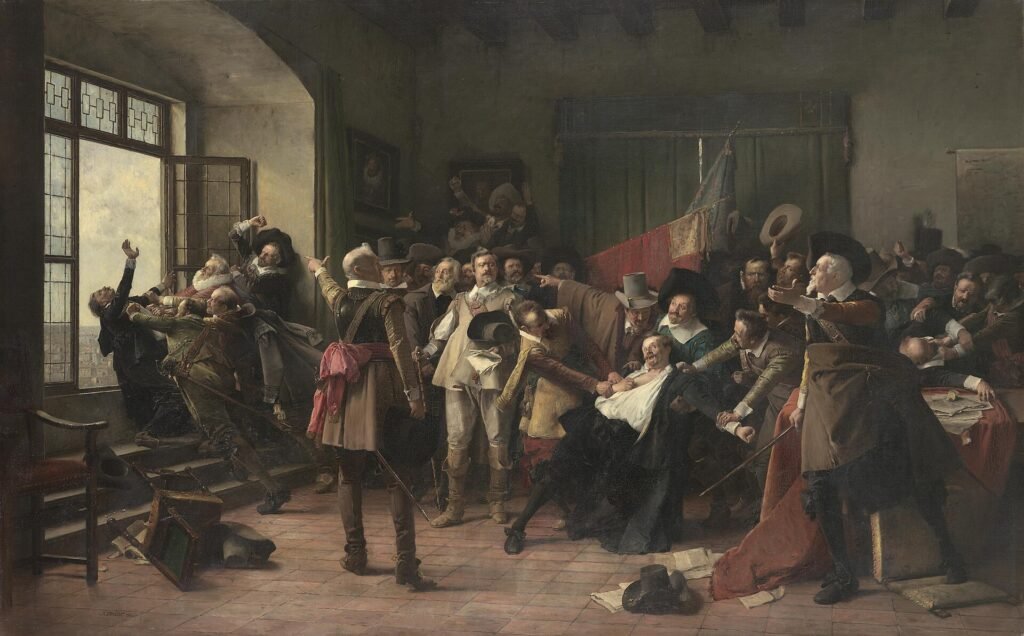
The Thirty Years’ War was a series of linked conflicts fought from 1618 to 1648, mostly in the Holy Roman Empire, in the area that is now Germany. It began as a revolt by Protestant nobles in Bohemia and grew into a struggle that drew in Spain, France, Sweden, Denmark and the Dutch. It ended with the Peace of Westphalia, signed on 24 October 1648.
Background of the Thirty Years’ War
The roots of the war lay in the religious divisions of the Protestant Reformation, which began in 1517. The Peace of Augsburg of 1555 tried to settle them with the principle of cuius regio, eius religio, meaning that each ruler decided whether his territory would be Catholic or Lutheran. Calvinism, another Protestant branch, had no legal recognition under that arrangement.
The system worked poorly when a ruler’s faith differed from that of his subjects. Bohemia was a clear case. Its people had held religious freedom since the Council of Basel in 1436, and many were Protestants. When the devoutly Catholic Ferdinand II became king of Bohemia in 1617, they distrusted him because of his record of persecuting Protestants elsewhere.
Politics added to the tension. World History Encyclopedia lists resentment of Habsburg control over trade, the weakened authority of the emperor and rival commercial interests among the causes, while naming religion as the immediate trigger. The Habsburg family controlled Spain, Naples, Milan and most of the empire, which worried neighbors such as France.
Course of the Thirty Years’ War
Historians usually divide the war into four phases, each named for the main outside power involved.
The Bohemian phase, from 1618 to 1620, began in May 1618. Protestant nobles led by Count Thurn threw three of Ferdinand’s representatives from a window of Prague Castle, an event known as the Second Defenestration of Prague. All three men survived. The rebels offered the Bohemian crown to Frederick V of the Palatinate, who accepted. In November 1620, Catholic imperial troops under the Count of Tilly defeated the Bohemians at the Battle of White Mountain, and Prague fell.
The Danish phase, from 1625 to 1629, opened when the Protestant king Christian IV of Denmark entered the war, partly to protect his trade interests in northern Germany. Tilly defeated him at the Battle of Lutter in 1626, and the imperial general Albrecht von Wallenstein outmaneuvered him the following year. Denmark made peace in the Treaty of Lübeck in 1629.
The Swedish phase, from 1630 to 1634, began when King Gustavus Adolphus landed in Germany with about 20,000 troops. His army used mobile artillery and coordinated volley fire, and it beat Tilly at Breitenfeld in 1631. Gustavus Adolphus died at the Battle of Lützen in November 1632, although the Swedes held the field. Wallenstein was assassinated by his own officers in 1634, and a Habsburg army under Cardinal-Infante Ferdinand of Austria crushed the Swedish and German allies at Nördlingen that September. About 16,000 combatants died there in a single day.
The French phase, from 1635 to 1648, followed when Cardinal Richelieu, who had already supported the Protestant side with money, took France into open war against Spain. Rivalry with the Habsburgs, not religion, now drove events, and a Catholic power fought on the Protestant side. Diplomats had been scheduled to gather at Münster and Osnabrück in 1643, but the fighting continued while they talked.
Casualties and devastation
Armies on every side lived off the land, which meant plundering farms and killing civilians. Famine and epidemic disease followed the troops, and refugees crowded into cities where illness spread quickly. World History Encyclopedia puts the death toll at roughly 8 million people, soldiers and civilians together, although figures for a war of this scale rest on estimates and not on counts.
Some places suffered far more than others. According to the same source, Magdeburg lost about 20,000 of its 25,000 inhabitants and about 1,700 of its 1,900 buildings. Many villages across the empire were almost entirely destroyed.
Aftermath: the Peace of Westphalia
The settlement consisted of treaties negotiated at Münster and Osnabrück. An English text of the treaty between the emperor and France, held by Yale’s Avalon Project, is dated Münster, 24 October 1648. The peace also ended the separate Eighty Years’ War between Spain and the Netherlands.
On religion, the settlement largely repeated the terms of 1555 and extended recognition to Calvinism alongside Lutheranism and Catholicism. The treaty also ordered that the armies of all parties fighting in the empire be disbanded.
Territorial changes strengthened France and Sweden and weakened the emperor’s hold over the empire’s many states. World History Encyclopedia lists Dutch and Swiss independence, the rise of France as a major power and the decline of the Spanish Empire among the results.
Significance and legacy
Many historians treat 1648 as a turning point in European history. World History Encyclopedia describes the peace as a foundation for the idea of sovereignty, under which one state should not interfere in another’s internal laws, and as a step toward the modern international system. The treaty text itself deals mostly with territory, religion and the disbanding of armies, so the larger claims about sovereignty come from later interpretation.
The war also changed how armies fought. The same source credits Gustavus Adolphus with mobile field artillery, cross-trained units and disciplined volley fire, innovations that other armies later copied.
In Germany, the memory of the destruction lasted for centuries. World History Encyclopedia notes that later leaders used stories of foreign soldiers’ atrocities to build national feeling, and that this memory shaped propaganda before both world wars.
The war is also seen as the last of the great religious wars of the Reformation, since Calvinism had joined the accepted faiths. It did not end religious conflict, and later disputes continued in other forms.
More in History
Key facts
- The Thirty Years' War ran from 1618 to 1648 and was fought mostly in the Holy Roman Empire, in what is now Germany.1
- The Bohemian Revolt began in May 1618 with the Second Defenestration of Prague.1
- Historians divide the war into four phases: Bohemian, Danish, Swedish and French.1
- The treaty between the emperor and France is dated Münster, 24 October 1648.2
- World History Encyclopedia puts the death toll at roughly 8 million people.1
Related concepts
Quick checkWhen did the Thirty Years' War end?Show answer
It ended in 1648 with the Peace of Westphalia, whose treaty between the emperor and France is dated Münster, 24 October 1648.
Sources
- World History Encyclopedia, Thirty Years' War, https://www.worldhistory.org/Thirty_Years%27_War/
- Yale Law School Avalon Project, Treaty of Westphalia, https://avalon.law.yale.edu/17th_century/westphal.asp
- Oxford Companion to British History via Encyclopedia.com, Thirty Years War, https://www.encyclopedia.com/history/encyclopedias-almanacs-transcripts-and-maps/thirty-years-war
Editorially reviewed by Specialty Digest Editorial TeamLast reviewed November 4, 2026Researched and drafted with AI assistanceReport an issue