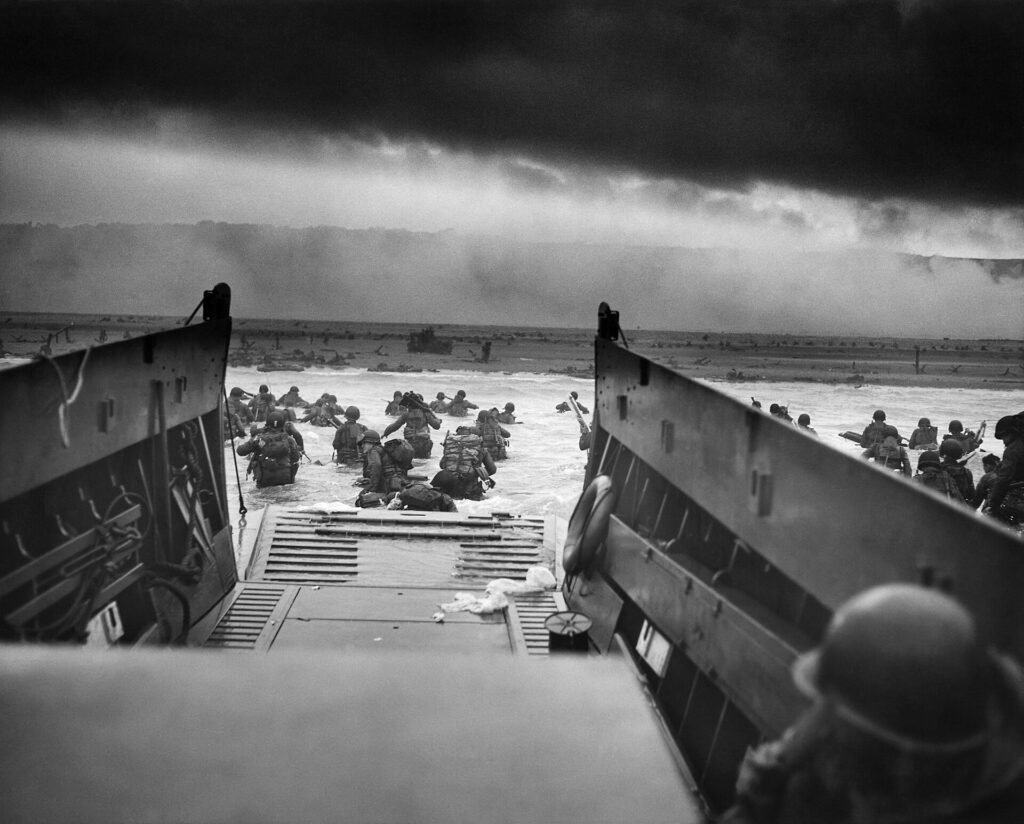
D-Day was the Allied invasion of German-occupied Normandy on 6 June 1944, the opening day of Operation Overlord. It was the largest amphibious invasion in military history, with troops landing from the sea on five beaches while paratroopers and glider troops arrived inland. The landings opened a second major front in Western Europe during World War II.
Background to D-Day
By 1943 the Western Allies had decided to invade northern France across the English Channel. Planning moved through a series of wartime conferences, including Trident in May 1943, Quadrant in August 1943, and Sextant and Eureka in November and December 1943. By the end of that year General Dwight D. Eisenhower had been chosen to command Operation Overlord, the code name for the invasion plan.
Soviet forces had been fighting Germany on the Eastern Front since 1941, so a landing in the west would force German commanders to fight on two large fronts at once. The invasion area was a stretch of the Normandy coast about 50 miles long. The Allies gave its five landing beaches the code names Utah, Omaha, Gold, Juno and Sword. Utah and Omaha were American beaches, Gold and Sword were assigned to British forces, and Juno to Canadian forces.
The National WWII Museum notes that the Allied force drew mainly on the United States, the United Kingdom and Canada, with troops from 12 other nations. Senior Allied commanders included Eisenhower and Omar Bradley for the United States, and Bernard Montgomery, Trafford Leigh-Mallory, Arthur Tedder, Miles Dempsey and Bertram Ramsay for the United Kingdom. On the German side, the museum lists Erwin Rommel, Gerd von Rundstedt and Friedrich Dollmann.
Eisenhower understood that the operation might fail. He wrote a short press release to be issued if the landings did not succeed, and the handwritten note survives in his papers. The Eisenhower Presidential Library points out that it was mistakenly dated 5 July instead of 5 June.
Course of D-Day
The invasion began in the dark hours before the seaborne landings, when airborne troops went in behind the coast. About 23,400 paratroopers and glider troops were delivered into Normandy by 822 aircraft and gliders. Landing soldiers inland was meant to disrupt the defenders and ease the pressure on the men coming ashore from the sea.
The naval force was far larger. The National WWII Museum counts more than 7,000 naval vessels, including about 4,000 landing craft and 1,200 warships, with roughly 12,000 aircraft supporting the operation. The Eisenhower library describes 7,000 ships and landing craft crewed by more than 195,000 naval personnel from eight Allied countries, delivering five naval assault divisions to the beaches.
Sources differ on how many troops landed. The museum says nearly 160,000 Allied troops landed on D-Day, while the Eisenhower library says almost 133,000. The gap may reflect whether airborne troops are counted, so both figures are best read as estimates rather than a precise headcount.
Omaha Beach was the costliest of the five. More than 34,000 Americans came ashore there on 6 June, and Allied casualties on the beach were approximately 2,400. The V Corps history put the corps losses on D-Day at 2,374, including 1,190 in the 1st Infantry Division, 743 in the 29th Infantry Division and 441 among corps troops. The Army historian Gordon Harrison cautioned that accurate unit-by-unit loss figures would probably never be available, because the reports did not fully agree.
Across all the beaches, both the museum and the Eisenhower library put Allied casualties for the first day, counting killed, wounded and missing, at roughly 10,300.
The term D-Day is a military label for the day an operation begins, and it was used for many planned operations. It became attached to 6 June 1944 because of the scale of the Normandy landings. The wider Battle of Normandy continued for weeks afterward.
Aftermath of D-Day
The landings were the start of a campaign, not its end. By the end of June 1944 the Allies had put ashore more than 850,000 troops, 570,000 tons of supplies and nearly 150,000 vehicles across the Normandy beaches, according to the museum. Keeping an army of that size supplied across open beaches was a major problem of military logistics.
Months of hard fighting followed before Germany was defeated. On 7 May 1945, General Alfred Jodl signed an unconditional surrender at Reims, France. The Eisenhower library credits the Western Allies together with Soviet forces on the Eastern Front for the defeat of Nazi Germany.
Significance and legacy of D-Day
D-Day showed that a large amphibious assault against a defended coast could succeed, and it gave the Allies the foothold they needed to begin the campaigns that liberated occupied Europe. The operation was unusual for joining land, air and sea forces from many countries under one overall command. Historians study it as an example of military strategy carried out on an enormous scale.
The multinational character of the force is one reason the operation is still studied. Ground troops came from the United States, the United Kingdom, Canada and 12 other Allied nations, and the naval personnel came from eight countries. Coordinating so many national forces, languages and chains of command was itself a major achievement of the planning.
Eisenhower addressed the troops in an Order of the Day issued on the morning of the invasion. The Eisenhower library says the message shows his determination that Overlord would bring a quick end to the war.
The human cost is central to how the day is remembered, and the casualty figures remain approximate. The historian Stephen Ambrose observed that no exact figures are possible for the men landed or for the casualties on D-Day alone, and the museum describes many of its own numbers as approximations. The numbers in this entry should therefore be read as the best available estimates, with ranges given where sources differ.
Key facts
- D-Day was 6 June 1944, when Allied forces landed on five Normandy beaches code-named Utah, Omaha, Gold, Juno and Sword.1
- Allied casualties on the first day, counting killed, wounded and missing, were roughly 10,300.1
- Estimates of troops landed range from almost 133,000 (Eisenhower Library) to nearly 160,000 (National WWII Museum).2
- About 23,400 airborne troops were delivered into Normandy by 822 aircraft and gliders.1
- By the end of June 1944 the Allies had landed more than 850,000 troops and 570,000 tons of supplies.1
- Germany signed an unconditional surrender at Reims, France, on 7 May 1945.2
Related concepts
Quick checkWhat was D-Day?Show answer
D-Day was the Allied invasion of Normandy on 6 June 1944, the first day of Operation Overlord, when troops landed on five beaches and airborne forces dropped inland.
Sources
- The National WWII Museum, D-Day Fact Sheet, https://www.nationalww2museum.org/media/press-releases/d-day-fact-sheet-0
- Eisenhower Presidential Library, World War II: D-Day, The Invasion of Normandy, https://www.eisenhowerlibrary.gov/research/online-documents/world-war-ii-d-day-invasion-normandy
Editorially reviewed by Specialty Digest Editorial TeamLast reviewed November 4, 2026Researched and drafted with AI assistanceReport an issue