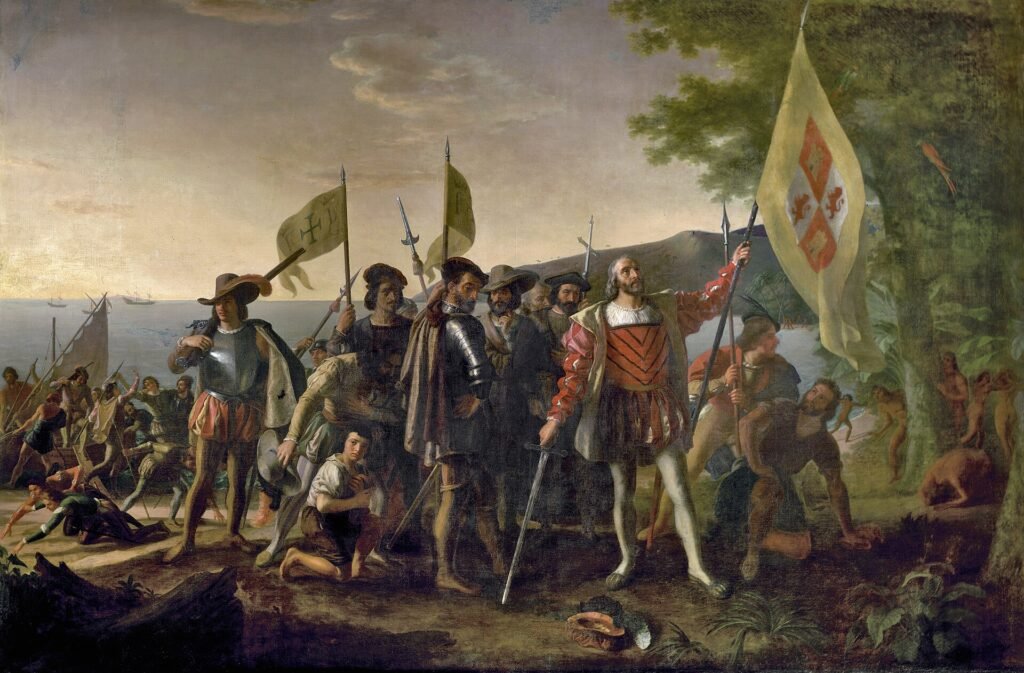
The Columbian Exchange was the transfer of plants, animals, diseases and people between the Old World of Europe and Africa and the New World of the Americas that began after Christopher Columbus’s voyages in 1492. The term was coined by the historian Alfred Crosby Jr. in 1972. The exchange changed diets, farming, populations and economies on several continents, and it caused severe loss of life among the peoples of the Americas.
Background of the Columbian Exchange
World History Encyclopedia notes that the Americas had been cut off from Asia since the end of the last Ice Age, about 12,000 years ago. Apart from occasional contact with Vikings in eastern Canada and a few Polynesian voyages, there was no regular contact between the peoples of the two hemispheres.
European interest in new trade routes grew in the 1400s. Portuguese ships worked their way down the coast of Africa, hoping to reach the markets of India, China and Japan. Columbus, an Italian sailing for Spain, set out westward instead. He left Spain on 3 August 1492 and made landfall in the Bahamas on 12 October, on an island he renamed San Salvador.
After the first voyage, Spain and later other European powers began to settle in the Americas, and they tried to recreate their familiar ways of life there. The exchange speeded up as colonialism spread.
Plants and crops exchanged
The Spanish first planted wheat, olives and grapevines in the Americas, in order to produce the bread, oil and wine that were central to their diet and religious practice. Sugar, rice and indigo followed, and later tobacco and cotton plantations became a new basis for wealth and trade. Gale’s encyclopedia of economic history lists citrus fruits among the other plants carried west. Africans also contributed plants, including rice, bananas, plantains, lemons and black-eyed peas, according to World History Encyclopedia.
The flow in the other direction was just as important. Columbus found maize, sweet potatoes, peppers and pineapples on his first voyage, and later expeditions found potatoes, squash, tomatoes, cacao, peanuts, cashews and tobacco. Many of these crops had been developed by Indigenous farmers over centuries. By the 1530s, tobacco had become a valuable cash crop, especially in the British colonies of the mid-Atlantic coast.
Some of them reshaped diets worldwide. Hernan Cortes brought cacao to Spain in 1528, where the bitter drink made from it was sweetened, and chocolate followed. Peppers became part of the cuisines of Hungary and Korea, among others. World History Encyclopedia argues that the potato had the greatest effect on Europe, since it grew in many soils and gave high yields, which helped to reduce hunger and raise population growth.
Animals exchanged
The Old World’s main domestic animals crossed the Atlantic, including cattle, horses, sheep, goats, pigs and chickens. The sources differ on timing. Gale says Columbus brought horses and cattle on his first voyage in 1492, while World History Encyclopedia says domestic animals arrived on his second voyage in 1493.
The new animals spread quickly. Cattle ranching had reached from the Caribbean to Mexico and Florida by 1565, and the Spanish also brought the metal plow. Horses allowed Europeans to cover long distances and gave them an advantage in conflicts, and over time Native peoples adopted horses for travel and warfare. Pigs came on the second voyage, and Hernando de Soto’s expedition of 1539 to 1542 took them to North America. Pigs that escaped became ancestors of today’s feral pigs.
With few natural predators, the introduced herds ate and trampled native plants and upset the ecological balance in some areas, according to World History Encyclopedia.
Disease and population loss
The most destructive part of the exchange was disease. Europeans carried smallpox, measles, mumps, whooping cough, chickenpox, typhus and influenza, and the later slave trade brought hepatitis B, malaria and yellow fever. Many of these illnesses began as zoonotic diseases, which passed from domestic animals to people. Europeans had lived alongside herds for thousands of years and had built partial immunity, while the peoples of the Americas had not.
World History Encyclopedia says smallpox appeared in the Americas in 1519 and that it has been estimated that 90 percent of Native people had died by 1650. It also cites a fall in central Mexico from roughly 11 to 25 million people to about 2 million, with disease, warfare and starvation all playing a part. By the 1560s, the source adds, the Caribbean islands were largely depopulated. These are estimates, and the range shows how uncertain the numbers are.
Disease moved the other way as well. The first recorded European case of syphilis was reported in Naples in 1495, and some accounts link it to Columbus’s sailors. The same source notes a competing theory that the disease already existed in Europe and was misdiagnosed as leprosy.
Aftermath: labor and the Atlantic slave trade
The collapse of Native populations and the growth of plantations created a labor shortage. Europeans turned to Africa, and the transatlantic slave trade carried an estimated 12 million to 20 million Africans to the Americas between the sixteenth and nineteenth centuries, according to World History Encyclopedia. This forced migration formed one side of the triangular trade between the Americas, Europe and Africa.
Significance and legacy
The Columbian Exchange is often described as one of the most pivotal events in world history. New crops made it possible to farm soils that had been unproductive, and the new animals changed food supplies and transport. Gale’s encyclopedia adds that the exchange set off waves of migration and changed the way people dressed, ate, traveled and provided for their families. The same process brought catastrophe to Indigenous societies and tied the hemispheres into a single economic system.
Scholarship continues to refine the numbers and causes, so the figures cited here should be read as estimates and not as settled counts.
Key facts
- The term Columbian Exchange was coined by Alfred Crosby Jr. in 1972.1
- Columbus left Spain on 3 August 1492 and landed in the Bahamas on 12 October 1492.1
- Maize, potatoes, tomatoes, cacao and tobacco were among the crops carried from the Americas to the Old World.12
- Cattle, horses, sheep, goats, pigs and chickens were carried from Europe to the Americas.12
- World History Encyclopedia reports an estimate that 90 percent of Native peoples of the Americas died by 1650, largely from disease, and calls the figure an estimate.1
Related concepts
Quick checkWhat was the Columbian Exchange?Show answer
It was the transfer of plants, animals, diseases and people between the Old World and the Americas that began after Columbus's voyages in 1492, a term coined by Alfred Crosby Jr. in 1972.
Sources
- World History Encyclopedia, Columbian Exchange, https://www.worldhistory.org/Columbian_Exchange/
- Gale Encyclopedia of U.S. Economic History via Encyclopedia.com, Columbian Exchange, https://www.encyclopedia.com/history/encyclopedias-almanacs-transcripts-and-maps/columbian-exchange
Editorially reviewed by Specialty Digest Editorial TeamLast reviewed November 4, 2026Researched and drafted with AI assistanceReport an issue