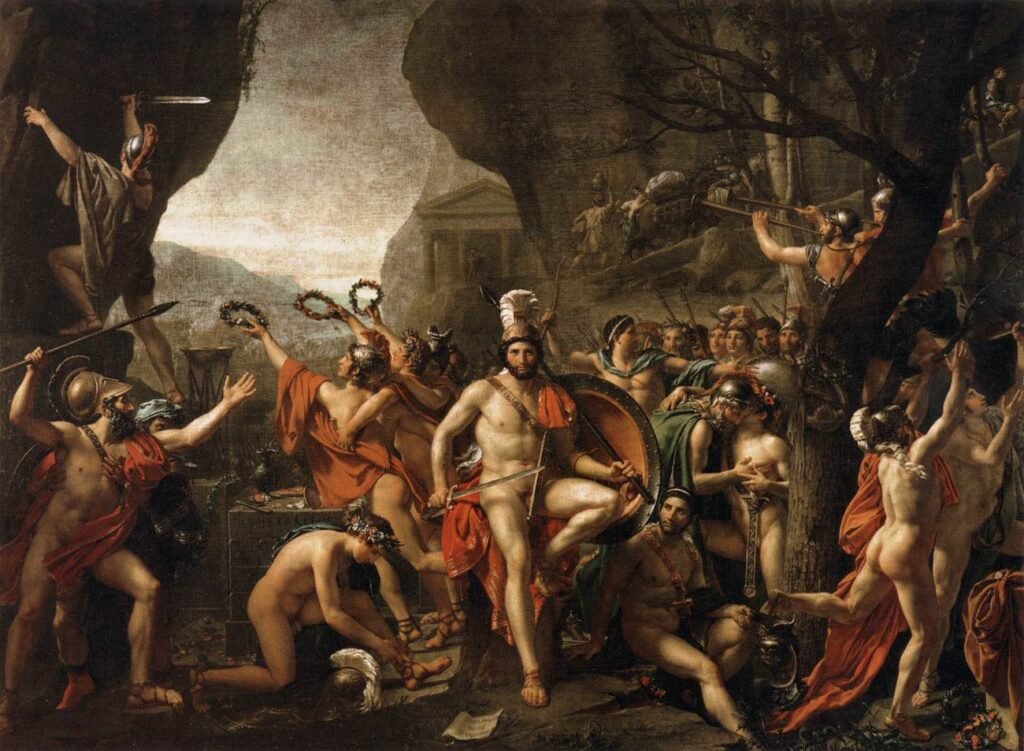
The Battle of Thermopylae was a three-day battle fought in August 480 BCE between a Greek alliance led by the Spartan king Leonidas and the invading Persian army of King Xerxes I. It took place at a narrow coastal pass in northern Greece. Although the Greeks were greatly outnumbered and were ultimately defeated, their stand became one of the most famous last stands in history.
Background of the Battle of Thermopylae
The battle was part of the Persian Wars. In 490 BCE, Greek forces led by Athens had defeated a Persian expedition at Marathon, but Persia, ruling the largest empire in the world, was far from beaten. When Xerxes I became king in 486 BCE after the death of his father Darius, he began massive preparations for a new invasion. His engineers dug a canal at Chalkidike and built boat bridges across the Hellespont so that his troops could cross into Europe.
News of the invasion alarmed the Greek states, which were often suspicious of one another. After much discussion and compromise, they sent a joint army of between 6,000 and 7,000 men to defend the pass at Thermopylae, through which any army had to pass to enter central Greece. A fleet of triremes, which are ancient warships, took up a position at Artemision, off the northern coast of Euboea, to stop the Persian navy from sailing down the coast.
The Spartan contribution was small: 300 hoplites, who are heavily armed infantrymen, led by King Leonidas. A World History Encyclopedia summary lists the other contingents, including about 2,120 Arcadians, 1,000 Phokians, 1,000 Lokrians, 700 Thespians, 400 Corinthians and 400 Thebans. The Greek historian Herodotus, whose account is the main ancient source, also records the Spartans, the Arcadians, the Corinthians, the Thespians and the Thebans. Some scholars suggest that Sparta sent few men because the Karneia religious festival and the Olympic Games limited fighting at that time.
The Greeks chose their position well. At Thermopylae, steep mountains run down to the sea and leave only a narrow path along the coast, in a gap about 15 meters wide in places. The local Phokians had fortified it with a wall, which the Spartans repaired. The Persian army is said to have been in the region of 80,000 men by modern estimates, although figures vary widely and no total is certain.
Course of the Battle of Thermopylae
Xerxes waited four days, expecting the Greeks to flee. When they did not, he sent envoys to demand that they lay down their weapons. According to tradition, Leonidas replied with the short phrase molon labe, which is usually translated as come and take them. The fighting then began.
In the first day’s fighting, Xerxes sent in Median and Kissian troops, and then his elite soldiers, called the Immortals. In the confined pass, the Greek phalanx, a tight formation of armored spearmen, held firm, and the Persians could not use their superior numbers. The Greeks reportedly used feigned retreats to draw their enemies forward before turning on them. The second day followed the same pattern.
The Greek position was ruined by betrayal. A local man named Ephialtes, from the district of Trachis, told Xerxes about a mountain track, known as the Anopaia path, that led around the Greek position. Herodotus identifies him as the son of Eurydemos and as a Malian, and says he later fled and had a price put on his head. He also mentions another story naming two different men as the guides, which he rejects. The Phokians, who had been posted to guard the track, withdrew to higher ground when the Persians approached, and the Persian column could pass.
Learning that the position was lost, Leonidas ordered most of the Greek army to withdraw. On the third day, he remained with a rearguard. This force included the surviving Spartans, 700 Thespians and 400 Thebans, according to the summary. The Greeks attacked the Persians in the widest part of the pass. Herodotus reports that most of their spears broke and that they kept fighting with swords. Leonidas was killed, along with other noted Spartans, and Herodotus says that two sons of King Darius also fell on the Persian side. The surviving Greeks, now surrounded and without their king, withdrew to a small hill and were overwhelmed. Whether the Thebans surrendered at this point is disputed among scholars.
Aftermath of the Battle of Thermopylae
At sea, the Persian fleet lost some 400 triremes in a storm off Magnesia and more in a second storm off Euboea. The naval battles at Artemision were indecisive, and after news of Leonidas’s defeat the Greek fleet withdrew to Salamis.
The Greek defeat opened the way into central Greece. Many states then submitted to Persia, and Athens itself was sacked. Yet the Greeks were not finished. They defeated the Persian fleet at Salamis in 480 BCE, and in the following year the Persian invasion was repulsed at the Battle of Plataea. Xerxes returned home and left his general Mardonius in command.
Neither Herodotus nor the modern summary used here offers a reliable total of the dead on either side, so casualty figures should be treated with caution.
Significance and legacy of the Battle of Thermopylae
Thermopylae soon acquired legendary status in Greece. Free men, according to later accounts, had sacrificed themselves to defend their way of life against foreign aggression. An epitaph attributed to the poet Simonides was set up at the site in honor of the Spartan dead. For later writers, the battle became the standard example of courage against overwhelming odds.
In practical terms, the stand delayed the Persians at a critical moment and gave the Greek alliance time to organize a defense. Its military lesson was also clear: in a narrow pass, a smaller force of well-armed infantry could hold back a much larger army, but only until the enemy found a way around.
The battle shaped the later story of Greece and especially of Athens, which grew in confidence after the victories at Salamis and Plataea. Historians still debate the numbers on both sides, the motives of the Greek states that sent few men, and how much of the traditional tale is fact, since most of it comes from one main source, written decades afterward.
Key facts
- The battle took place at a narrow pass in northern Greece in August 480 BCE and lasted three days.1
- A joint Greek army of about 6,000 to 7,000 men, including 300 Spartans under King Leonidas, defended the pass.12
- A local man named Ephialtes showed the Persians a mountain path that led around the Greek position.12
- Leonidas was killed in the last stand, and the Persian army then advanced into central Greece.12
- The Greek fleet defeated the Persians at Salamis in 480 BCE, and the invasion was repulsed at Plataea the next year.1
Related concepts
Quick checkHow did the Persians get behind the Greek position at Thermopylae?Show answer
A local man named Ephialtes told them about a mountain path, called the Anopaia path, that avoided the narrow pass.
Sources
- World History Encyclopedia, Battle of Thermopylae, https://www.worldhistory.org/thermopylae/
- Herodotus, The Histories, Book 7, Project Gutenberg edition, https://www.gutenberg.org/cache/epub/2456/pg2456.txt
Editorially reviewed by Specialty Digest Editorial TeamLast reviewed November 4, 2026Researched and drafted with AI assistanceReport an issue