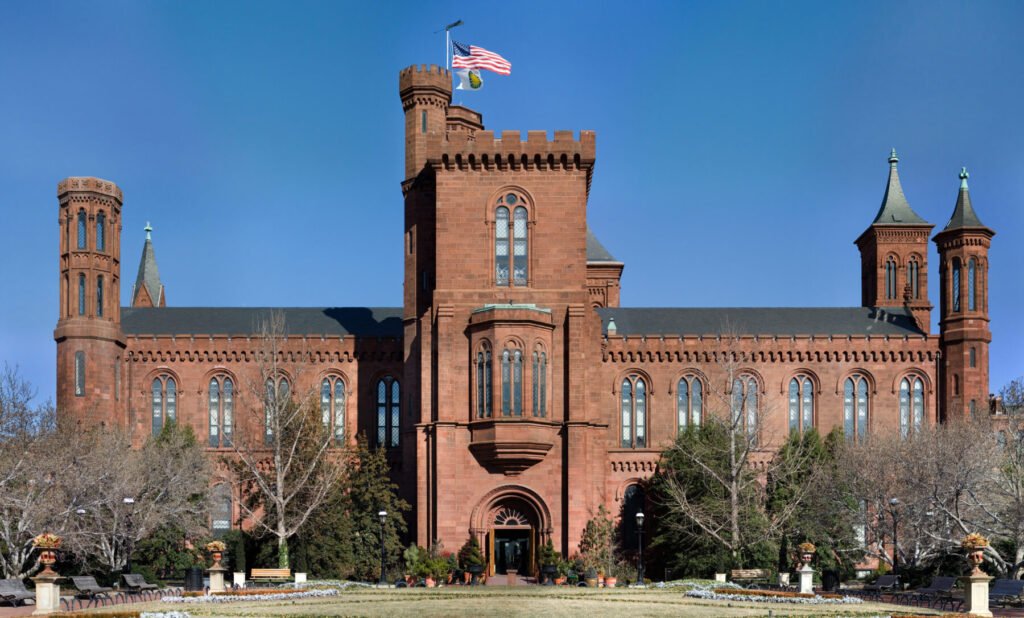
The Smithsonian Institution is a museum, education and research complex in the United States made up of 21 museums, the National Zoological Park and a set of research facilities. It was founded in 1846 with money left by the Englishman James Smithson, and it holds an estimated 157 million objects, works of art and specimens. Admission to all its museums in Washington, D.C. is free.
History of the Smithsonian Institution
The Smithsonian was founded in 1846 with funds from James Smithson (1765 to 1829), who left his estate to the people of the United States. Smithson’s wish was for an institution, under the name of the Smithsonian Institution, for “the increase and diffusion of knowledge.” That phrase is still how the Smithsonian states its mission.
Smithson died in 1829, and the Institution took shape in the years after. The federal statutes that govern it still trace parts of its rules, including how its governing board meets, to an act of 10 August 1846.
The Smithsonian Institution Building, known as the Castle, is among the sites it lists today alongside many later museums. In December 2020 Congress established two more museums, the National Museum of the American Latino and the Smithsonian American Women’s History Museum. As of 2025 neither has been built, and the proposed sites are on the National Mall.
Museums, zoo and research centers
The Institution’s 21 museums and galleries include the National Museum of Natural History, the National Museum of American History, the National Air and Space Museum, the National Museum of African American History and Culture and the National Museum of the American Indian. The list also includes the Anacostia Community Museum, the National Museum of African Art and the National Museum of Asian Art, which combines the Arthur M. Sackler Gallery and the Freer Gallery of Art. Others include the National Portrait Gallery, the Smithsonian American Art Museum, the Hirshhorn Museum and Sculpture Garden, the National Postal Museum and the Renwick Gallery.
Not every site is in Washington. The Cooper Hewitt, Smithsonian Design Museum and the George Gustav Heye Center of the National Museum of the American Indian are in New York City, and the Steven F. Udvar-Hazy Center of the Air and Space Museum is in Chantilly, Virginia. The Arts and Industries Building and the Smithsonian Institution Building, known as the Castle, were temporarily closed as of mid-2025.
The Smithsonian also runs research facilities. They include the Archives of American Art, the Smithsonian Conservation Biology Institute, the Smithsonian Astrophysical Observatory, the Smithsonian Environmental Research Center, the Museum Conservation Institute, the Smithsonian Libraries and Archives, the Smithsonian Tropical Research Institute and a marine station at Fort Pierce, Florida. The Institution describes itself as one of the foremost research centers in science, the arts and the humanities, and as a global organization active in conserving biodiversity and priceless art.
Collections and public reach
The Smithsonian estimates that it holds nearly 157 million objects, works of art and specimens. Nearly 148 million of them are scientific specimens at the National Museum of Natural History, so the great majority of the collection is research material rather than exhibition pieces.
Through its Affiliations program, long-term loans of collections and staff expertise reach more than 200 affiliates in nearly every state, Puerto Rico and Panama. The Smithsonian Institution Traveling Exhibition Service sends more than 40 exhibitions each year to hundreds of towns and cities across all 50 states and the District of Columbia.
The Institution is also heavily used online. In 2024 its home page had 150 million unique visitors, and its Collections Search Center holds more than 17 million images and records. It also offers more than 30 mobile apps and several digital magazines.
Funding and governance of the Smithsonian
A Board of Regents conducts the business of the Institution. By federal law it is made up of the Vice President, the Chief Justice of the United States, three Members of the Senate, three Members of the House of Representatives and nine other persons who are not members of Congress. Two of the nine live in Washington, and the other seven come from different states, with no two from the same state.
The Senate members are appointed by the President of the Senate, and the House members by the Speaker. A 1970 law authorized three additional members for the board.
The Smithsonian’s current federal appropriation is more than one billion dollars, and the Institution is about 62 percent federally funded, counting both the annual congressional appropriation and federal grants and contracts. The rest comes from trust funds and other non-federal money, which include private donations and endowments and revenue from Smithsonian Enterprises, whose business lines are magazines, e-commerce, product development, shops and cafes.
In September 2024 the Smithsonian launched a 2.5 billion dollar fundraising campaign called the Campaign for Our Shared Future. It aims to support four priority areas: sustainability and discovery, illuminating the nation’s past, opening pathways to new knowledge, and powering creativity and innovation. The campaign is scheduled to culminate with the 250th anniversary of the United States.
Legacy and impact of the Smithsonian
The Smithsonian began as a private gift to the American people. Its mix of free museums, a national zoo and scientific research stations makes it part of the educational life of the United States, and its traveling exhibitions and affiliate network extend that reach well beyond the capital.
The breadth of the Institution, which spans art, history, science and a national zoo, matches the general wording of its founding purpose. A single organization runs an astrophysical observatory, a tropical research institute and museums of American history and design, all under the same mission of increasing and spreading knowledge.
Key facts
- The Smithsonian was founded in 1846 with funds from the Englishman James Smithson (1765 to 1829).1
- The Smithsonian is a complex of 21 museums, the National Zoological Park and research facilities, and admission to its Washington museums is free.2
- The Smithsonian holds an estimated 157 million objects, works of art and specimens, nearly 148 million of them scientific specimens at the National Museum of Natural History.2
- The Institution is about 62 percent federally funded, with a federal appropriation of more than 1 billion dollars.2
- The Board of Regents includes the Vice President, the Chief Justice, three Senators, three Representatives and nine other persons.3
- The Smithsonian launched a 2.5 billion dollar campaign on 13 September 2024.2
Related concepts
In the news
Quick checkWho sits on the Smithsonian Board of Regents?Show answer
By federal law it includes the Vice President, the Chief Justice of the United States, three Senators, three House members and nine other persons.
Sources
- Smithsonian Institution. About the Smithsonian. Undated (accessed 4 November 2026)
- Smithsonian Institution. Facts About the Smithsonian Institution (media fact sheet). 18 June 2025 (accessed 4 November 2026)
- Legal Information Institute, Cornell Law School. 20 U.S. Code Section 42, Board of Regents; members. Undated (accessed 4 November 2026)
- U.S. Government Publishing Office. United States Code, Title 20, Chapter 3, Smithsonian Institution (sections 42 to 46 and notes). 2023 (accessed 4 November 2026)
Editorially reviewed by Specialty Digest Editorial TeamLast reviewed November 4, 2026Researched and drafted with AI assistanceReport an issue