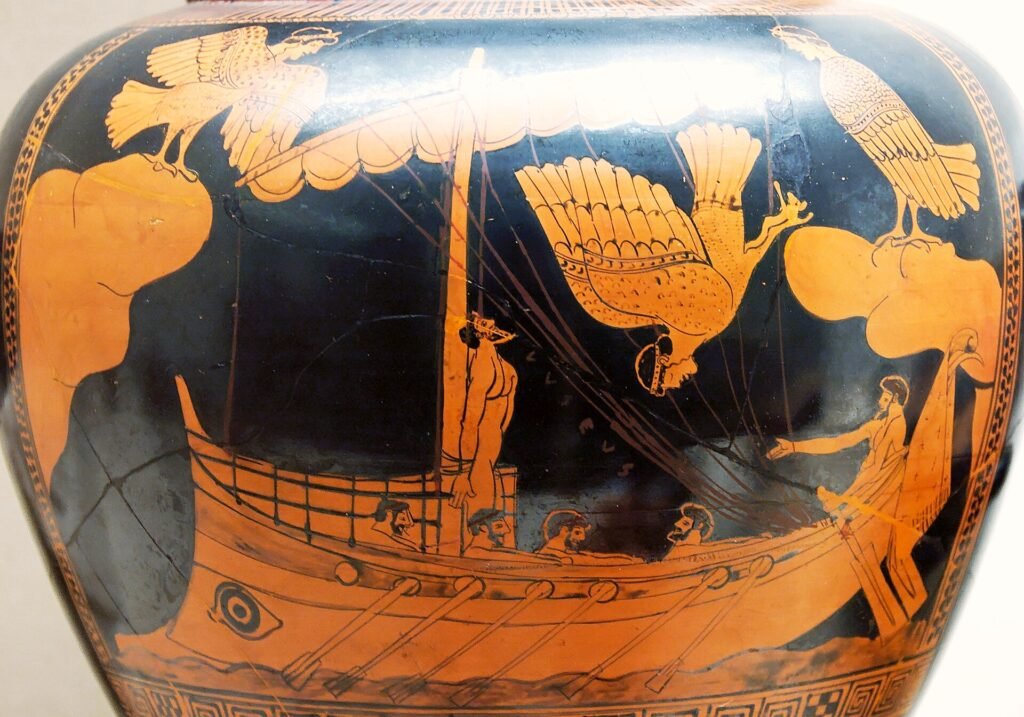
The Odyssey is an ancient Greek epic poem attributed to Homer that follows Odysseus, king of Ithaca, as he struggles to return home after the fall of Troy. It is divided into 24 books and is one of the two surviving epics credited to Homer, the other being the Iliad. Its date and authorship are debated, and tradition places Homer in the ninth or eighth century BCE.
Background and creation of The Odyssey
Almost nothing secure is known about Homer. The Poetry Foundation says that it is not even certain he existed, and it describes the traditional image of a blind Greek oral poet who lived in the ninth or eighth century BCE. The Italian encyclopedia Treccani notes that the ancient biographies of Homer are really romances, that many cities claimed to be his birthplace, among them Smyrna, Chios, Pylos, Ithaca, Argos and Athens, and that Herodotus guessed he lived around the middle of the ninth century BC, though it was only a hypothesis.
Whether one poet or many created the two epics is an old question. The Poetry Foundation asks whether they came from one genius or from many bards who reworked an oral tradition over generations. Treccani explains that in 1795 Friedrich August Wolf argued that poems on this scale were impossible without writing and proposed that they were assembled in the age of Pisistratus from separate songs. Treccani also reports that modern criticism has tended to credit a single early poet with the Iliad more than with the Odyssey.
The poem’s style points to oral roots. Treccani describes a language shaped by the dactylic hexameter, which produced fixed formulas that return again and again, and a mixture of Ionic with an older Aeolic layer.
Treccani also compares the two epics. The Odyssey assumes a political world in which monarchy is declining in the face of aristocracy and the popular assembly matters. Its religious ideas are more advanced than those of the Iliad. Unlike the Iliad, it has no real historical core, and its content is more directly legendary, though it relates to the Trojan War. Its wanderings are placed in the west.
Summary of The Odyssey
The summary below follows the book-by-book arguments in Samuel Butler’s public-domain prose translation, which uses the Roman names Ulysses and Minerva for Odysseus and Athena.
The poem opens with the gods in council and with Odysseus long absent. In Ithaca, a crowd of suitors consumes his household while his wife Penelope waits. His son Telemachus challenges them, then sails to Pylos to see Nestor and to Sparta to see Menelaus in search of news. Meanwhile the nymph Calypso is holding Odysseus on her island until the gods order his release. He sails on a raft and reaches Scheria, where he meets the princess Nausicaa and is welcomed at the palace of King Alcinous with a banquet and games.
At the banquet Odysseus tells his story. He describes the Cicones, the Lotus-eaters and the Cyclopes, then Aeolus, the Laestrygonians and the goddess Circe. He visits the dead, passes the Sirens and the monsters Scylla and Charybdis, and loses his crew after they eat the cattle of the Sun.
The Phaeacians send him home to Ithaca. He goes first to the hut of the swineherd Eumaeus, where Telemachus returns and learns his father’s identity. Disguised as a beggar, Odysseus enters his own house. He is insulted by suitors, recognized by his old dog Argos and by his nurse Eurycleia from a scar, and he speaks with Penelope. She sets a contest with the bow and iron axes. Odysseus wins it and kills the suitors, and Penelope finally accepts him as her husband. The last book shows the suitors’ ghosts in Hades, Odysseus visiting his father Laertes, and a peace arranged by the goddess.
Themes and interpretation of The Odyssey
Hospitality is a recurring test. Alcinous and Eumaeus treat a stranger well, and the suitors abuse their host’s household and a beggar who turns out to be its master. The poem often shows a person’s character through how he or she treats a guest.
Disguise and recognition are equally central. Odysseus is known in turn by a dog, a servant’s memory of a scar and, finally, his wife. Each recognition happens in a different way, so that the poem treats identity as something proved by loyalty and memory as much as by appearance.
Homecoming ties the plot together. The long wandering is not only a series of marvels but also a process by which Odysseus loses his men and returns alone, reclaiming his place after great cost.
Reception and legacy of The Odyssey
The Poetry Foundation says that the Iliad and the Odyssey provided the basis of ancient Greek education and culture, became the template for the epic poem for two thousand years, and served as the central text of classical humanities education through the Roman Empire and the spread of Christianity down to the nineteenth century. Treccani adds that already in antiquity Homer’s name came to stand for the best of epic poetry, and that ancient critics eventually narrowed the many poems credited to him to the Iliad and the Odyssey.
Ancient artists took scenes from the poem. The image above comes from an Attic red-figure stamnos, a type of jar, made around 480 to 470 BC and found at Vulci in Italy, and it shows Odysseus and the Sirens. Its Commons record gives the British Museum number E 440.
Project Gutenberg hosts Butler’s prose translation, the version used for the summary above. Because the poem sits at the start of the European literary tradition, it remains a basic text in the study of Greece and of world literature.
More in Literature
Key facts
- The Odyssey is an ancient Greek epic attributed to Homer and divided into 24 books.13
- It follows Odysseus, king of Ithaca, on his return from the Trojan War, while his wife Penelope and son Telemachus face suitors at home.3
- The Poetry Foundation places the traditional Homer in the ninth or eighth century BCE and says nothing certain is known of him.1
- Treccani says the Odyssey assumes a political world where monarchy is declining and its content is more legendary than that of the Iliad.2
- In 1795 Friedrich August Wolf proposed that the Homeric poems were assembled from separate songs in the age of Pisistratus.2
Related concepts
Quick checkWho wrote the Odyssey?Show answer
It is attributed to Homer, but whether one poet or many created it is still debated.
Sources
- Poetry Foundation, Homer, https://www.poetryfoundation.org/poets/homer
- Treccani, Enciclopedia on line: Omero, https://www.treccani.it/enciclopedia/omero/
- Project Gutenberg, The Odyssey, rendered into English prose by Samuel Butler (ebook 1727), https://www.gutenberg.org/ebooks/1727
Editorially reviewed by Specialty Digest Editorial TeamLast reviewed November 5, 2026Researched and drafted with AI assistanceReport an issue