The Iliad is an ancient Greek epic poem attributed to Homer that tells of the anger of the warrior Achilles during the Trojan War. It is divided into 24 books and ends with the funeral of the Trojan prince Hector, not with the fall of the city. It is one of two surviving epics credited to Homer, the other being the Odyssey.
Background and creation of The Iliad
Little is known about the poet. The Poetry Foundation describes Homer as a figure culturally pictured as a blind oral poet of the ninth or eighth century BCE, and it says that scholars do not know whether the Iliad and the Odyssey were the work of one genius or of many bards who reworked an oral tradition over generations.
The Italian encyclopedia Treccani gives more detail. It explains that the ancient Greeks credited Homer with many poems, but that over time the Iliad and the Odyssey were singled out, and that the Iliad was the more famous, so that the poet, Homer and the Iliad were often treated as the same thing. According to Treccani, modern criticism is fairly agreed that, if an early poet named Homer existed, the Iliad is the work to credit to him, or the greater part of it, with later additions made by others. Herodotus guessed that Homer lived around the middle of the ninth century BC, but Treccani calls that only a hypothesis.
The poem rests on a war story that its audience already knew. Treccani says the Iliad presumes a conflict in which a confederation of independent Greek princes marched against Troy, which was helped by allied princes from Asia Minor. The legend probably has a historical core, though like every epic it is hard to reconstruct and cannot be pinned down exactly. Excavations at the site, begun by Heinrich Schliemann and continued by Wilhelm Dörpfeld, are covered in the entry on the discovery of Troy.
Treccani adds a clue about the poet’s setting. A prophecy in the twentieth book says that the descendants of Aeneas will later rule in the Troad. This suggests that the poet may have sung at the court of a prince of that region who claimed descent from Aeneas.
The style shows oral roots. Treccani notes that the dactylic hexameter led to fixed formulas that recur throughout, and that the epic dialect combines Ionic with an older Aeolic layer.
Summary of The Iliad
This summary follows the book-by-book arguments in Samuel Butler’s public-domain prose translation, which uses Roman names such as Jove, Juno and Minerva for the Greek gods Zeus, Hera and Athena.
The first book opens with a quarrel between the Greek leader Agamemnon and Achilles. Achilles withdraws from the war and sends his mother Thetis to ask Jove to help the Trojans. After the Greek and Trojan forces are listed, Paris challenges Menelaus to a duel while Helen and King Priam watch from the wall. The truce breaks when an arrow wounds Menelaus.
Fighting follows over many books. Diomedes has a great day of battle, and Hector meets his wife Andromache. Hector fights Ajax until night parts them, and the Greeks build a wall around their ships. An embassy goes to Achilles to ask him to return, but he stays out of the war. Jove then favors the Trojans, who break the wall and reach the ships.
Patroclus fights in the armor of Achilles, drives the Trojans back and is killed by Euphorbus and Hector. Achilles grieves, and his mother has new armor made for him by the smith god Vulcan, called Hephaestus in Greek. He is reconciled with Agamemnon and returns to battle. He kills many Trojans, fights the river Scamander and finally kills Hector in book 22.
The last two books turn from fighting to mourning. Achilles holds the funeral and games of Patroclus. Then King Priam comes to ransom his son’s body, and the poem closes with the funeral of Hector.
Themes and interpretation of The Iliad
The first line names the poem’s subject: the anger of Achilles, which Butler’s translation says brought countless ills upon the Achaeans, as the poem calls the Greeks. The plot is organized around that anger, its cost and its end. Achilles’ withdrawal causes Greek losses. His return and his killing of Hector come after the death of his friend Patroclus.
The gods are active in the story. They quarrel on Olympus, rescue favorites and sometimes persuade mortals to break oaths, so the poem shows human choices and divine intervention working together. Because the gods take sides, the war is never only a human affair.
The final books bring out a different theme, grief. The poem lingers on mourning for Patroclus and Hector and ends not with a victory but with a father ransoming a body and a funeral. For many readers this ending is the poem’s central statement about war and loss, though the text itself leaves the interpretation open.
Reception and legacy of The Iliad
The Poetry Foundation counts the Iliad and the Odyssey among the most influential works in Western civilization. They provided the basis for ancient Greek education and culture, became the model for epic poetry for two thousand years, and served as the central text of classical humanities education through the Roman Empire, the spread of Christianity and the nineteenth century.
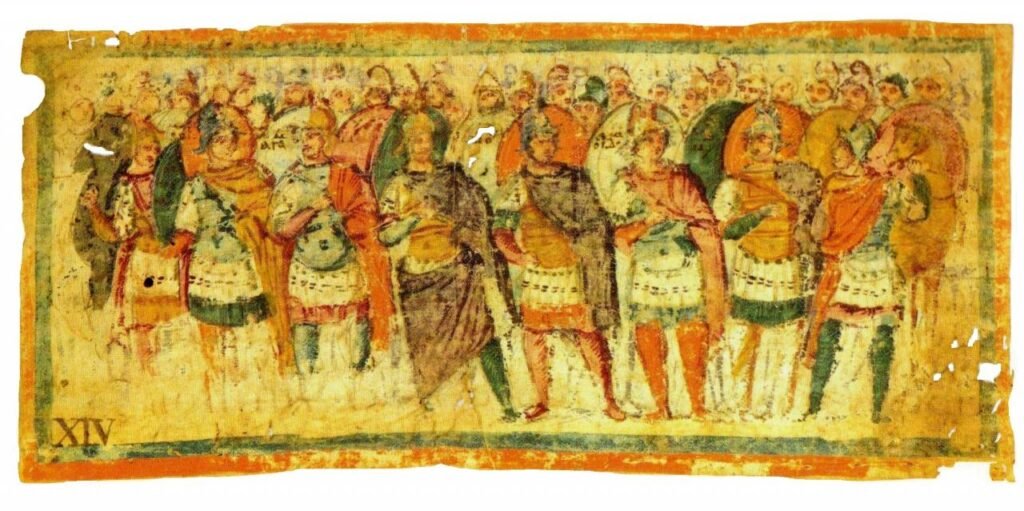
Manuscripts carried the poem across the centuries. The image above is a miniature from the Ambrosian Iliad, an illustrated manuscript kept at the Biblioteca Ambrosiana in Milan. Project Gutenberg hosts Butler’s prose translation for modern readers, and the story’s setting links to Greece and to the ancient site of Troy in Asia Minor.
More in Literature
Key facts
- The Iliad is an ancient Greek epic attributed to Homer and divided into 24 books.13
- It begins with the quarrel between Agamemnon and Achilles and ends with the funeral of Hector.3
- The Poetry Foundation places the traditional Homer in the ninth or eighth century BCE and says it is unknown whether one poet or many created the epics.1
- Treccani says modern criticism tends to credit the Iliad, rather than the Odyssey, to a single early poet.2
- Treccani says the Iliad probably rests on a historical core, though it is hard to reconstruct.2
Related concepts
Quick checkHow does the Iliad end?Show answer
With the funeral of the Trojan prince Hector after King Priam ransoms his body from Achilles.
Sources
- Poetry Foundation, Homer, https://www.poetryfoundation.org/poets/homer
- Treccani, Enciclopedia on line: Omero, https://www.treccani.it/enciclopedia/omero/
- Project Gutenberg, The Iliad, rendered into English prose by Samuel Butler (ebook 2199), https://www.gutenberg.org/ebooks/2199
Editorially reviewed by Specialty Digest Editorial TeamLast reviewed November 5, 2026Researched and drafted with AI assistanceReport an issue