Tolerance is an easy word to praise and a hard one to practice. Each year on November 16, the world pauses to ask what it really requires. The International Day for Tolerance, led by UNESCO, is not a call to put up with everything. It is a call to respect people who differ from us in culture, belief, language or way of life, and to defend the rules that protect them. At a time when millions of people have been uprooted from their homes and hateful speech travels around the world in seconds, the question is practical, not abstract. This article explains where the day came from, what the word means in the text that created it, what the numbers say about why it matters, and what everyday action looks like.
From a UN Year to a yearly day
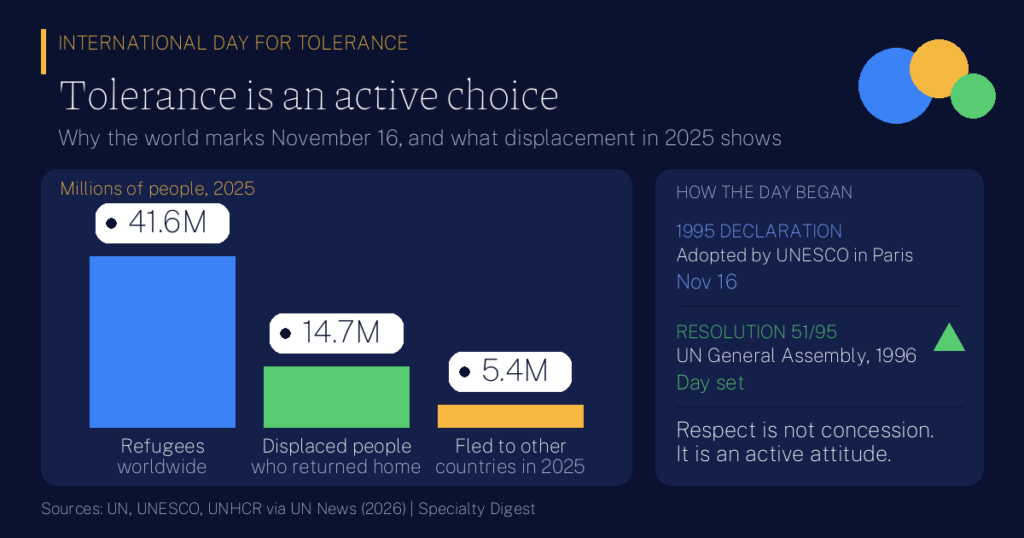
The story begins with the United Nations Year for Tolerance, 1995, which the General Assembly proclaimed in 1993 at the initiative of UNESCO. At its 28th session, held in Paris from October 25 to November 16, 1995, UNESCO’s General Conference adopted the Declaration of Principles on Tolerance on the final day. That date became the date of the observance. In 1996 the General Assembly, by resolution 51/95, invited Member States to observe the International Day for Tolerance on November 16.
A prize followed the same logic. The UNESCO-Madanjeet Singh Prize for the Promotion of Tolerance and Non-Violence was created in 1995 by UNESCO’s Executive Board to mark the Year for Tolerance, and it was first awarded in 1996. It carries US$100,000 and is given every two years on November 16. The 2026 ceremony, the prize’s 30th anniversary, is scheduled for UNESCO Headquarters in Paris.
What tolerance means, and what it does not
The Declaration opens with a definition that is worth reading slowly. Article 1 says tolerance is “respect, acceptance and appreciation of the rich diversity of our world’s cultures.” It calls tolerance “harmony in difference” and states that it is “not only a moral duty, it is also a political and legal requirement.” That last phrase matters. Tolerance here is not a mood or a courtesy. It is part of how a fair society is organized.
Just as important is what the text rules out. Article 1.2 says tolerance is “not concession, condescension or indulgence.” Instead it is “an active attitude prompted by recognition of the universal human rights and fundamental freedoms of others.” In plain words, tolerance does not mean giving up your own beliefs, and it does not mean pretending that every act is acceptable. It means recognizing that other people hold the same basic rights you do, and acting on that recognition.
Example 1: the lunchroom. Imagine a school of 500 students in which 100 speak another language at home. A tolerant school does not simply allow those 100 students to sit quietly in the corner. It makes sure the rules apply equally, the notices are understood, and every student can take part in clubs and sports. The numbers are round and illustrative, but the idea is the Declaration’s: tolerance is shown by what a community does, not by what it merely puts up with.
A declaration with six parts
The Declaration is short and well organized. After a preamble it has six articles, and the sequence tells a story. It starts with meaning, then asks what governments must do, how society works, and what schools can do. It ends with a commitment to act and with the creation of the day itself. Article 6 solemnly proclaims November 16 as the annual International Day for Tolerance.
The numbers behind the day
Intolerance shows up in many ways, and no single statistic captures it. One measurable sign is forced displacement, because people most often flee when they are persecuted for who they are or what they believe, or when conflict erupts. UNHCR’s Global Trends report, released in June 2026, found that the number of refugees worldwide fell by 3 percent in 2025, to 41.6 million. That was the first decline in a decade. During 2025, 5.4 million people fled to other countries to escape violence and persecution, while 14.7 million displaced people returned to their areas or countries of origin, among them 4.4 million refugees and 10.3 million people displaced within their own countries.
- 81,800resettlement or sponsorship arrivals in 2025, down by more than half
- 46,000stateless people gained citizenship in 24 countries in 2025
- 70%of refugees remain in exile for years
- 30 yearssince the Madanjeet Singh Prize was first awarded, in 1996
Example 2: a host town. Suppose a town of 20,000 residents receives 2,000 newcomers who fled conflict. Newcomers are then one in ten people on the street. If local leaders share facts, open school places and treat disputes by the same rules for everyone, the town can adjust. If rumors spread unchecked, fear can harden into hostility. The figures are made up and rounded, but the lesson is the one the Declaration draws: tolerance is built by institutions and habits, not only by good feelings.
Words matter: the hate speech connection
Intolerance often starts with language. The UN Strategy and Plan of Action on Hate Speech was launched by Secretary-General António Guterres on June 18, 2019, and the UN describes it as the first UN-wide initiative to tackle the problem. In 2021 the General Assembly adopted resolution A/RES/75/309, which proclaimed June 18 as the International Day for Countering Hate Speech. The UN’s working definition covers any communication in speech, writing or behavior that attacks or uses pejorative or discriminatory language about a person or group because of who they are. The UN notes that hate speech is rising around the world, and Mr. Guterres has described it as an alarm bell, warning that the louder it rings, the greater the threat of genocide. The two days work together: tolerance is the positive habit, and countering hate speech is the guard against its opposite.
Who is left behind, and how the day is marked
Those who feel intolerance first are usually people on the margins: religious and ethnic minorities, migrants and refugees, stateless people, and anyone whose identity differs from the local majority. The Declaration points toward the most lasting remedy, which is education. Its Article 4 gives education a central place, and schools are where children first meet people unlike themselves. It is also why the day’s events are so often aimed at young people. The UN Alliance of Civilizations, for example, runs the PLURAL+ youth video festival, launched in 2009.
Example 3: one classroom. Picture a class of 30 students in which three have been teased for the way they dress or speak. That is 1 in 10. A teacher who sets one clear rule, that everyone is addressed with respect and reports are taken seriously, reaches all 30. The count is illustrative, but the principle is real: small, consistent rules protect the few without costing the many anything.
On November 16 you will find UNESCO events, school lessons and cultural programs around the world, along with the ceremony for the Madanjeet Singh Prize in Paris in 2026. You do not need an event to take part. You can learn about a neighbor’s tradition, speak up when a joke targets a group, and report threats and hate crimes to local authorities or your national human rights institution if you or someone you know is targeted. Dignity has many foundations, and basic services matter too; see World Toilet Day for another day that links dignity to everyday life.
Key Takeaways
- The date has a source. November 16 is the day UNESCO’s Member States adopted the Declaration of Principles on Tolerance in 1995.
- The UN made it official in 1996. General Assembly resolution 51/95 invited Member States to observe the day.
- Tolerance is active. The Declaration says it is not concession, condescension or indulgence, but an attitude rooted in human rights.
- It is also a legal and political requirement. Article 1 calls it more than a moral duty.
- Displacement shows the stakes. There were 41.6 million refugees worldwide in 2025, and 5.4 million people fled to other countries during that year.
- Words and schools both matter. The UN links hate speech to wider harm, and the Declaration treats education as central.
- Everyone can act. Learning, speaking up respectfully and reporting hate crimes are all ways to give the day meaning.
How solid is this? The dates, resolution numbers and quoted definitions come from UN and UNESCO pages. The 2025 displacement figures are UNHCR numbers as reported by UN News in June 2026 and may be revised in later reports. The three worked examples use round, made-up numbers to show an idea. The exact calendar date of resolution 51/95 is not stated on the pages consulted, so only the year is given. See also the International Days hub and the International Days Calendar.
More in Society
- United Nations, International Day for Tolerance
- UNESCO, International Day for Tolerance
- UNESCO, Declaration of Principles on Tolerance (1995)
- UNESCO, UNESCO-Madanjeet Singh Prize for the Promotion of Tolerance and Non-Violence
- UNESCO, 2026 award ceremony of the Madanjeet Singh Prize
- UN News, Refugee numbers drop for first time in a decade (June 2026)
- United Nations, Say #NoToHate