Every adult was a child once, yet children are the people with the least power over the decisions that shape their lives. They cannot vote, sign contracts or sit in parliaments. World Children’s Day, observed every year on November 20, exists to remind the world that childhood is not a waiting room for adult life. It is a stage with its own rights, and those rights have been written into international law. The day is a promise renewed once a year, and a checkpoint for how well it is being kept.
How November 20 became children’s day
The idea is older than the date. By resolution 836(IX) of December 14, 1954, the United Nations General Assembly recommended that all countries institute a Universal Children’s Day. The resolution did not fix a calendar date. It suggested that governments observe the day on the date and in the way each considers appropriate. Many countries chose their own, which is why you may see children’s days on other dates around the world.
November 20 became the common reference point because of two decisions by the Assembly on that date. In 1959 it adopted the Declaration of the Rights of the Child. On November 20, 1989 it adopted the Convention on the Rights of the Child, without a vote. UNICEF now uses the date as its annual day of action for children.
Example 1: a classroom vote. Imagine a class of 30 children deciding how to use a shared reading corner. The teacher asks every child to speak before the class chooses. Some will be shy and some will be loud, but each opinion gets a hearing and the final choice takes account of all of them. The numbers are made up, but the habit is the one the Convention asks adults to practice: listen to children on matters that affect them.
What the Convention actually says
The Convention on the Rights of the Child is a treaty, so countries that join it accept legal duties. The UN describes it as the most widely ratified international human rights treaty. UNICEF’s count, published in 2015, was 196 states parties, with the United States the only country not to have ratified it, although it has signaled an intention to do so. Check the UN Treaty Collection for the current list.
UNICEF describes four guiding principles that run through the whole text. The first is non-discrimination: every child has the same rights. The second is that the best interests of the child are a primary consideration in all actions concerning children. The third is the inherent right to life and the obligation to ensure the survival and development of the child. The fourth is the child’s right to express views freely in all matters affecting the child, with those views given due weight.
The numbers: poverty is more than money
The flagship report launched on World Children’s Day 2025, UNICEF’s State of the World’s Children 2025: Ending child poverty, measures child poverty in two ways. One is money. More than 19 percent of children in low- and middle-income countries live in extreme monetary poverty, defined as living on less than $3 a day. The other counts what children go without in six areas: education, health, housing, nutrition, sanitation and water.
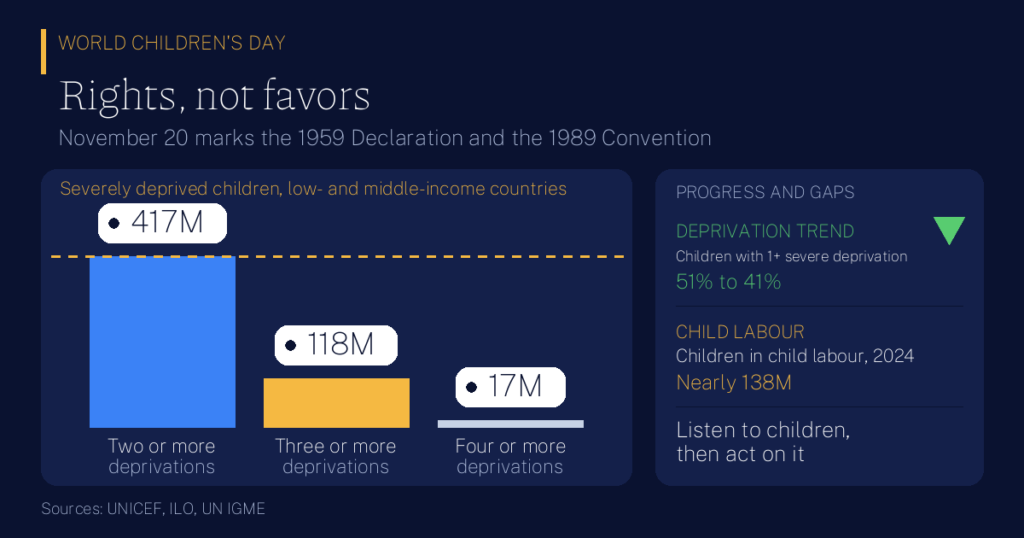
By that second measure, 417 million children in low- and middle-income countries were severely deprived in at least two of the six areas, more than 1 in 5. Of these, 118 million faced three or more deprivations and 17 million faced four or more. Progress is visible: the share of children with at least one severe deprivation fell from 51 percent in 2013 to 41 percent in 2023. Poverty is not only a problem of poorer countries, either. About 50 million children in 37 high-income countries, 23 percent, live in relative monetary poverty.
Example 2: counting deprivations. Picture a child in a village where the household has no safe toilet and no clean water source nearby, though the child attends school and eats enough. That child faces two severe deprivations, and under the measure described above would be counted among the group facing at least two. The village is invented, but it shows why the count looks past income alone. The sanitation link is explored in our article on World Toilet Day.
Survival and work: two unfinished stories
The most basic right is the right to life, and here the long-run record is encouraging. The UN Inter-agency Group for Child Mortality Estimation reports that the global under-five mortality rate has fallen by 52 percent since 2000. Even so, an estimated 4.8 million children died before their fifth birthday in 2023. Of these, 2.3 million were newborns in their first 28 days and 2.5 million were aged 1 to 59 months. A further 2.1 million young people aged 5 to 24 also died that year. The group warns that, on current trends, an estimated 30 million children could die before their fifth birthday by 2030.
Example 3: what a 52 percent fall means. Suppose that in 2000 a country lost 100 children in every 1,000 births before age five. A 52 percent fall would bring that to 48 per 1,000. The figure is made up for clarity, but it shows both sides of the story: a huge improvement, and 48 families in every 1,000 still grieving.
Work is the other unfinished story. UNICEF and the International Labour Organization estimate that nearly 138 million children were in child labour in 2024. That is more than 100 million fewer than in 2000, even though the child population grew by 230 million over the same period. The agencies also note that the feared deterioration after COVID-19 did not materialize. Progress is real, and the remaining number is still very large.
- 417 millionchildren severely deprived in two or more areas, 2025 report
- 4.8 millionchildren died before age five, 2023
- 52%fall in the under-five mortality rate since 2000
- 138 millionchildren in child labour, nearly, in 2024
How the day is marked, and what progress needs
UNICEF organizes the day as a day of action for, and with, children. In 2025 the theme was “My day, my rights.” Children took over high-profile roles in media, politics, business and sport, UNICEF ran a global poll asking whether children’s rights are being fulfilled, and landmarks and buildings were lit blue. National events included a dialogue in Sierra Leone with child representatives from all 16 districts and a regional State of the Children Address in Botswana. The 2026 theme was not confirmed in the sources checked for this article, so see UNICEF’s World Children’s Day page for it.
The evidence points to a clear agenda: reduce poverty in all its forms, keep health systems reaching newborns, put children in school instead of work, and ask children what they need. Most of all, it asks adults to treat the Convention as a standard to measure budgets and laws against, not a poster on a wall.
- 1954Assembly recommends a Universal Children’s Day
- 1959Declaration of the Rights of the Child
- 1989Convention on the Rights of the Child
- 2025My day, my rights
Key Takeaways
- The day rests on two decisions. The Assembly adopted the 1959 Declaration and the 1989 Convention on November 20.
- The Convention is close to universal. The UN calls it the most widely ratified human rights treaty, and UNICEF’s 2015 count was 196 states parties.
- Four principles guide it. Non-discrimination, best interests, life and development, and the child’s voice.
- Poverty is multidimensional. 417 million children face at least two severe deprivations, and the share with at least one fell from 51 to 41 percent between 2013 and 2023.
- Survival gains are real but incomplete. The under-five mortality rate is down 52 percent since 2000, yet 4.8 million children died before age five in 2023.
- Child labour is falling, not gone. Nearly 138 million children were in child labour in 2024.
- Listening is a right. Ask the children you know what they think, and let it shape decisions that affect them.
How solid is this? Mortality and poverty figures are modeled estimates from UN and UNICEF reports and are revised as new data arrive. The ratification count dates from 2015 and should be checked against the UN Treaty Collection. The three worked examples use round, made-up numbers. See also the International Days hub and the International Days Calendar.
More in Society
- United Nations, World Children’s Day: Background
- UNICEF, History of child rights
- UNICEF, Frequently asked questions on the Convention on the Rights of the Child
- UNICEF, World Children’s Day 2025 highlights
- UNICEF, press release on The State of the World’s Children 2025 (November 20, 2025)
- UN IGME via UNICEF DATA, Levels and trends in child mortality
- ILO and UNICEF, Child Labour Global Estimates 2024