A tsunami is rare in any one place and in any one lifetime, which is exactly why it is dangerous. Communities forget, coastlines fill with people, and the next wave arrives to a generation that has never seen one. World Tsunami Awareness Day, observed every year on November 5, exists to interrupt that forgetting. It asks a simple question of everyone who lives, works or travels near the sea: if the ground shook right now, would you know what to do?
From a burning rice field to a United Nations day
In December 2015, the UN General Assembly designated November 5 as World Tsunami Awareness Day. The date was not chosen at random. On November 5, 1854, a magnitude 8.4 earthquake sent a massive tsunami toward the Kii Peninsula in Japan. According to the UN, a village leader named Goryo Hamaguchi set fire to piles of newly harvested rice in his own field. The blaze drew his neighbors up to high ground in the darkness, and many lives were saved. The story is told in Japan as “The Fire of Inamura.”
The first observance took place in 2016, with the theme “Education and Evacuation Drills.” That theme still sets the tone. The day is less about mourning past waves than about teaching ordinary people to act in the minutes that matter, and it sits alongside the UN’s wider work on disaster risk reduction, which UNDRR leads.
What a tsunami really is
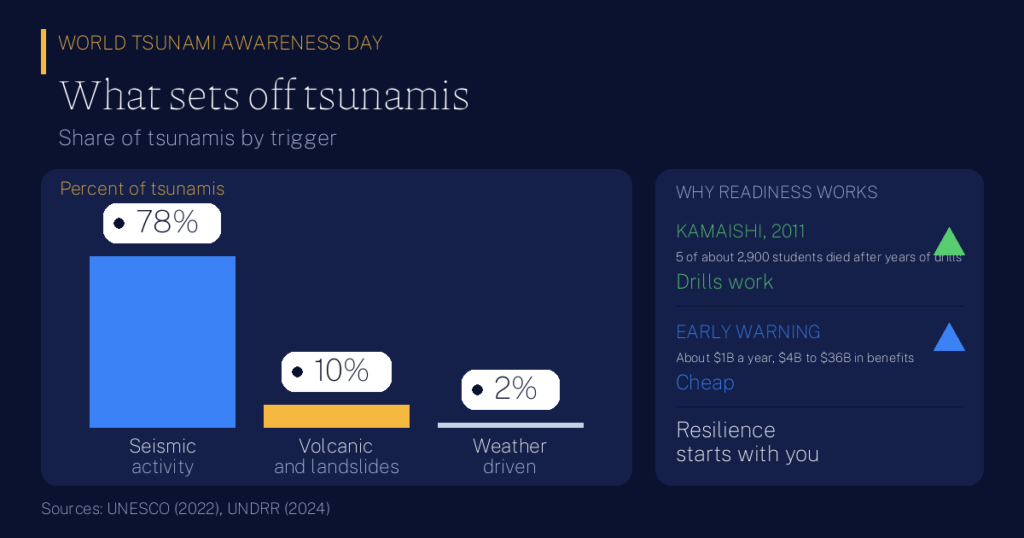
The word comes from Japanese and is usually translated as “harbor wave.” The image is misleading. A tsunami is not a single towering breaker but a series of long surges, set off when a large volume of water is suddenly displaced. Most often the trigger is an earthquake under the seabed, but eruptions and landslides can do it too. In a 2022 release, UNESCO put the shares at 78 percent from seismic activity, 10 percent from volcanic activity and landslides, and 2 percent from meteorological activity.
Example 1: why a quake is a warning. Imagine a seaside town where the ground shakes hard for a full minute. Nothing has flooded yet and the water looks calm. The shaking itself is the alarm. The town does not wait for a siren or a phone alert, because the earthquake that shook it may also have launched a wave. The numbers here are not data, only a picture of the rule UN agencies teach.
The numbers behind the day
Tsunamis are uncommon but severe. The UN reported in 2016 that between 1996 and 2015, 250,900 people died in 21 countries affected by 30 tsunamis. The deadliest on record is the Indian Ocean tsunami of December 26, 2004. UNDRR, citing the European Commission, says it killed over 230,000 people and left 2 million homeless around the Indian Ocean, with waves up to 30 meters high. Banda Aceh in Indonesia was struck about 20 minutes after the earthquake. Counts of affected countries differ between UN pages, 14 on some and 17 on others, so treat that detail with care.
Japan’s earthquake and tsunami of March 11, 2011 left more than 18,000 people dead or missing, according to the UN. Yet the same event produced one of the most hopeful figures in disaster education, discussed below.
Why the same wave kills in one place and not another
The tallest wave ever recorded was not the deadliest. UNDRR notes that a 1,720 foot tsunami towered over Lituya Bay in Alaska in 1958 and claimed five lives, because few people were around. By contrast, the 2004 disaster was made so lethal by the hundreds of hotels and businesses built in a tsunami risk zone. In UNDRR’s words, tsunamis are only devastating if people and their livelihoods get in the way.
That sentence explains the whole logic of the day. Nobody can stop the ocean from moving. Societies can, however, decide where to build, how to warn, and how to teach. Hazard is natural. Disaster is a human outcome.
Natural warning signs and the Kamaishi lesson
Official alerts matter, but UNDRR’s day page lists the signs nature gives: strong or prolonged ground shaking, an unusual rise or recession of the sea, and a loud ocean roar. The guidance that follows each of them is the same: move immediately to high ground or inland, without waiting to be told, and know your local evacuation routes in advance.
Training works. In Kamaishi, Japan, only 5 of approximately 2,900 elementary and junior-high students died in 2011, a result UNDRR calls the “Kamaishi Miracle.” The children had practiced evacuation and acted on their own.
- 5 of 2,900Kamaishi students who died in 2011, after years of drills
- 100%of at-risk coastal communities UNESCO aims to make Tsunami Ready by 2030
- 40pilot communities trained in 21 countries by 2022
- 23,000lives saved each year by modern early warning, a WMO-based estimate
Example 2: the value of a drill. Suppose a school practices its route to high ground twice a year, and the walk takes 12 minutes. On a real day, nobody has to decide where to go, which is when people lose precious time. The figures are round and made up, but the idea matches the Kamaishi story: rehearsal turns a frightening choice into a habit.
Warning systems and the money question
Warnings are among the best bargains in disaster policy. UNDRR cites a global analysis that estimates US$4 billion to US$36 billion in annual benefits for roughly US$1 billion invested each year in modern early warning, including approximately 23,000 lives saved annually (WMO, 2024, and others). It adds that universal access to early warnings for storms, floods and tsunamis can reduce asset losses by up to 20 percent, preventing about US$13 billion in damage annually.
Example 3: a coastal budget. Imagine a region spends $2 million a year on sirens, sea-level sensors and drills, and a single warning prevents $20 million in losses over a decade. The numbers are illustrative only, but they show the shape of the argument: preparation costs little compared with rebuilding.
How the day is marked and what 2026 asks
UNESCO’s Intergovernmental Oceanographic Commission runs the Tsunami Ready programme, which trains communities and recognizes those that meet its standards. UNESCO set the aim that 100 percent of coastal communities would be Tsunami Ready by 2030. The 2026 theme, in the Secretary-General’s message, is “Be tsunami ready: Resilience starts with you.” It calls for knowing the warning signs, preparing household emergency plans, joining drills, and helping people who may need extra support, including people in informal settlements, children, older persons and persons with disabilities.
- 2016Education and Evacuation Drills
- 2026Be tsunami ready: Resilience starts with you
Key Takeaways
- The day honors an act of foresight. November 5 recalls the 1854 rice fire that guided villagers to safety.
- Earthquakes cause most tsunamis. UNESCO puts the seismic share at 78 percent, so strong shaking is itself a warning.
- Exposure decides the toll. A 1,720 foot wave killed five people, while the 2004 tsunami killed over 230,000.
- Know nature’s signs. Prolonged shaking, a strange sea level or a roar means move to high ground at once.
- Drills save children. In Kamaishi, 5 of about 2,900 students died in 2011.
- Warning is cheap. About $1 billion a year is estimated to bring $4 billion to $36 billion in benefits.
- Resilience starts with you. Learn your evacuation route and help neighbors who may need support.
How solid is this? Death tolls for large tsunamis are estimates, and UN pages differ on the number of countries hit in 2004. The early warning benefits are modeled global estimates, not tsunami-only figures. The Tsunami Ready count of 40 pilot communities dates from 2022 and has grown since. The three worked examples use round, made-up numbers. See the International Days hub and the International Days Calendar.
More in Science
- UNDRR. World Tsunami Awareness Day.
- UN Secretary-General. World Tsunami Awareness Day 2026 message (5 November 2026).
- UNESCO. Tsunami resilience: UNESCO will train 100% of at-risk coastal communities by 2030 (2022).
- UNDRR. The tallest tsunami wave ever wasn’t the deadliest (2021).
- UNDRR. The day the wave came: 20 years after the Indian Ocean tsunami (2024).
- UN News. Feudal-era Japanese village leader stands as beacon for tsunami education (2016).