When countries disagree, scientists often keep talking. Their measurements, instruments and shared questions make a kind of common ground that politics struggles to build. The International Week of Science and Peace, held each year in the week that contains November 11, asks the world to notice that ground and to protect it. It is a quieter observance than many on the calendar, yet it carries a bold idea: knowledge shared across borders can lower the risk of conflict.
Where the week comes from
The week was set up by the United Nations General Assembly, and the UN lists it each year under its international days and weeks. The rule is simple. It is observed during the week in which November 11 falls, so the dates move slightly. In 2026 the UN lists it as November 9 to 15. The week sits beside a better known date, World Science Day for Peace and Development, celebrated every November 10 and led in the UN system by UNESCO.
UNESCO describes that day as a chance to highlight the role of science in society and to engage the wider public in debates about emerging scientific issues. It names four aims: strengthen public awareness of science for peaceful and sustainable societies, promote national and international solidarity, renew commitment to scientific cooperation, and draw attention to the challenges science faces. The 2026 theme is Common ground through science diplomacy.
What science for peace actually means
It does not mean that scientists are always peaceful, or that research is always used well. It means that the habits of science, such as sharing data, checking each other work and relying on evidence, can build trust between people who have little else in common. Trust tends to grow in steps. First people share findings. Then they share costly instruments that no single country could afford alone. In the strongest cases they agree on shared rules.
Example 1: the shared telescope. Suppose a telescope costs $900 million to build. No single one of three neighboring countries could pay it alone, but each paying $300 million can. Once built, all three depend on it, and all three have a reason to keep relations steady so it keeps running. The numbers are round and illustrative, but the logic is the one behind many real shared facilities.
Milestones in cooperation
History offers concrete cases. CERN, the European physics laboratory, was founded in 1954 under the auspices of UNESCO, and UNESCO calls its birth one of the first large initiatives in science and science diplomacy at the organization. In 1955 the Russell-Einstein Manifesto, made public in London, warned of the dangers of nuclear weapons and urged scientists to act. It led to the first Pugwash conference in 1957 in Nova Scotia, Canada. In 1995 the Nobel Peace Prize went jointly to the Pugwash Conferences and Joseph Rotblat for their efforts to diminish the part played by nuclear arms in international politics.
The numbers behind the idea
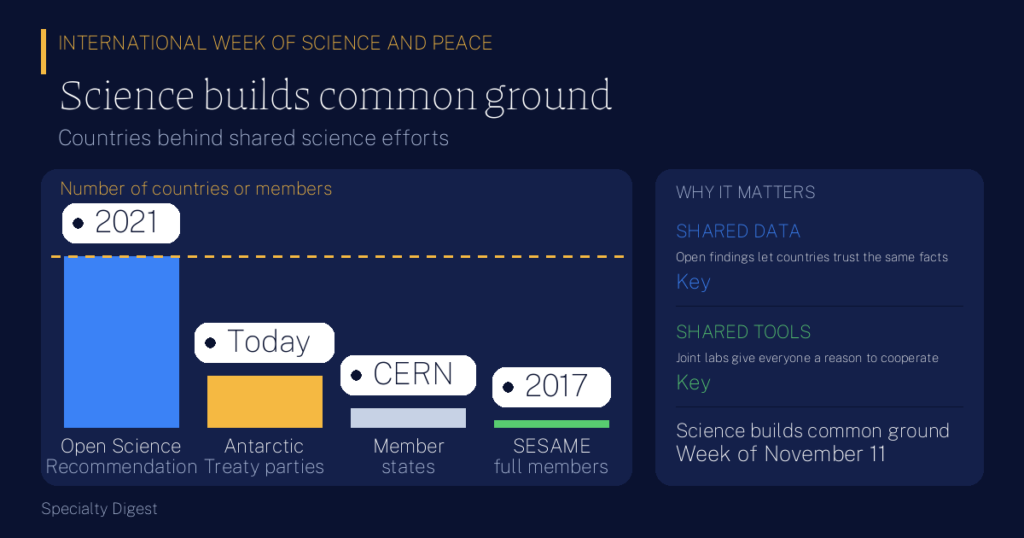
Two cases show cooperation across hard political lines. The Antarctic Treaty was signed on December 1, 1959, by the twelve countries whose scientists had been active in and around Antarctica during the International Geophysical Year of 1957 and 1958. It entered into force in 1961. In summary form, it says Antarctica shall be used for peaceful purposes only, that freedom of scientific investigation shall continue, and that scientific observations and results shall be exchanged and made freely available. The Antarctic Treaty Secretariat now counts 58 parties.
SESAME, a synchrotron light laboratory near Amman, Jordan, began at UNESCO in 1999 and was opened on May 16, 2017. Its eight full members are Cyprus, Egypt, Iran, Israel, Jordan, Pakistan, Palestine and Turkey. UNESCO calls it a beacon of science diplomacy. In 2021, 193 countries adopted UNESCO Recommendation on Open Science, the first global standard on the subject.
- 1954CERN founded under UNESCO auspices
- 12original signatories of the Antarctic Treaty, 1959
- 8full members of SESAME
- 193countries adopted the Open Science Recommendation, 2021
Why it matters
The first reason is practical. Many of the biggest problems, such as climate change, disease outbreaks, shared rivers and shared oceans, do not stop at a border. Measuring them well requires data from many places, and using the data well requires countries to trust each other enough to share it. A shared stream of evidence also makes it harder to argue over basic facts. The same logic applies to water, which is why this week pairs naturally with World Water Day.
Example 2: a river measured twice. Imagine two countries sharing a river. Each measures flow separately and reports different numbers, so every dry season brings an argument. When they agree to use one set of gauges and publish the readings openly, the argument shifts from what is true to what to do. The figures are invented for illustration, but disputes over measurement are a familiar source of friction.
Who is left out
Cooperation is uneven. UNESCO lists among its aims the need to draw attention to the challenges faced by science, and many of those challenges are about access: laboratories that cannot afford equipment, researchers who cannot read paywalled papers, and young scientists who lack a route to international networks. The Open Science Recommendation exists partly to widen that door by promoting shared knowledge, open data and fairer participation. Peace built on science is strongest when more people can take part in it.
How the week is marked
Schools, museums, universities and research institutes mark the week with open days, public talks, exhibitions and classroom activities. UNESCO also publishes a message from its Director-General for World Science Day for Peace and Development. You can take part simply by asking where the science around you comes from and who shares it.
Example 3: a class project. A school class of 30 students collects local rainfall data for a month and swaps it with a partner class in another country. Each class now has two datasets instead of one, and each has met a group of peers it would never otherwise have known. The scale is tiny and the numbers are illustrative, yet it is the same pattern, on a small scale, as the larger efforts above.
Key Takeaways
- The week moves with November 11. It is observed in the week containing that date, which is November 9 to 15 in 2026.
- Science builds common ground. Shared data, instruments and rules give people reasons to keep working together.
- History offers proof. CERN in 1954, the Antarctic Treaty in 1959 and SESAME in 2017 grew from cooperation across political lines.
- Peaceful use is written down. The Antarctic Treaty summary says the continent is for peaceful purposes only and that scientific results are to be shared.
- Access decides who benefits. The Open Science Recommendation, adopted by 193 countries in 2021, aims to widen participation.
- You can join in. Ask where your local science comes from, and support open and shared knowledge.
How solid is this? Dates, member counts and quotations come from UNESCO, the UN and the Antarctic Treaty Secretariat pages listed below; counts change as countries join, and the UN week page does not state its originating resolution, so none is cited here. The three worked examples use round, made-up numbers to show an idea. See also the International Days hub and the International Days Calendar.
More in Science
- United Nations, International Week of Science and Peace
- UNESCO, World Science Day for Peace and Development
- UNESCO, Cooperation through science diplomacy: benefits and examples
- UNESCO, SESAME facility opens in the Middle East (2017)
- Antarctic Treaty Secretariat, The Antarctic Treaty
- Nobel Prize, Pugwash Conferences and Joseph Rotblat, 1995