When people count the cost of war, they usually count lives, homes and money. The land, water and air that people depend on often go uncounted. Fields are burned, wells are fouled, forests are cut for fuel and dams are destroyed, and the damage can last long after the fighting stops. The International Day for Preventing the Exploitation of the Environment in War and Armed Conflict, observed every November 6, asks the world to count that cost and to prevent it. It also points to a second lesson: when nature is shared fairly and managed well, peace is easier to keep.
How the day came to be
The United Nations General Assembly declared November 6 as the day on November 5, 2001, in resolution A/RES/56/4. The observance has since become a yearly moment for UN bodies, governments and experts to examine how conflict harms ecosystems and how natural resources can fuel or calm a conflict. The UN Environment Programme (UNEP) takes the lead on the environmental side of the work.
The day grew into a broader agenda. In May 2016 the UN Environment Assembly adopted resolution UNEP/EA.2/Res.15 on protecting the environment in areas affected by armed conflict, and the resolution recognized the role of healthy ecosystems and sustainably managed resources in reducing the risk of armed conflict. The UN also lists partnerships that connect environment, peacebuilding and development agencies, among them UNEP, UNDP and the Peacebuilding Support Office.
What “exploitation” and “damage” mean
Two ideas sit inside the name of the day. The first is damage in war: bombing that sets oil facilities alight, fighting that pollutes soil and water, and attacks on dams, farms and forests. The second is exploitation: using timber, minerals, land or water to pay for fighting, or controlling those resources to hold power. Often the two overlap. A group that seizes a mine may also poison the river below it.
International law already speaks to this. The International Law Commission, the UN body of legal experts, adopted a set of 27 draft principles on the protection of the environment in relation to armed conflicts in 2022. They cover the time before, during and after a conflict. Earlier treaty law, including Additional Protocol I to the Geneva Conventions of 1977, also bars warfare methods meant to cause widespread, long-term and severe damage to the natural environment.
Example 1: the poisoned well. Imagine a village of 2,000 people that draws all its drinking water from one well. Fuel from a damaged depot seeps into the ground and the well becomes unsafe. The nearest clean source is a two-hour walk away. The numbers are round and illustrative, but the pattern is what humanitarian agencies describe: damage to water supplies falls first on the civilians who live nearest to it.
What the numbers show
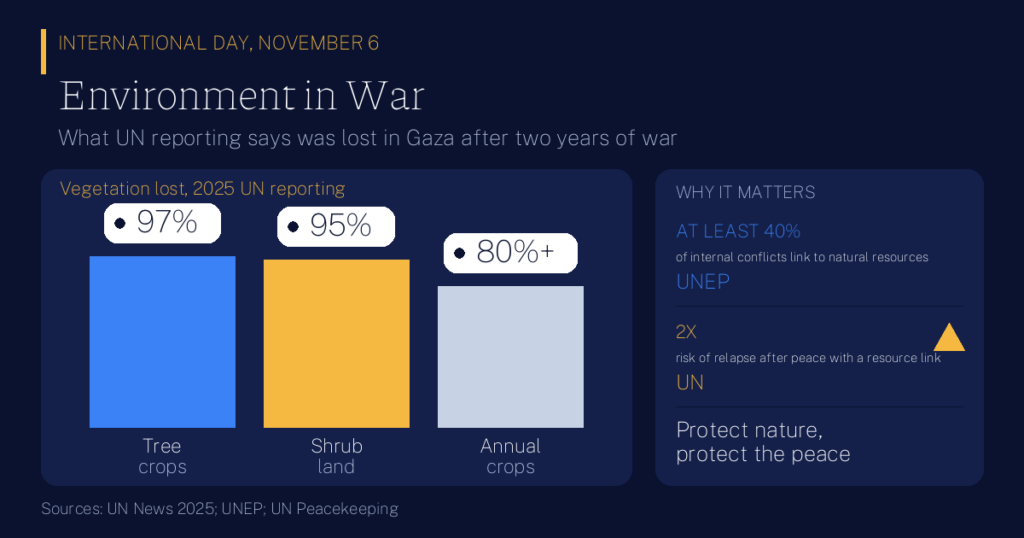
UN reporting on the 2025 observance described armed conflicts raging across the planet at a rate not seen since the Second World War, with two billion people, a quarter of the global population, living in conflict-affected areas. That report also cited estimates for Gaza after two years of war: a loss of 97 percent of tree crops, 95 percent of shrubland and more than 80 percent of annual crops, along with more than 61 million tonnes of debris to be cleared. In Ukraine, the UN Environment Programme’s chief, Inger Andersen, noted that the destruction of the Kakhovka Dam in June 2023 flooded more than 600 square kilometers of land. These figures are attributed to the UN statements and assessments cited in that report.
Why nature and conflict are linked
The link runs in both directions. UNEP found that over the last 60 years at least 40 percent of all internal conflicts have had a link to natural resources. Such conflicts are also more likely to return: UN peacekeeping materials state that the link doubles the risk of a relapse in the first five years after a peace agreement. In plain terms, disputes over land, water, timber, minerals or oil can help start a war, and unresolved disputes can restart one.
Example 2: the shared river. Picture two farming districts that share one river, and a peace deal that ends a local war. If the deal says nothing about who gets water in a dry year, a drought can reopen the quarrel. If it sets up a joint water committee with clear rules, the same drought becomes a problem to manage instead of a reason to fight. The setting is made up, but it shows why peace agreements increasingly address natural resources directly.
Who carries the burden
Ecosystem damage is not an abstract loss. Farmers lose harvests, herders lose grazing land, and families lose clean water and fuel. Displaced people often settle in areas that cannot support them, which puts new strain on land and forests. Women and girls, who in many places gather water and firewood, can face added risk and added labor when those resources vanish or become unsafe to reach.
Cleanup and recovery also take time. The Gaza figures include more than 61 million tonnes of debris to be cleared, and debris is only one part of rebuilding.
Example 3: the size of a pile. Suppose one truck hauls 10 tonnes of rubble. Moving 61 million tonnes would take 6.1 million truckloads. The truck size is a round, illustrative figure, but the arithmetic shows why recovery is measured in years, not weeks.
What progress needs
The day points to practical steps. Governments can apply the Law Commission’s principles in their own military manuals and national laws. Peace negotiators can write resource sharing and environmental repair into agreements. Humanitarian and environmental agencies can assess damage early so that recovery plans include water, soil and ecosystems. And ordinary readers can follow how the places they care about are covered, since the Security Council debate marking the 2025 observance showed that the topic now reaches the highest levels of the UN.
Key Takeaways
- The day dates from 2001. The General Assembly created it on November 5, 2001, in resolution A/RES/56/4.
- War harms nature and people together. Damaged water, farmland and forests hit civilians first and longest.
- Resources can fuel conflict. At least 40 percent of internal conflicts in the last 60 years have a natural resource link, per UNEP.
- Peace needs resource rules. The same link doubles the risk of relapse in the first five years after a peace agreement.
- Law gives a framework. The International Law Commission adopted 27 draft principles in 2022.
- Recovery is slow. More than 61 million tonnes of debris in Gaza show how long cleanup can take.
- Prevention is the goal. Protecting ecosystems before and during conflict is cheaper and kinder than repairing them later.
How solid is this? The 40 percent and doubled-relapse figures are UNEP findings reported by the UN, and the 2025 damage figures are UN-reported assessments that may be revised as surveys continue. The three worked examples use round, made-up numbers to show an idea. This topic touches ongoing conflicts, so the article reports what UN bodies state and takes no side. See also World Water Day, the International Days hub and the International Days Calendar.
More in Nature
- United Nations, International Day for Preventing the Exploitation of the Environment in War and Armed Conflict
- UN News, Battlefields to wastelands (November 6, 2025)
- UN Peacekeeping, Conflict and natural resources
- UNEP, Environment is the silent casualty of armed conflict (2016)
- International Law Commission, Draft principles on protection of the environment in relation to armed conflicts (2022)
- UN Environment Assembly, Protection of the environment in areas affected by armed conflict