Corruption rarely makes headlines the way a flood or an outbreak does, yet it quietly shapes both. When a contract is inflated, a clinic runs short of medicine, or a permit goes to the highest bidder, the loss lands on ordinary people. International Anti-Corruption Day, observed every year on December 9, asks the world to look at that loss, name it and act. It sits close to World Water Day in spirit, because public services such as water and sanitation depend on honest budgets. This article explains where the day came from, what the numbers say, and what the United Nations treaty behind it asks governments to do.
Where the day comes from
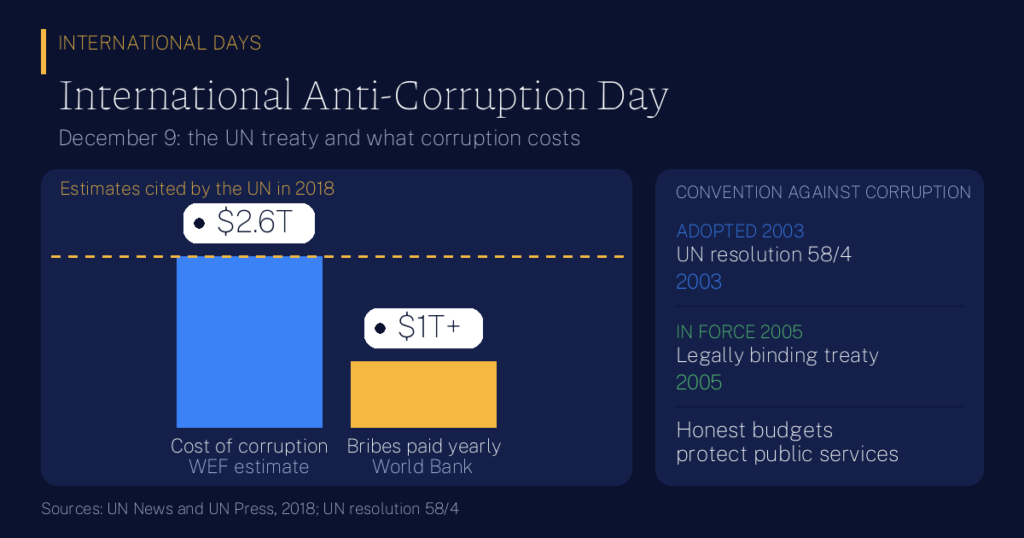
The day grows out of a treaty. On October 31, 2003, the UN General Assembly adopted resolution 58/4, which approved the United Nations Convention against Corruption. The same resolution designated December 9 as International Anti-Corruption Day and asked the UN Office on Drugs and Crime (UNODC) to serve as the convention’s secretariat. The convention was opened for signature at a high-level conference in Merida, Mexico, in December 2003, and the date of the day marks that signing. It entered into force in December 2005 and is widely described as the only legally binding global agreement against corruption.
Today UNODC and the UN Development Programme (UNDP) are the agencies most closely tied to the day. Each year they publish campaign materials, and governments, schools, businesses and civil society groups hold events of their own.
What corruption means
Corruption is often defined as the abuse of entrusted power for private gain. The convention does not squeeze this into a single sentence. Instead it lists the behaviors countries must treat as crimes or take seriously, including bribery, embezzlement, abuse of functions, trading in influence, money laundering and obstruction of justice. It covers public officials and, in several areas, the private sector too.
That breadth matters. Corruption is not only a minister taking a suitcase of cash. It can be a clerk asking for a small payment to process a form, a company paying to win a tender, or a bank helping to hide stolen money. The harm differs in size but the pattern is the same: a rule meant for everyone is bent for someone.
Example 1: the inflated road. Suppose a government awards a $100 million road contract and a 10 percent kickback is built into the price. Ten million dollars never becomes asphalt. If a rural school costs $500,000, that is the price of about twenty schools. The numbers are round and illustrative, but they show how a hidden cost turns into a missing public good.
The numbers behind the day
Measuring corruption is hard, because those involved work to hide it. The figures most often cited by the United Nations are estimates, and they are worth reading with that in mind. In 2018, Secretary-General Antonio Guterres told the Security Council, citing World Economic Forum estimates, that corruption costs at least $2.6 trillion, or 5 percent of global gross domestic product. He also cited the World Bank in saying that businesses and individuals pay more than $1 trillion in bribes each year.
- 5%of global GDP lost to corruption, per WEF estimates cited by the UN in 2018
- $1 trillion+paid in bribes each year, per the World Bank, cited in 2018
- 1.9 billionyoung people in the world, nearly a quarter of the population
- 1,300+submissions to the 2024 global youth essay competition
Why it matters: who pays
The United Nations has long stressed that corruption falls hardest on the poor and vulnerable. The reason is simple. Wealthy people can often buy their way around a broken system, while poorer families cannot. They pay the extra fee for a document, wait longer for a hospital bed, or go without a service that public money was meant to provide.
There is also a link to peace and security. In 2018 the Security Council held a session on tackling corruption for the sake of international peace and security. The argument is that when people see institutions as unfair, trust erodes, and weak trust makes societies more fragile. Corruption also drains the money that pays for health, education, water and roads, which are the services that keep communities stable.
Example 2: the small payment. Imagine a family is asked for an unofficial $20 fee each time a child needs a clinic visit that should be free. Over five visits in a year that is $100. For a household living on a few dollars a day, it is a serious sum, and some families will simply stay home. The figures are made up and rounded, yet they capture how petty corruption quietly shuts people out.
What the convention asks of governments
The convention is built around five areas of action. States are asked to prevent corruption, to criminalize it and enforce the law, to cooperate across borders, to recover stolen assets, and to share technical help and information. Asset recovery is a notable feature, because corrupt money is often moved abroad and returning it to the country it was taken from is difficult and slow.
Example 3: money that comes home. Suppose investigators trace $50 million stolen from a national budget to bank accounts abroad, and cooperation between countries returns it. If a basic rural clinic costs $500,000 to build, that sum could fund about one hundred clinics. The figures are round and illustrative, but they show why recovery is treated as a development issue, not only a legal one.
Young people and how the day is marked
Recent campaigns have centered on youth. UNODC notes there are 1.9 billion young people in the world, nearly a quarter of the global population, and that a global youth essay competition held in 2024 drew more than 1,300 submissions. The 2025 observance carried the title “Uniting with Youth Against Corruption.” The theme is set by the organizers each year, so check UNODC and UNDP for the current one.
The day is marked in many ways: school debates, essay contests, public lectures, social media campaigns and announcements from anti-corruption agencies. Ordinary people can take part too. You can ask how your local budget is published, support groups that monitor public spending, refuse to pay informal fees where you can, and report wrongdoing through safe, legal channels.
Key Takeaways
- The day comes from a treaty. Resolution 58/4 in 2003 approved the convention and set December 9 as the day.
- Corruption is broader than bribes. It includes embezzlement, abuse of office, trading in influence and money laundering.
- The scale is large. The UN has cited estimates of at least $2.6 trillion a year, or 5 percent of global GDP.
- The poor pay most. Wealthier people can buy their way around broken systems, and poorer families cannot.
- Cooperation across borders is essential. Stolen money moves abroad, so recovering it takes countries working together.
- Young people are central. With 1.9 billion young people worldwide, recent campaigns focus on the next generation.
- You can help. Ask for transparency, support public watchdogs and use safe channels to report wrongdoing.
How solid is this? The cost figures are estimates by the World Economic Forum and the World Bank, quoted by the UN Secretary-General in 2018, and corruption is hard to measure precisely. Treaty dates follow the General Assembly resolution and the UN treaty record. The three worked examples use round, made-up numbers to show an idea. See also the International Days hub and the International Days Calendar.
More in Society
- UNODC, International Anti-Corruption Day
- UN News, Pervasive corruption costs $2.6 trillion (2018)
- UN Press, Global cost of corruption at least 5 per cent of world GDP (2018)
- UN General Assembly resolution A/RES/58/4 (2003)
- UN Office of Legal Affairs, United Nations Convention against Corruption
- UNDP, International Anti-Corruption Day
- UNODC, Learn about UNCAC