Most of us learn solidarity in small settings. A neighbor lends a ladder, a village shares a well, a family pools money so a cousin can finish school. International Human Solidarity Day, observed every year on December 20, asks a larger question: can the whole world act the same way? The United Nations created the day to remind governments and citizens that fighting poverty is a shared task, and that people who benefit least deserve help from people who benefit most. It pairs naturally with days like World Toilet Day, which shows what happens when basic services are treated as a common responsibility.
From a value to a day
The day has a short but deliberate history. In September 2000, world leaders adopted the Millennium Declaration (A/RES/55/2), which named solidarity as one of the fundamental values essential to international relations in the twenty-first century. Two years later, on December 20, 2002, the General Assembly endorsed a decision of the World Summit on Sustainable Development and established the World Solidarity Fund (A/RES/57/265). The Fund was set up in February 2003 as a trust fund of the United Nations Development Programme, with the aim of eradicating poverty and promoting human and social development in developing countries.
In December 2005, the General Assembly took the final step. By resolution 60/209 it proclaimed December 20 of each year as International Human Solidarity Day, choosing the anniversary of the Fund’s founding. The UN describes the resolution as affirming solidarity as a fundamental and universal value that should underlie relations among peoples.
What solidarity means here
In everyday speech, solidarity is a feeling. In UN usage it is closer to a principle with consequences. It means that burdens and benefits are shared fairly, and that those who suffer or who benefit least deserve help from those who benefit most. A UN pamphlet on the day puts the case plainly: only an international community guided by human solidarity and a shared sense of justice can ensure sustainable social and economic development for all.
The day is not a pledge drive for one charity. The UN presents it as an occasion to celebrate unity in diversity, to raise public awareness of why solidarity matters, to encourage debate on ways to promote it, and to spur action against poverty. Its practical reach shows up in the UN system’s work on emergency funding, refugee protection, children’s welfare and human rights.
Example 1: the shared flood fund. Imagine 100 farming households, each facing a 1 in 20 chance of losing a $2,000 crop to flooding in a given year. Alone, a loss could ruin a family. If each household pays $100 into a common fund, the pool of $10,000 can replace the five crops likely to be lost. The numbers are round and illustrative, but the logic is the oldest form of solidarity: a small, predictable contribution replaces a large, unpredictable disaster.
The numbers behind the day
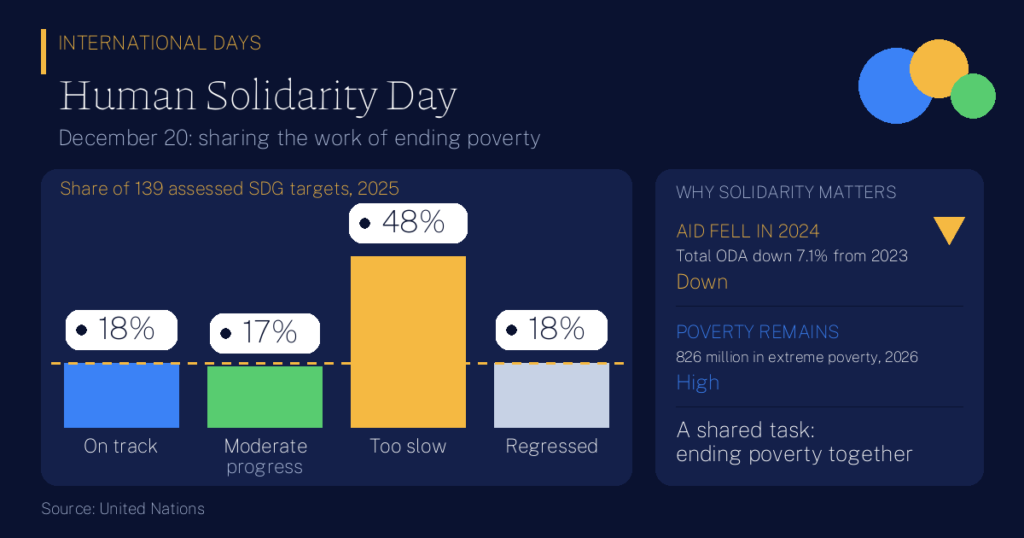
The case for solidarity rests on how much work remains. In 2015 the General Assembly adopted the 2030 Agenda (A/RES/70/1), built around 17 Sustainable Development Goals. The UN’s 2025 progress report assessed 139 of the 169 targets. It found that 18 percent were on track and 17 percent were making moderate progress, while 48 percent showed insufficient progress and 18 percent had regressed below 2015 levels. Figures are rounded, so shares may not sum to exactly 100.
- 826 millionpeople in extreme poverty, 2026 estimate, at $3.00 a day
- 120 million+people forcibly displaced by the end of 2024
- 1 in 11people worldwide faced hunger in 2023
- $4 trillionannual financing gap for development, 2025 report
Why it matters now
Solidarity between countries is often measured in official development assistance, or ODA. According to the UN’s 2025 report, ODA fell 7.1 percent in 2024 after five years of growth, with further cuts expected through 2025. The UN’s 2026 poverty update adds that grants aimed specifically at poverty reduction fell 8.7 percent between 2023 and 2024, to $19.1 billion. That sum equals 0.02 percent of donor countries’ combined gross national income in 2024.
Example 2: what 0.02 percent looks like. Suppose a country earns $1 trillion a year in national income. At 0.02 percent, its poverty-focused aid grants would come to $200 million. For a household earning $50,000, the same share would be $10 a year. The figures are round and illustrative, but they show how small the sums can be for the giver and how much they can mean for the receiver.
Who is left behind
The 2030 Agenda promises to leave no one behind, and solidarity is how that promise is kept. The people most at risk are often those least able to ask: refugees, people living through conflict, children out of school, and communities far from services. More than 120 million people were forcibly displaced by the end of 2024, which the UN notes is more than double the number in 2015, and the global refugee population reached 37.8 million by mid-2024. Nearly 1 in 11 people worldwide faced hunger in 2023.
The UN’s 2025 report also describes an annual financing gap of about $4 trillion that holds back development. Closing it takes more than aid. It takes fair trade, debt relief, domestic investment and political will. Solidarity is the thread that ties these tools together.
How the day is marked
International Human Solidarity Day has no single annual theme in the UN sources reviewed for this article. Instead, it serves as a standing invitation. Governments, schools, charities and local groups hold events, UN offices publish messages, and the UN’s social development division maintains a record of past observances. The day also draws attention to the World Solidarity Fund, which finances poverty alleviation projects and welcomes voluntary contributions.
For most readers, the more important question is personal. Solidarity can mean giving to a trusted relief group, volunteering locally, supporting fair-trade purchasing, or simply learning how aid is spent. Example 3: the monthly gift. If 1,000 people each give $5 a month, the group raises $60,000 in a year. At an illustrative cost of $30 to supply a child with school materials, that covers 2,000 children. The numbers are made up for illustration, but they show how many small acts add up.
Key Takeaways
- Solidarity is a stated UN value. The Millennium Declaration of 2000 named it a fundamental value of international relations.
- The day has a clear origin. Resolution 60/209 proclaimed December 20 in December 2005, the anniversary of the World Solidarity Fund.
- The goals are off course. In 2025, only 35 percent of assessed targets were on track or moving at a moderate pace.
- Need is large. About 826 million people were estimated to live in extreme poverty in 2026.
- Aid is shrinking. Total ODA fell 7.1 percent in 2024, and poverty-focused grants fell 8.7 percent.
- Small shares matter. Poverty-focused grants equaled only 0.02 percent of donor income in 2024.
- Solidarity starts close to home. Giving, volunteering and learning how aid works are all ways to take part.
How solid is this? Dates and resolution numbers come from UN documents and pages. Poverty and progress figures are modeled estimates that the UN revises with each report, so the 2025 and 2026 numbers differ. The three worked examples use round, made-up numbers to show an idea. See also the International Days hub and the International Days Calendar.
More in Society
- United Nations, International Human Solidarity Day
- UN DESA, International Human Solidarity Day
- UN DESA, International Human Solidarity Day pamphlet (2006)
- UN ECOSOC resolution E/RES/2003/4, World Solidarity Fund
- United Nations, The Sustainable Development Goals Report 2025
- United Nations, SDG Report 2025 press release
- United Nations, SDG Report 2026, Goal 1