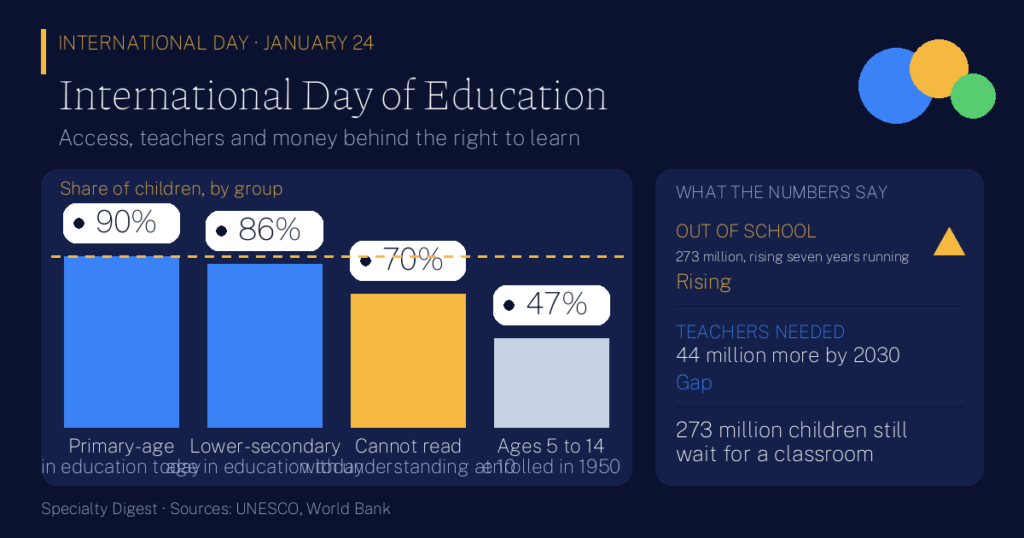
Education is the one human right that opens almost every other door. A child who learns to read can read a health notice, a contract or a ballot. Yet in a world where about nine in ten primary-school-age children are now in education, 273 million children and young people are still out of school. International Day of Education, observed every year on January 24, asks the world to look at that gap and to act on it. It is a natural companion to World Water Day and World Toilet Day, because children learn best when water is clean, toilets are safe and bodies are healthy.
From a General Assembly vote to a yearly day
On December 3, 2018, the United Nations General Assembly adopted by consensus a resolution proclaiming January 24 as International Day of Education. The text, recorded as A/RES/73/25, was co-authored by Nigeria and 58 other member states, 59 in all, and it celebrates the role of education for peace and development. UNESCO, the UN specialized agency for education, facilitates the observance each year in close collaboration with the main education actors.
The day belongs to a larger promise. Sustainable Development Goal 4 commits countries to inclusive and equitable quality education and lifelong learning opportunities for all by 2030. A yearly date does not build a school, but it gives governments, teachers, students and agencies a regular moment to ask how far that promise has come and who is still outside the classroom.
Access is only half the story
When people say “education for all,” they usually picture a child at a desk. That is access, and it matters. But a desk is not a guarantee of learning. The World Bank’s 2026 education brief reports that 70 percent of children in low- and middle-income countries cannot read with understanding by age 10, a problem often called learning poverty.
Time in school matters too. UNESCO’s 2026 Global Education Monitoring (GEM) Report notes that the share of countries with 12 years of compulsory education rose from 8 percent to 26 percent between 1998 and 2023, real progress that still leaves most countries below the mark.
The numbers behind the day
The long view is encouraging. UNESCO notes that in 1950 only about 47 percent of the world’s children aged 5 to 14 were enrolled in school. Today about 90 percent of primary-school-age children and 86 percent of lower-secondary-age children are in education, and there are 327 million more students in primary and secondary school than there were in 2000.
The recent picture is harder. The 2026 GEM Report, drawing on data from the UNESCO Institute for Statistics, shows that 273 million children, adolescents and youth are out of school, a number that has risen for seven consecutive years. That is one in six. Progress has slowed across almost every region since 2015, with a sharp slowdown in sub-Saharan Africa.
Who is left behind
Almost three quarters of the children and young people out of school live in Central and Southern Asia and sub-Saharan Africa. Conflict, displacement and disaster add to the barrier. UNESCO points to nearly a quarter of a billion crisis-affected children and adolescents in urgent need of learning support, citing the Education Cannot Wait 2025 update. Disability widens the gap: children with disabilities are 2.5 times more likely never to have attended school, according to the 2020 GEM Report.
Example 1: one district. Picture a district with 600 school-age children. If one in six is out of school, about 100 children are at home, working, caring for siblings or too far from a classroom. If a new school road and a school meal bring half of them in, 50 more children begin learning. The numbers are round and illustrative.
Teachers: the other half of the equation
No school is better than its teachers. The 2024 Global Report on Teachers, from UNESCO and the International Task Force on Teachers for Education 2030, found an urgent need for 44 million primary and secondary teachers worldwide by 2030, including an estimated 15 million new teachers in sub-Saharan Africa. Seven in ten of the teachers needed are at the secondary level. The report also stresses the need to replace the many teachers who leave the profession, and it finds that primary teacher attrition almost doubled, from 4.62 percent globally in 2015 to 9.06 percent in 2022.
Example 2: a teacher gap. Suppose a region has 10,000 primary teachers and attrition runs at 9 percent a year. About 900 teachers leave each year, and the region must train and hire 900 just to stay level. At 4.6 percent, the global rate of 2015, it would lose about 460. The figures are round and illustrative, and the difference of roughly 440 teachers shows what rising attrition costs.
What it costs and what it returns
UNESCO estimates that salaries for the new teachers alone would reach about $120 billion a year, and it says an estimated annual increase of $97 billion is needed for low- and lower-middle-income countries to reach quality education for all by 2030. Only four in 10 countries meet the benchmark of spending 4 percent of national income (GDP) on education, and international aid to education is projected to fall by 25 percent between 2023 and 2027.
The reward for closing the gap is large. The World Bank reports that each extra year of education amounts to about 10 percent higher future earnings, and UNESCO says school dropouts and education gaps could cost the global economy up to $10 trillion a year by 2030.
Example 3: what a year is worth. Take a worker who would earn $10,000 a year with the schooling she has now. If each extra year of education adds about 10 percent, two more years would lift her earnings to roughly $12,000. The numbers are round and illustrative, and real returns vary by country.
How the day is marked, and the 2026 theme
UNESCO chooses a focus for the day each year. The 2026 theme, the power of youth as co-creators of education, rests on a simple line from UNESCO: education policies must be shaped with youth, not just for them. UNESCO noted that people under 30 make up more than half of the global population. At a hybrid event at UNESCO Headquarters on January 23, 2026, it planned to present a new Global Education Monitoring measurement of student and youth participation in education legislation and policymaking, produced with the UN Youth Office.
You can take part without attending a conference: ask your school how students are consulted, support a local literacy group, or thank a teacher. UNESCO announces each year’s focus ahead of the day, so check its website for the January 24, 2027 theme.
Key Takeaways
- The day has a clear origin. The UN General Assembly proclaimed January 24 International Day of Education on December 3, 2018, by consensus.
- Access is not learning. The World Bank reports that 70 percent of children in low- and middle-income countries cannot read with understanding by age 10.
- The long climb is real. Enrollment rose from about 47 percent of children aged 5 to 14 in 1950 to about 90 percent of primary-age children today.
- Progress has stalled for some. 273 million children and youth are out of school, a number that has risen for seven straight years.
- Crisis and disability deepen the gap. Nearly a quarter of a billion children are affected by crises, and children with disabilities are 2.5 times more likely never to attend school.
- Teachers are the bottleneck. The world needs 44 million more teachers by 2030, and primary teacher attrition has almost doubled.
- Money and youth voices both matter. An extra $97 billion a year is needed in poorer countries, and the 2026 theme says policy should be built with young people.
How solid is this? The out-of-school total comes from the 2026 GEM Report and UNESCO Institute for Statistics data, and UNESCO has published slightly different totals in different releases, so treat it as an estimate. The learning-poverty figure comes from the World Bank’s 2026 brief. The teacher figures come from the 2024 global report. The three worked examples use round, made-up numbers to show an idea. See also the International Days hub and the International Days Calendar.
More in Education
- United Nations, International Day of Education, Background
- UNESCO, International Day of Education
- UNESCO, International Day of Education 2026 celebrates the power of youth as co-creators of education
- UNESCO, Education: what you need to know and why it matters (2026)
- UNESCO GEM Report, What does the 2026 GEM Report say about access and equity in education?
- UNESCO, Global report on teachers: What you need to know (2024)
- World Bank, International Day of Education 2026: Education Works