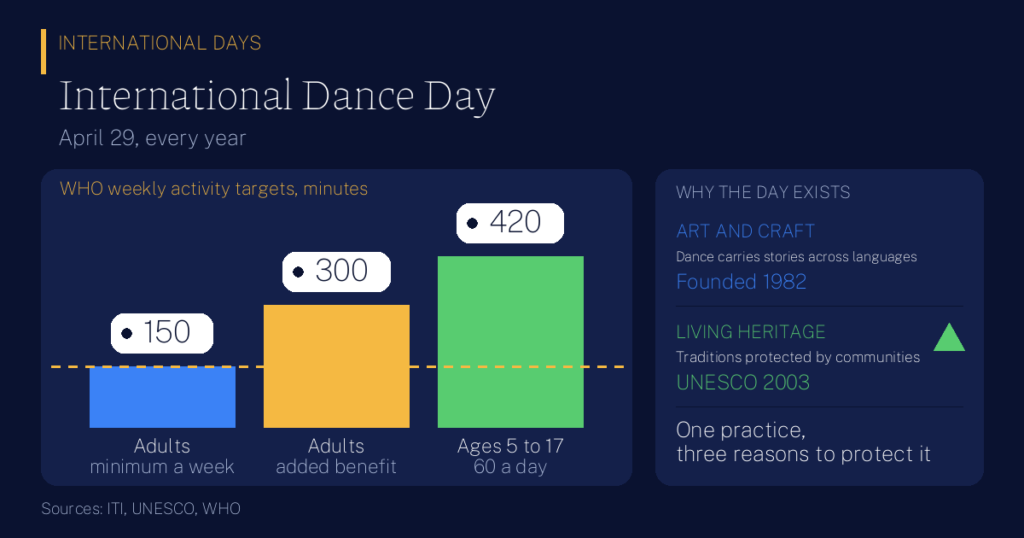
Dance is older than writing, and it needs no translation. A drum, a clap or a few steps can tell a story to people who share no spoken language. International Dance Day, observed every year on April 29, asks the world to notice that. It celebrates dance as an art, a living heritage and a practice that moves the body, and it asks governments, schools and communities to give dancers the space and respect they need. It is a close relative of World Theatre Day, which comes from the same family of performing arts.
Where the day came from
Unlike many days in this series, International Dance Day was not created by a General Assembly vote. It was founded in 1982 by the Dance Committee of the International Theatre Institute, a worldwide organization for the performing arts that works as a partner of UNESCO. The committee chose April 29 because it is the birthday of Jean-Georges Noverre, born in 1727, a French dancer and ballet master widely known as the creator of modern ballet. He argued that dance should tell a story and express feeling, not only show off technique.
That origin matters for how the day works. It is a civil-society observance carried out under UNESCO patronage, so it has no binding rules and no treaty behind it. What it has is reach. Each year ITI publishes a message written by a renowned choreographer or dancer, and its member centers around the world organize performances, classes, open rehearsals and street events that match the message.
What counts as dance
The day takes a wide view. Ballet, contemporary and hip-hop are included, but so are folk dances, ritual dances, social dances and the improvised steps people do at weddings and festivals. Many of these forms are not performed on a stage at all. They are learned in families and villages, passed from one generation to the next, and tied to a season, a harvest, a faith or a rite of passage.
This is exactly the kind of practice that UNESCO’s 2003 Convention for the Safeguarding of the Intangible Cultural Heritage was written to protect. The Convention covers traditions that communities recognize as part of their identity, including performing arts. Its lists include dance traditions from many regions. Examples include Chhau dance of India, listed in 2010, and Garba of Gujarat, listed in 2023. Kenya’s Mwazindika sacred spirit dance has also been inscribed. Each entry exists because a community asked for it and agreed to safeguard it.
Example 1: a village troupe. Imagine a village with 20 elders who know a ceremonial dance, and each teaches 5 young people a year. That is 100 new learners a year, and 500 after five years. If the elders stop teaching, or the young leave for work and school with no time to practice, the chain breaks in a single generation. The numbers are round and illustrative, but the arithmetic shows why safeguarding means supporting teachers, not only recording steps on video.
Dance and the body
Dance is also exercise, and the world needs more of it. The World Health Organization’s 2020 guidelines recommend that adults do at least 150 minutes of moderate-intensity aerobic activity each week, and up to 300 minutes for added benefit. Children and adolescents aged 5 to 17 should average 60 minutes a day of moderate to vigorous activity. WHO reported in 2024 that nearly 1.8 billion adults were not doing enough, based on 2022 data.
Dance is one of the easiest ways to reach those targets because it hides the effort. People who would never run on a treadmill will dance for an hour. It also adds balance, coordination, memory and social contact. A 2019 WHO Regional Office for Europe scoping review of the evidence on the arts and health concluded that the arts, including performing arts such as dance, can help prevent illness, support people living with it and promote well-being.
Example 2: a weekly routine. Suppose an adult attends three 45-minute dance classes a week, which is 135 minutes. Adding 15 minutes of practice at home brings the total to 150, which meets the WHO minimum. The figures are round and illustrative, but they show how a hobby can quietly do the work of a fitness plan.
Dance as work and community
Dancers are also workers. UNESCO reported in 2015 that cultural and creative industries account for 29.5 million jobs worldwide, and dance companies, teachers, choreographers, costume makers and venue staff are part of that picture. Many dancers have short careers, irregular income and little social protection, which is one reason the day asks societies to value the profession and not only the performance.
Who gets left out
Not everyone gets to dance. Girls and women face limits on public movement and performance in some places. People with disabilities are often shut out of studios that lack access, even though inclusive and wheelchair dance are well established forms. Rural children may have no teacher within reach, and many schools treat dance as the first subject to cut when budgets tighten. Older adults, who gain a great deal from social movement, are rarely offered classes made for them.
Example 3: a school block. Take a school of 400 students that adds a 30-minute dance block twice a week for a 36-week year. Each student gains 60 minutes a week, or 36 hours a year, and the school as a whole gains 14,400 hours of movement. The numbers are round and illustrative, yet they show how a modest timetable change adds up.
How the day is marked
Every April 29, ITI centers and independent artists stage events. The ITI guidelines for celebrating the day suggest open classes, flash performances in public spaces, screenings and conversations with choreographers. The official message, written by a different artist each year, sets a tone that organizers can adapt. Anyone can take part: attend a community performance, try a class you have never tried, support a local company, or teach a child a dance from your own family. If you need a place to start, look for your national ITI center.
Key Takeaways
- The day belongs to the dance community. It was created in 1982 by the ITI Dance Committee, not by a General Assembly vote.
- April 29 honors a pioneer. It is the birthday of Jean-Georges Noverre, born in 1727 and widely called the creator of modern ballet.
- Dance is living heritage. UNESCO’s 2003 Convention protects traditions such as Chhau and Garba because communities keep them alive.
- Dance counts as exercise. WHO recommends 150 to 300 minutes a week for adults and 60 minutes a day for ages 5 to 17.
- Dance is also a livelihood. It is part of the cultural and creative sector, which UNESCO reported at 29.5 million jobs in 2015.
- Access is uneven. Gender, disability, geography and school budgets decide who gets to dance.
- You can take part. Attend, learn, teach or support a local artist on April 29.
How solid is this? The date, founding and role of ITI are documented by the organization itself, and the day is not a United Nations designation. The activity targets come from WHO’s 2020 guidelines and the 1.8 billion figure is a modeled estimate for 2022. The jobs figure comes from a 2015 UNESCO report and has not been updated here. The three worked examples use round, made-up numbers to show an idea. See also World Theatre Day, the International Days hub and the International Days Calendar.
More in Society
- International Theatre Institute. International Dance Day.
- International Theatre Institute. How to Celebrate International Dance Day: guidelines (2026).
- UNESCO. Lists of Intangible Cultural Heritage and the Register of good safeguarding practices.
- UN India. Garba joins UNESCO list of Intangible Cultural Heritage.
- World Health Organization. WHO guidelines on physical activity and sedentary behaviour: at a glance (2020).
- World Health Organization. Nearly 1.8 billion adults at risk of disease from not doing enough physical activity (2024).
- WHO Regional Office for Europe. What is the evidence on the role of the arts in improving health and well-being? A scoping review (2019).