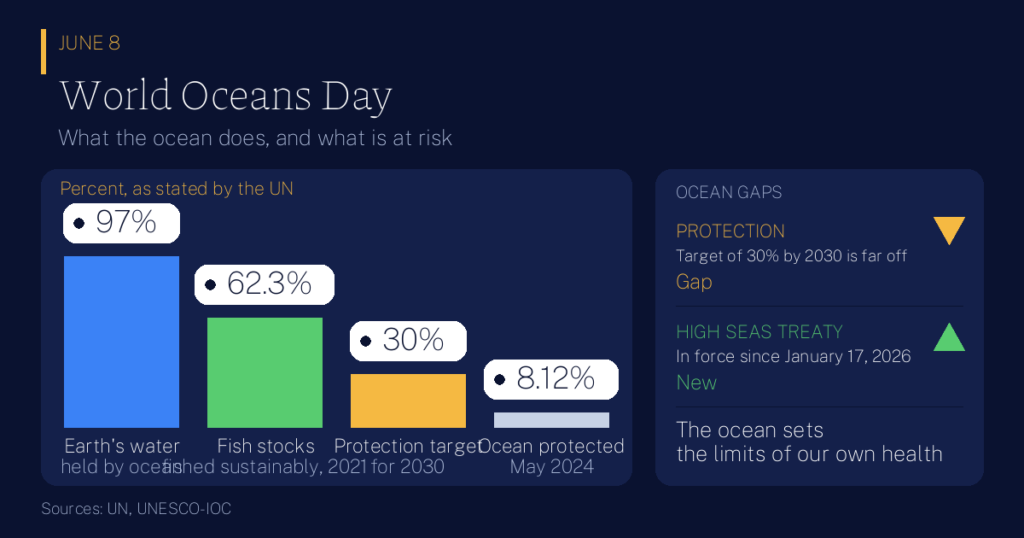
Look at Earth from space and the dominant color is blue. The United Nations describes the ocean as covering about three-quarters of the planet’s surface and holding 97 percent of its water. Yet most of us meet it only at a beach, on a plate or in a weather forecast. World Oceans Day, observed every year on June 8, exists to close that gap. It asks a simple question with a hard answer: if the ocean gives us so much, what do we owe it in return? Like World Water Day, it is a reminder that something enormous can still be strained.
From a Rio forum to a United Nations day
The idea is older than the official day. According to the United Nations, an “Oceans Day” was first declared at the Global Forum in Rio de Janeiro, held alongside the 1992 UN Conference on Environment and Development, and many countries have celebrated it since. In 2008 the General Assembly decided, in resolution 63/111, that from 2009 June 8 would be designated World Oceans Day. A UN release describes the effort as led by Canada. The first official UN observance took place in 2009 under the theme “Our Oceans, Our Responsibility.” Today the day is hosted by the Division for Ocean Affairs and the Law of the Sea in the UN Office of Legal Affairs, in partnership with the non-profit Oceanic Global.
What the ocean does for us
These numbers are hard to hold in the mind, so consider what the UN says the ocean does quietly every day. It generates about half of the oxygen we need, absorbs about 30 percent of carbon dioxide emissions, and captures 90 percent of the heat generated by those excess emissions. It supplies 15 percent of the animal protein people eat and supports more than 150 million jobs that depend on sound management and sustainable production. It is home to a million known species. The health of marine ecosystems and coastal communities is vital to more than 3 billion people, according to the same 2025 UN fact sheet.
A buffer this large can still wear down. The Third World Ocean Assessment, summarized in a UN release on June 8, 2026, reports that about 16 percent of the total increase in ocean heat content since 1955 has occurred since 2018. Sea level is rising at increasing rates, from less than 2.0 millimeters a year before 2015 to 4.3 millimeters a year in 2023. The 2025 UN fact sheet adds that, as of April 2024, sea surface temperatures had reached record highs for 13 consecutive months.
Example 1: the value of a mangrove. The UN notes that mangroves store on average 1,000 tons of carbon per hectare in their biomass and underlying soils. Suppose a coastal town protects 50 hectares of mangrove. At that average, about 50,000 tons of carbon stay locked away. The town size is made up and the arithmetic is round, but it shows why protecting a shoreline can be a climate decision as well as a local one.
Fishing: food, jobs and a shrinking margin
For billions of people the ocean is dinner. It is also a livelihood. The 2026 assessment says small-scale fisheries employ 60.2 million people and produce 25.1 million tonnes a year. But the margin is thinning. The UN fact sheet reports that the share of fish stocks fished at biologically sustainable levels declined from 90.0 percent in 1974 to 64.6 percent in 2019 and 62.3 percent in 2021. It also says one in five fish caught comes from illegal, unreported and unregulated fishing.
Example 2: borrowing from the future. Imagine a fishery that can safely yield 100,000 tonnes a year, but boats land 120,000. The 20,000-tonne overshoot looks small in one season. After five seasons, 100,000 tonnes have been taken from the breeding stock, which is a full year of safe catch borrowed from tomorrow. The numbers are round and illustrative, but this is the logic behind catch limits.
Plastic, pollution and what we cannot see
Pollution is easier to see on a beach than in deep water. The 2025 UN fact sheet says 5 to 12 million metric tons of plastic enter the ocean each year, a figure set to double or triple by 2040. The 2026 assessment cites a higher figure of 52.1 million tonnes of plastic waste a year, contributing to an estimated 24.4 trillion microplastic particles now known to affect more than 4,000 marine species. The two estimates differ because sources and methods differ, which is itself a clue that measurement lags behind the problem.
The same gap shows up on the map. The 2026 assessment states that only 27.3 percent of the seafloor had been mapped as of 2025. We are making decisions about a place we have seen less than a third of in detail.
Example 3: a harbor town’s plastic. Suppose 10,000 households in a harbor town each avoid 2 kilograms of single-use plastic a year. That is 20,000 kilograms, or 20 tonnes, that never reaches the water. The household count and the saving are made up for illustration, but small habits add up when many people share a coastline.
Protection: targets and a new treaty
Under the Kunming-Montreal framework agreed at COP 15 in December 2022, countries committed to protect 30 percent of the ocean by 2030. The UN fact sheet reports that, as of May 2024, 18,200 marine protected areas and 199 area-based conservation measures covered over 8.12 percent of the ocean. That leaves a wide gap to close.
A legal milestone arrived in 2026. UNESCO’s Intergovernmental Oceanographic Commission reports that the High Seas Treaty, formally the BBNJ Agreement under the UN Convention on the Law of the Sea, entered into force on January 17, 2026. It covers areas beyond national jurisdiction, nearly two-thirds of the ocean. For the first time there are legally binding rules to conserve and sustainably use marine biodiversity, share the benefits of marine genetic resources fairly, create marine protected areas on the high seas, and strengthen scientific cooperation. The first Conference of the Parties is to be convened within a year of entry into force. Separately, the UN notes that the Port State Measures Agreement against illegal fishing had 80 Parties as of July 2024, and calls SDG 14 one of the most underfunded of the 17 Goals.
- 97%of Earth’s water is held by the ocean (UN, 2025)
- 62.3%of fish stocks fished sustainably, 2021
- 8.12%of the ocean protected, May 2024
- 27.3%of the seafloor mapped, 2025
Who depends on it, and what the day asks of us
The people most exposed are those closest to the water: coastal communities and the small-scale fishers who feed them, part of the more than 3 billion people whose wellbeing the UN links to marine ecosystems. The theme for 2026 is “Reimagine: Beyond the world we know, a new relationship with our ocean.” That framing treats the ocean not as a limitless supply or a dumping ground, but as a partner whose health sets the limits of our own. For individuals, the day is a prompt to learn where seafood comes from, cut single-use plastic, and support protection and research. For governments, it is a yearly check on whether the 30 percent promise and the new treaty are becoming real.
Key Takeaways
- The day has deep roots. It began at a 1992 Rio forum and became a UN day under resolution 63/111, first observed in 2009.
- The ocean runs quiet services. The UN says it generates about half our oxygen and absorbs about 30 percent of carbon dioxide emissions.
- Heat and sea level are rising. Sea level rise reached 4.3 millimeters a year in 2023.
- Fishing margins are thinner. Sustainably fished stocks fell from 90.0 percent in 1974 to 62.3 percent in 2021.
- Protection lags the promise. About 8.12 percent was protected in May 2024 against a 30 percent goal for 2030.
- The High Seas Treaty is new. It entered into force on January 17, 2026 and covers nearly two-thirds of the ocean.
- We know little of the seafloor. Only 27.3 percent was mapped as of 2025, so more science is needed.
How solid is this? Figures are taken from UN, UNESCO-IOC and related reports and carry the years stated. Plastic estimates differ between the 2025 fact sheet and the 2026 assessment because methods differ. The three worked examples use round, made-up numbers to show an idea. See also the International Days hub and the International Days Calendar.
More in Nature