Every refugee story begins with a decision no one wants to make: to leave home because staying is no longer safe. World Refugee Day, observed every June 20, asks the world to pause and look at the people who have made that choice. It is a day to understand who refugees are, how many people are displaced, where they find shelter, and what it would take to help them go home, settle or rebuild. In 2026 it carries extra weight, because the 1951 Refugee Convention reaches its 75th anniversary.
How the day began
The day grew out of an anniversary. In 2000, at its 55th session, the United Nations General Assembly adopted a resolution on the fiftieth anniversary of the Office of the United Nations High Commissioner for Refugees (UNHCR) and World Refugee Day. The idea was to give the world one shared date to recognize refugees, and it has been marked every year since. UNHCR, the UN refugee agency, leads most of the global campaign, and governments, schools, cities and community groups organize their own events.
The 2026 campaign is called “Until Everyone is Safe.” It rallies young people to stand with refugees and defend the right to seek asylum, and it challenges stereotypes about people who have fled. UN News reported that the UNHCR chief, Barham Salih, called refugee status “a temporary condition, not a lifelong fate,” and set a goal of cutting by half, within ten years, the number of refugees living in long-term displacement.
Who counts as a refugee
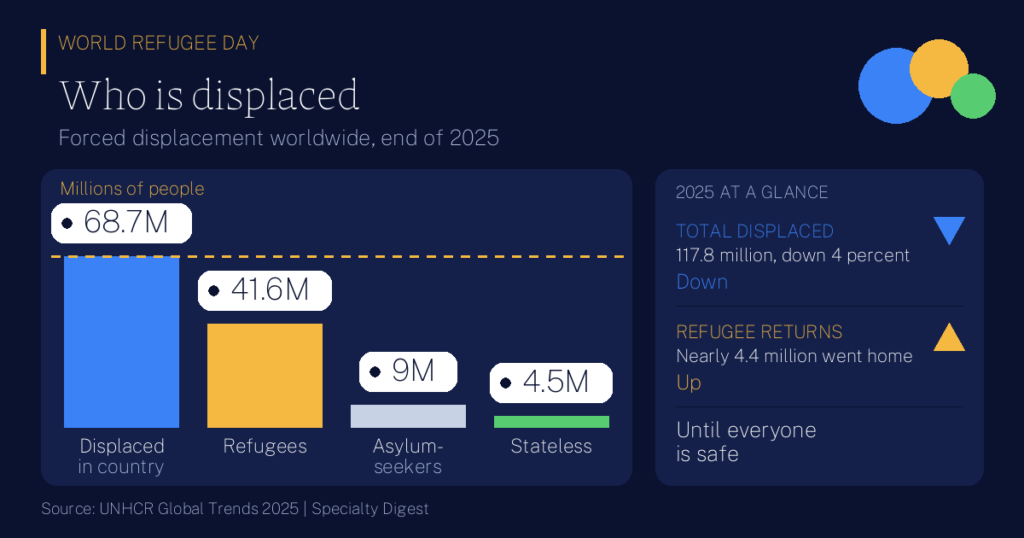
The word is often used loosely, so precision helps. A refugee is a person who has fled their country because of conflict, violence or persecution and cannot safely return. An asylum-seeker is someone who has asked for protection and is waiting for a decision. An internally displaced person has been forced from home but remains inside their own country. A stateless person is not recognized as a citizen by any state. UNHCR counts all of these groups, but they overlap and should not simply be added together.
The 1951 Refugee Convention, adopted in the aftermath of the Second World War, is the treaty that gave refugee protection its legal backbone. This anniversary year is a reminder that the rules were written for a world that had just seen mass flight, and that they still apply to a world where flight is common.
The numbers behind the day
UNHCR’s Global Trends report, published in June 2026, tells the story of 2025. By the end of that year, an estimated 117.8 million people worldwide were forcibly displaced. That is 5.4 million fewer than a year earlier, a decline of 4 percent, and UN News described it as the first drop in a decade. Even so, about one in 70 people on Earth remained displaced.
Example 1: one in 70. Picture a town of 7,000 people. At the global rate, about 100 of them would be displaced from their homes. The numbers are round and illustrative, but they show that displacement is not a rare event happening far away. It touches a measurable share of humanity.
Why the number fell, and what it hides
The fall was driven largely by returns. Nearly 4.4 million refugees went back to their countries of origin in 2025, and when internally displaced people are included, returns reached just over 14.7 million. Afghanistan accounted for 1.9 million refugee returns, Syria for 1.3 million and Sudan for 651,500. UNHCR cautions that many of these returns took place under adverse conditions, so a smaller total does not by itself mean people are safe.
The hidden side is the shrinking door to a new start. Resettlement arrivals, the organized transfer of refugees to a third country, fell to 81,800 in 2025 from 188,800 in 2024. Roughly 70 percent of refugees are in protracted situations, meaning they have been displaced for years with no durable solution in sight. That is the problem the 2026 goal to halve long-term displacement is meant to address.
Example 2: the long wait. Suppose a camp shelters 1,000 refugees and 700 of them, about 70 percent, have been displaced for many years. Halving that group within a decade would mean 350 people finding a lasting solution, whether return, local integration or resettlement. The camp and numbers are made up, but they show how large the task is even at small scale.
Who hosts the world’s refugees
A common belief is that wealthy countries take in most refugees. The data say otherwise. Low- and middle-income countries hosted 68 percent of the total at the end of 2025, and the least developed countries alone hosted 26 percent, about 9.4 million people. UN News named Colombia, Germany and Türkiye as the largest hosting countries. More than 70 percent of refugees came from just six countries: Afghanistan, South Sudan, Sudan, Syria, Ukraine and Venezuela.
Example 3: sharing a burden. Imagine a country of 10 million people that receives 500,000 refugees. That equals 1 in every 20 residents, and schools, clinics and water systems feel it quickly. A country ten times larger receiving the same number would see 1 in 200. The figures are illustrative, which is why UNHCR also tracks hosting relative to a country’s size and income, not only raw counts.
Children, protection and the road ahead
Children are 39 percent of refugees and other people in need of international protection, while they make up 29 percent of the world’s population. That gap means refugee communities are young, and that interrupted schooling and lost years of safety weigh heavily on the next generation.
- 117.8 millionpeople forcibly displaced, end of 2025
- 9 millionasylum-seekers awaiting a decision
- 4.5 millionpeople estimated to be stateless
- 81,800resettlement arrivals in 2025, down from 188,800
The 2026 message from UN Secretary-General Antonio Guterres, as reported by UN News, notes that new and protracted conflicts are compelling millions of women, children and men to seek safety far from home. The day itself asks for modest, practical things: learn the facts, listen to refugees tell their own stories, support local welcome efforts and defend the principle that people fleeing danger can ask for protection. It also connects to broader rights questions explored on Human Rights Day and to the wider movement of people discussed on International Migrants Day.
Key Takeaways
- The day has a clear origin. The UN General Assembly created it in 2000, tied to the fiftieth anniversary of UNHCR.
- Displacement fell, but remains vast. About 117.8 million people were displaced at the end of 2025, roughly one in 70 people.
- Returns drove the decline. Nearly 4.4 million refugees returned home in 2025, often in difficult conditions.
- Poorer countries carry most of the load. Low- and middle-income countries hosted 68 percent of refugees.
- Waiting is the real crisis. About 70 percent of refugees are in protracted situations, and resettlement arrivals more than halved in 2025.
- Children are overrepresented. They are 39 percent of refugees and 29 percent of the world population.
- You can act locally. Learn the facts, challenge stereotypes and support welcome and protection in your own community.
How solid is this? Figures come from UNHCR’s Global Trends report for 2025 and UN News coverage of it, and displacement estimates are revised as new data arrive. The internally displaced figure is an IDMC estimate. The three worked examples use round, made-up numbers to show an idea. If you or someone you know needs protection, UNHCR’s help pages list services by country. Browse the International Days hub and the International Days Calendar.
More in Society
- UNHCR, Global Trends: Forced Displacement in 2025 (June 2026)
- UN News, Refugee numbers drop for first time in a decade (June 2026)
- UN News, World Refugee Day: UN calls for renewed commitment and solidarity (June 2026)
- United Nations, World Refugee Day observance page
- UNHCR, General Assembly resolution on the fiftieth anniversary of UNHCR and World Refugee Day
- UNHCR, World Refugee Day 2026