Most of us will never stand inside a cave, yet many of us drink from one. Caves and karst landscapes, the sinkholes, springs and limestone hills around them, cover nearly a quarter of Earth’s land surface, according to UNESCO, and they provide drinking water to more than a billion people. They also shelter animals found nowhere else and keep a record of ancient climates. Despite all that, these places had never had a day of their own at the global level. Now they do. The International Day of Caves and Karst, observed every September 13, asks the public to notice a hidden landscape that quietly holds up water, wildlife and communities. Its nearest companion in the calendar is World Water Day, because so much of what happens underground is about water.
A first for caves and karst
The day is new. At the UNESCO General Conference held in Samarkand, Uzbekistan, on November 12, 2025, member states proclaimed September 13 as the International Day of Caves and Karst. The International Union of Speleology (UIS) reports that the decision was confirmed by consensus of all member states present at the plenary session, and it describes the day as the first time caves and karst have been recognized globally through an official UNESCO observance.
The path there ran through the UNESCO Executive Board, which adopted its decision on October 9, 2025. The proposal was submitted by Slovenia together with Algeria, Bosnia and Herzegovina, Bulgaria, Croatia, Ecuador, Egypt, Guatemala, Luxembourg, Malta, Mexico, Monaco, Portugal, Serbia and Slovakia, and the UIS reports backing from more than 150 organizations. The first celebration was scheduled for Postojna, Slovenia, from September 10 to 13, 2026, anchored by an international scientific conference and an official ceremony, as UNESCO’s day page describes it.
What karst means
Karst is the name for a landscape shaped by water dissolving rock, usually limestone. Rain absorbs carbon dioxide and becomes slightly acidic, and as it seeps into cracks it widens them over very long periods. The result is a terrain of sinkholes, disappearing streams, springs and caves, where much of the drainage runs underground instead of across the surface. A cave is one visible part of the system. The rest is a hidden network of passages and fractures that can carry water quickly across great distances. That network is the key to everything that follows, because what enters at one place can emerge at another.
The numbers behind the day
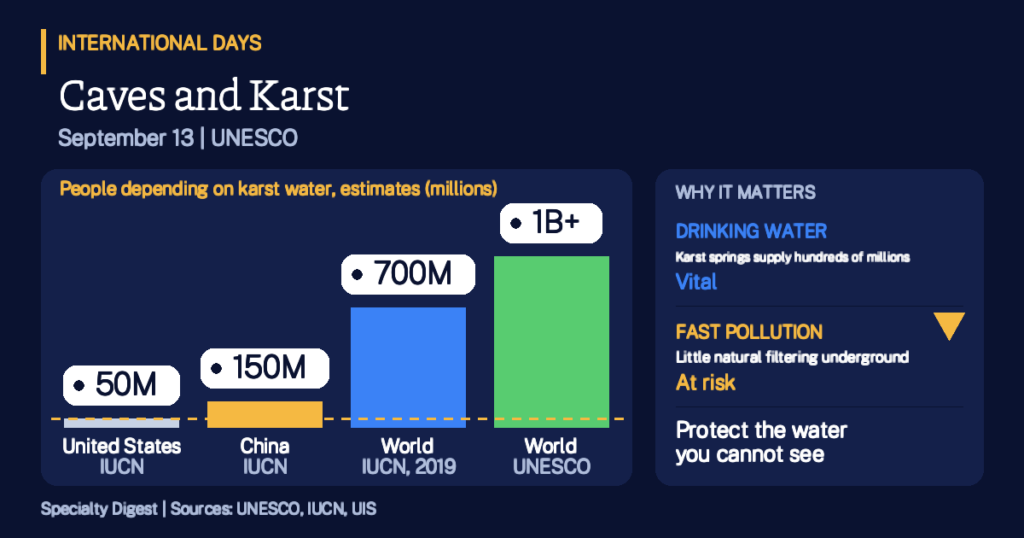
UNESCO says caves and karst landscapes provide drinking water to more than a billion people. The IUCN, in its Guidelines for Cave and Karst Protection, cites a 2019 estimate that around 10 percent of the world’s population, about 700 million people, gained their potable water supplies from karst. A 2025 review summarized by Eos likewise says karst groundwater provides drinking water to nearly 10 percent of the world’s population. The estimates differ because they count and model different things, so they are best read as a range. They agree on the main point: hundreds of millions of people depend on this water.
The IUCN guidelines name the heaviest users. China has around 150 million people depending primarily on karst groundwater, and the United States is second, with around 50 million.
- Nearly 1/4of Earth’s land surface is caves and karst, per UNESCO
- 1 billion+people receive drinking water from them, per UNESCO
- About 10%of the world’s people, per IUCN’s 2019 estimate
- 150+organizations backed the proposal, per the UIS
Example 1: one spring, one town. Imagine a town of 20,000 people that draws all its water from a single karst spring. After heavy rain, runoff from a farm field a few miles away enters a sinkhole and reaches the spring within days. In a sand aquifer the same water might spend months or years being filtered. The numbers are round and illustrative, but the pattern is the one scientists warn about: in karst, the distance between a pollution source and a tap can be short.
Life in the dark
Caves are not empty. Their isolation makes them natural laboratories for evolution, and UNESCO says these environments preserve unique subterranean biodiversity. The IUCN guidelines give concrete cases. Movile Cave in Romania, rich in hydrogen sulfide, is home to at least 51 species, of which 34 are endemic, meaning found nowhere else. The Edwards Aquifer in Texas hosts more than 60 species.
Endemic life is the heart of the matter. A species confined to one cave system has nowhere to retreat if its home is polluted, drained or quarried.
Example 2: the cost of one cave. Suppose a survey of a single cave finds 10 species, and 7 of them live in no other place on Earth. If the cave is filled in for construction, 7 species vanish from the planet, even though no one ever saw them. The figures are made up for illustration, but the logic matches the Movile Cave case, where most known species are endemic.
A landscape that is easy to harm
Because water moves quickly through karst, there is little natural filtering. The IUCN guidelines state that industrial and agricultural pollutants can be transported rapidly through the subsurface networks of karst, and that quarrying has the potential to destroy caves and their contents. The 2025 review adds that industrial chemicals, agricultural runoff, sewage and land use changes are common threats, and that there is little time or space for pollutants to be filtered or degraded. A river that turns muddy warns everyone downstream. A karst spring can decline out of sight.
Groundwater as a whole is already essential. The UN World Water Development Report 2022 notes that groundwater provides half of the volume of water withdrawn for domestic use by the global population. Karst is one of its most productive and most exposed forms.
Example 3: prevention versus cure. Say a region can protect the land around its karst springs for $1 million, or later build a treatment plant for $5 million after the water is spoiled. The figures are round and illustrative, but they capture a common argument in water management: keeping a source clean is usually cheaper than cleaning it afterward.
Shared water, shared responsibility
Karst pays no attention to borders. UNESCO describes the Dinaric Karst Aquifer System as one of the world’s largest transboundary freshwater systems, shared by several countries in South-East Europe. Its second-phase project, run jointly by UNESCO and UNDP with Global Environment Facility backing, aims to catalyze effective multi-country cooperation for the sustainable management of the system. Albania, Bosnia and Herzegovina, Montenegro and Croatia are listed as beneficiaries. The idea is simple: when water flows underground across a border, so must the planning.
How the day is marked
UNESCO sets out four objectives. The first is to raise global awareness of karst systems and caves. The second is to advance the UN Sustainable Development Goals, particularly Goals 6, 11, 13 and 15, covering water, urban development, climate action and biodiversity. The third is to strengthen cooperation and education, and the fourth is to promote sustainable tourism in cave and karst destinations. Organizers can submit events through an official form handled by the International Union of Speleology.
For individuals, the day invites small questions. Where does your tap water come from, and is the source karst? Does a nearby cave or sinkhole have protection? Do the tour operators you support follow rules that keep caves intact? Learning the answers is a first step to caring about a landscape most of us never see.
Key Takeaways
- The day is brand new. UNESCO member states proclaimed September 13 at the General Conference in Samarkand on November 12, 2025.
- Karst is water in stone. Dissolved rock creates sinkholes, springs and caves that move water underground.
- Hundreds of millions depend on it. Estimates range from about 700 million (IUCN, 2019) to more than a billion (UNESCO).
- Caves shelter unique life. Movile Cave alone holds at least 51 species, 34 of them endemic.
- Pollution travels fast. Little filtering means contaminants can reach springs within a short time.
- Cooperation is essential. Aquifers such as the Dinaric system cross borders, so management must too.
How solid is this? The proclamation facts come from UNESCO’s day page and the UIS account of the Samarkand decision; the sources reviewed did not state a resolution number, so none is given. UNESCO’s day page described the first celebration in the future tense. Population estimates for karst water are modeled and differ by source, and a 2024 UNESCO article on the Dinaric aquifer gives a higher figure, one quarter of people living on or obtaining water from karst aquifers, without citing a source. The three worked examples use round, made-up numbers. See also World Water Day, the International Days hub and the International Days Calendar.
More in Nature
- UNESCO, International Day of Caves and Karst
- International Union of Speleology, Bulletin 67(2), 13 September proclaimed as International Day of Caves and Karst
- IUCN, Guidelines for Cave and Karst Protection, 2nd edition (2022)
- Eos (2025), Groundwater Pollution in Karst Regions: Toward Better Models
- UNESCO, Improving Groundwater Governance and Sustainability of Dinaric Karst
- UN World Water Development Report 2022, Groundwater: Making the Invisible Visible