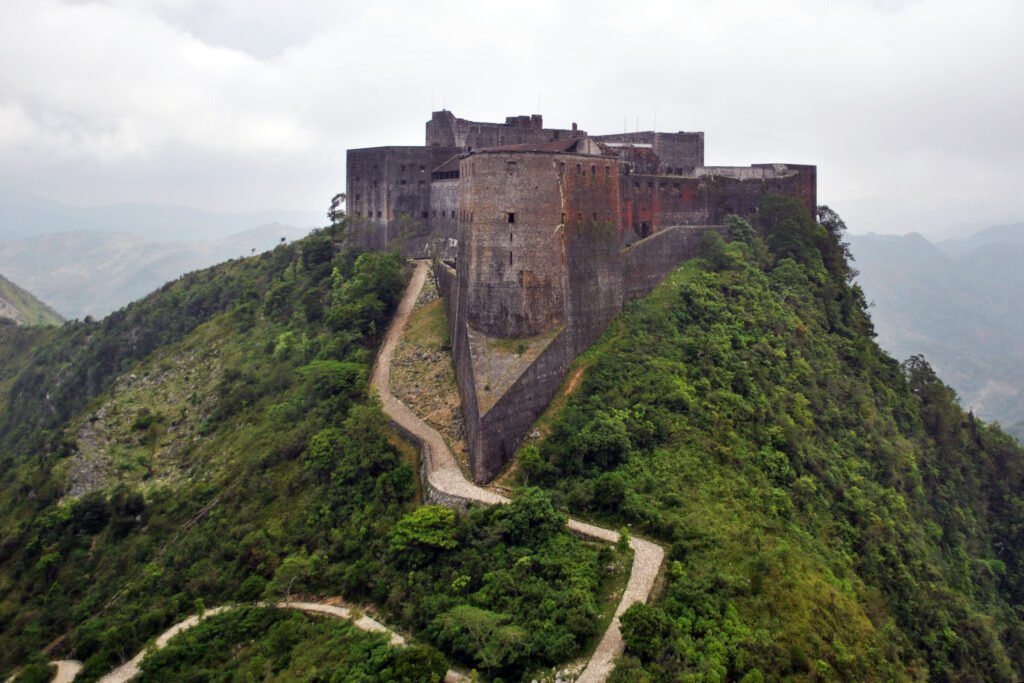
Haiti is a Caribbean country that occupies the western third of the island of Hispaniola, which it shares with the Dominican Republic. It is the only nation in the world founded by a successful uprising of enslaved people, and it became the second independent country in the Americas when it declared independence from France on January 1, 1804. Today Haiti is a republic of an estimated 11.9 million people, known for its mountainous terrain, its Haitian Creole language, its Vodou and Catholic religious traditions, and for one of the most severe and persistent political and economic crises in the Western Hemisphere.
Key Takeaways
- Haiti occupies the western third of the Caribbean island of Hispaniola, bordering the Dominican Republic to the east.
- It became independent from France on January 1, 1804, after a revolution that began with a large-scale slave uprising in 1791.
- Haiti was the first country in the world established by formerly enslaved people, and the second independent nation in the Americas after the United States.
- Haiti’s population is estimated at about 11.9 million people (World Bank, 2025), most of whom speak Haitian Creole and French.
- The Citadelle Laferriere, a mountaintop fortress completed in the early 1800s, anchors a UNESCO World Heritage Site and is Haiti’s best-known landmark.
- Since the early 2020s, Haiti has faced a severe crisis marked by gang violence, political instability, and economic contraction.
- The World Bank classifies Haiti as a lower-middle-income economy and the poorest country in the Latin America and Caribbean region.
Where Is Haiti Located?
Haiti sits in the Caribbean Sea, occupying the western third of Hispaniola, the island it shares with the Dominican Republic. It lies between the Atlantic Ocean to the north and the Caribbean Sea to the south, with Cuba across the Windward Passage to the west and Jamaica farther to the southwest. The capital and largest city, Port-au-Prince, sits on a bay along the country’s southern peninsula. Haiti’s official name is the Republic of Haiti, and in Haitian Creole the country is called Ayiti.
The Geography of Haiti
Haiti is one of the most mountainous countries in the Caribbean. Its name derives from an Indigenous Taino word generally translated as land of high mountains. Roughly 60 percent of its terrain is hilly or mountainous, split into several ranges separated by river valleys and the fertile Artibonite Valley, the country’s principal agricultural region. The climate is tropical and moderated by trade winds, with distinct wet and dry seasons and a real risk of hurricanes between June and November.
Haiti’s location and terrain also make it one of the most disaster-exposed countries in the world. It sits near the boundary between the Caribbean and North American tectonic plates, a fault system that produced the catastrophic magnitude-7.0 earthquake of January 2010, and it is regularly affected by hurricanes and tropical storms. Centuries of deforestation, driven largely by charcoal production and land clearing for agriculture, have left much of the country vulnerable to flooding and soil erosion.
A Brief History of Haiti
Colonial Rule and the Haitian Revolution
Before independence, Haiti was the French colony of Saint-Domingue, established on the western part of Hispaniola after Spain ceded that portion of the island to France in 1697. Built on the forced labor of enslaved Africans, Saint-Domingue’s sugar and coffee plantations had made it the wealthiest colony in the Americas by the late 1700s.
That wealth rested on brutal exploitation, and the colony’s enslaved majority organized a large-scale uprising that broke out on August 22, 1791, according to the U.S. Department of State’s Office of the Historian. Over the following thirteen years, the uprising grew into a wider revolution and civil war that drew in French, Spanish, and British forces and produced a class of formerly enslaved military leaders, including Toussaint Louverture and, later, Jean-Jacques Dessalines. Dessalines declared independence on January 1, 1804, renaming the new nation Haiti.
Independence and the Nineteenth Century
Haiti’s independence unsettled slaveholding powers across the Atlantic world, and the new nation was diplomatically isolated for decades. The United States, whose political leadership at the time included many enslavers, did not formally recognize Haitian independence until 1862. France, meanwhile, used naval pressure to push Haiti into compensating former colonists for the loss of their human property. Under that pressure, Haiti agreed in 1825 to an indemnity it did not finish repaying until 1947. Historians differ on exactly how much this debt, later refinanced through French and American bank loans, held back the country’s development, but many economic historians treat it as a significant, if contested, contributing factor to Haiti’s long-term fiscal weakness.
Twentieth and Twenty-First Century Haiti
Haiti endured a nineteen-year occupation by United States military forces from 1915 to 1934, and later the long authoritarian rule of Francois Duvalier and his son Jean-Claude Duvalier from 1957 to 1986. Since the end of the Duvalier era, Haiti has cycled through periods of elected government, coups, and foreign-backed transitions. A magnitude-7.0 earthquake in January 2010 killed a widely cited but disputed number of people, with estimates ranging from roughly 100,000 to over 200,000, and devastated Port-au-Prince; Hurricane Matthew caused further heavy damage in 2016.
In the 2020s, Haiti’s political institutions have deteriorated further. The president was assassinated in July 2021, no national elections have been held since, and armed gangs have taken effective control of large parts of Port-au-Prince, displacing an estimated 1.4 million people as of early 2026, according to the World Bank. According to the United Nations High Commissioner for Human Rights, more than 5,500 people were killed by violence in 2025 alone. A transitional governing council has been overseeing the country pending planned elections, with support from an international security mission, though the timeline for any return to stable elected government remains unsettled as of this writing.
Government and Economy Today
Haiti is constitutionally a semi-presidential republic, with provision for an elected president, a prime minister, and a bicameral legislature. In practice, the collapse of elected government since 2021 has left the country under a transitional arrangement intended to organize new elections rather than under this structure as normally exercised. This article does not name current officeholders, since the transitional arrangement continues to change.
Economically, the World Bank classifies Haiti as a lower-middle-income country, and it remains the poorest nation in Latin America and the Caribbean. Its economy contracted for a seventh consecutive year in 2025, with real GDP falling by an estimated 2.7 percent amid intensifying gang violence, while inflation averaged 28.3 percent. The World Bank estimates that about 49 percent of Haitians were living on less than three U.S. dollars a day, in 2021 purchasing-power terms, in 2025. Agriculture, light manufacturing such as garment assembly for export, and remittances from Haitians living abroad are central to the economy, alongside substantial international aid.
Culture and People of Haiti
Language and Religion
Haiti’s two official languages are French and Haitian Creole (Kreyol), a language that developed among enslaved and free populations in colonial Saint-Domingue and is spoken by nearly the entire population; French remains dominant in government, formal education, and the courts. Roman Catholicism has historically been the largest religious affiliation, alongside a growing Protestant population, and many Haitians also practice or draw on Haitian Vodou, a religion with roots in West African traditions that developed alongside Catholicism during the colonial period.
Arts, Music, and the Diaspora
Haiti has a distinctive and internationally recognized artistic tradition, especially in painting: the vividly colored, often naive style associated with mid-twentieth-century artists helped establish Haitian art as a recognized genre in its own right. Haitian music, including genres such as compas (konpa), has shaped popular music across the French-speaking Caribbean. A large Haitian diaspora, concentrated in the United States, Canada, France, and the Dominican Republic, sends remittances that make up a substantial share of the national economy and maintains close cultural and family ties with the country.
What Is Haiti Best Known For?
Internationally, Haiti is best known for two things that sit in tension with each other: its founding history and its recent instability. As the first nation established by a successful revolt of enslaved people, Haiti holds a singular place in the history of abolition and Black self-determination, a legacy embodied above all by the Citadelle Laferriere. Built in the early 1800s on the orders of Henri Christophe, one of the new nation’s early rulers, the Citadelle is the largest fortress in the Americas and, together with the nearby Sans-Souci Palace and the Ramiers site, forms the National History Park, a UNESCO World Heritage property that UNESCO describes as carrying universal symbolism because it was built by formerly enslaved people who had won their freedom.
At the same time, Haiti is widely known, especially since the 2010 earthquake, for a series of overlapping crises: natural disasters, extreme poverty, and, most recently, gang violence and political collapse that have drawn repeated international attention and humanitarian response.
Why Haiti Matters
Haiti matters to global history out of proportion to its size. Its revolution was the only fully successful national slave revolt in the modern era, and it forced France, Britain, Spain, and the United States to reckon, in real time, with the fact that enslaved people could overthrow a colonial power and govern themselves. That history continues to inform debate today, including ongoing discussion of the long-term costs of the independence indemnity Haiti was forced to pay and of the broader history of foreign intervention in Haitian affairs.
Haiti also matters as a live test of how the international community responds to state fragility close to its own borders. Its proximity to the United States, its large diaspora, and its exposure to hurricanes and earthquakes mean that developments in Haiti, whether a security crisis, a migration wave, or a natural disaster, tend to have direct and immediate effects on its neighbors and on international aid, migration, and security policy.
Sources
- World Bank | Haiti Overview | Undated | https://www.worldbank.org/en/country/haiti/overview | Accessed 2026-09-27
- World Bank Open Data | Population, total: Haiti (SP.POP.TOTL) | Undated | https://api.worldbank.org/v2/country/HTI/indicator/SP.POP.TOTL?format=json&mrnev=1 | Accessed 2026-09-27
- World Bank Open Data | Haiti Country Data (capital city, income classification) | Undated | https://api.worldbank.org/v2/country/HTI?format=json | Accessed 2026-09-27
- UNESCO World Heritage Centre | National History Park, Citadel, Sans Souci, Ramiers | Undated | https://whc.unesco.org/en/list/180/ | Accessed 2026-09-27
- U.S. Department of State, Office of the Historian | The United States and the Haitian Revolution, 1791-1804 | Undated | https://history.state.gov/milestones/1784-1800/haitian-rev | Accessed 2026-09-27
Key facts
- Haiti's population is estimated at approximately 11.9 million people.2
- Haiti is classified by the World Bank as a lower-middle-income economy and the poorest country in Latin America and the Caribbean.1
- The capital and largest city is Port-au-Prince.3
- The Citadelle Laferriere, part of the National History Park World Heritage Site, is considered a symbol of the freedom won by formerly enslaved people.4
- The Haitian Revolution began with a large-scale slave uprising on August 22, 1791, leading to independence in 1804.5
Quick checkWhat historic event led to Haiti becoming an independent nation?Show answer
A revolution that began with a large-scale slave uprising in 1791 led to Haiti declaring independence from France on January 1, 1804, making it the first country founded by formerly enslaved people.
Sources
- World Bank. Haiti Overview. Undated (accessed 2026-09-27)
- World Bank Open Data. Population, total: Haiti (SP.POP.TOTL). Undated (accessed 2026-09-27)
- World Bank Open Data. Haiti Country Data (capital city, income classification). Undated (accessed 2026-09-27)
- UNESCO World Heritage Centre. National History Park, Citadel, Sans Souci, Ramiers. Undated (accessed 2026-09-27)
- U.S. Department of State, Office of the Historian. The United States and the Haitian Revolution, 1791-1804. Undated (accessed 2026-09-27)
Editorially reviewed by Specialty Digest Editorial TeamLast reviewed September 27, 2026Researched and drafted with AI assistanceReport an issue