Every language carries a way of seeing the world, and the United Nations works in six of them. Russian Language Day, observed every June 6, is one of six days the Organization set aside to celebrate those languages and the cultures behind them. It falls on the birthday of Aleksandr Pushkin, the poet whom UNESCO has called the father of modern Russian literature. The day can look like a purely cultural occasion, yet it also reflects a working rule of the UN: that the people it serves should be able to follow its work in more than one tongue. It belongs to a family of observances that includes Arabic Language Day and French Language Day.
A day for each official language
The idea took shape in February 2010, when the UN’s Department of Public Information announced “Language Days at the United Nations,” timed to International Mother Language Day on February 21. The department, now called the Department of Global Communications, assigned one day to each of the six official languages: Arabic, Chinese, English, French, Russian and Spanish. According to the UN, the purpose is to celebrate multilingualism and cultural diversity and to promote equal use of all six official languages throughout the Organization.
The 2010 announcement explained that each date was chosen for its symbolic or historic significance, and that the events should entertain as well as inform, raising awareness of each language’s history, culture and achievements. For Russian, the chosen date was Pushkin’s birthday.
Why Pushkin, and why June 6
Aleksandr Pushkin was born on June 6, 1799, and died in 1837. The UN Chronicle describes him as Russia’s most celebrated poet and writer, and in 2024 the chair of UNESCO’s Executive Board, opening the day’s observance in Paris, called him Russia’s greatest poet and the father of modern Russian literature. UNESCO has a long record of joining Pushkin celebrations: its General Conference resolved in 1997 to take part in the 200th anniversary of his birth, and in 1999 its Executive Board called on member states to hold official festivities.
One reason his name carries so far is the voice he chose. UNRIC notes that Pushkin wrote in the Russian that people actually spoke, rather than in the formal style of his era. In that sense a language was shaped by someone who listened closely to it, which is exactly the kind of story a language day is meant to tell.
How Russian became a UN language
Multilingualism is older than the day itself. At its first session in 1946, the General Assembly’s resolution 2(1) proclaimed Chinese, English, French, Russian and Spanish as official languages, with English and French as working languages. The UN states that Russian has been an official language since 1946, a working language of the General Assembly since 1968 and of the Security Council since 1969. It is also a working language of the Economic Commission for Europe and of ESCAP. Arabic joined in 1973, completing the six.
An official language is one the Organization recognizes formally, while a working language is used in the daily business of a particular body. The distinction matters, because the practice spread slowly. The first issue of the UN Chronicle, on August 3, 1946, appeared in English and French. Spanish was added in January 1948, and Russian translation began in 1982.
Example 1: the delegate’s choice. Imagine a meeting with 100 delegates, 20 of whom follow the debate most comfortably in Russian. If the room offered only English and French, those 20 would work in a second language and could miss nuance in a tense negotiation. Interpretation lets all 100 take part on equal terms. The numbers are round and illustrative, but they show the point of equal use of official languages.
The numbers behind the language
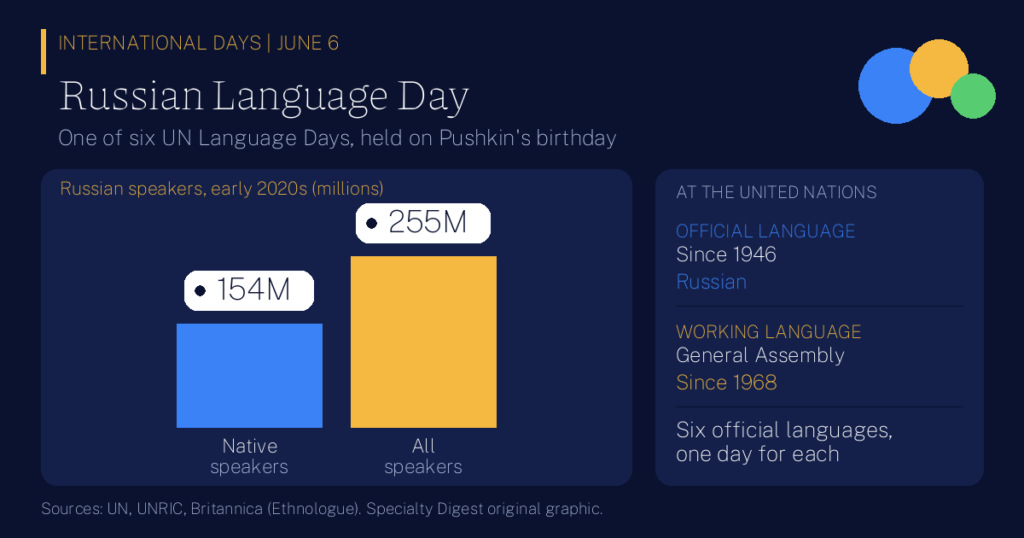
How many people speak Russian depends on who counts. Britannica, drawing on Ethnologue data from the early 2020s, lists Russian with about 255 million total speakers. In 2024 the chair of UNESCO’s Executive Board said Russian has over 250 million speakers worldwide. UNRIC puts native speakers at roughly 154 million, and it cautions that its own total of over 258 million is probably high because it counts people of Russian ancestry who may no longer speak the language. The fair summary is about 154 million native speakers and about 250 to 260 million in all.
Russian is an official language of Russia, Belarus, Kazakhstan and Kyrgyzstan, and UNESCO’s board chair noted its widespread use in Armenia, Azerbaijan, Tajikistan, Turkmenistan and Uzbekistan as well. UNRIC calls it the most spoken Slavic language and the most spoken native language in Europe. Online, the UN Chronicle reports that by number of websites Russian ranks second only to English.
- 6official languages at the United Nations
- 1946year Russian became an official UN language
- 154 millionnative speakers, by UNRIC’s estimate
- 255 milliontotal speakers, by Britannica’s early 2020s figure
Example 2: reading the two numbers. Suppose a survey found 100 Russian speakers in a city, and 60 grew up speaking it at home while 40 learned it later at school or work. That is close to the ratio between the native and total estimates above, about 60 percent. The survey is invented and rounded, but it shows why one language can have two quite different headline numbers.
A script, a sound, a vocabulary
Russian is written in Cyrillic, which UNRIC describes as closely based on the Greek alphabet, with about a dozen additional letters for Slavic sounds. Britannica counts 32 letters in the modern Russian alphabet, or 33 if the soft sign is included, though it notes the soft sign is not strictly a letter. Words travel across borders too. UNRIC lists bolshevik, cosmonaut, sputnik and vodka among the English words of Russian origin, and notes that the computers on the International Space Station use English and Russian. It also points out that Russian separates light blue and dark blue into distinct basic color words, a small reminder that languages carve up experience differently.
Why multilingualism matters
The UN treats multilingualism as a founding principle, set out in the second resolution of the first General Assembly session in 1946. The UN Chronicle argues that the practice helps combat illiteracy, helps preserve endangered languages, forms part of global citizenship, and improves the performance of staff and the quality of outcomes.
Example 3: a health notice. Picture a town where a vaccination notice printed in one language is understood by 60 of every 100 residents. Printed in two, it might reach 90 or more. The figures are made up and rounded, yet the logic is the one behind UN language policy: information that people cannot read does not protect them.
How the day is marked
Observances differ by year and place. The UN reports that its entities have held events in New York, Geneva and Vienna, including poetry readings, literary recitals, theatrical performances and discussions about the language. The UN Office at Nairobi hosted a Russian Language Day event in 2026, and a UN event in 2025 carried the title “Found in Translation.” At UNESCO in Paris, the 2023 event was organized by the permanent delegations of the Russian Federation, Armenia, Azerbaijan, Belarus, Kazakhstan, Kyrgyzstan, Tajikistan, Turkmenistan and Uzbekistan, and the Executive Board chair opened the 2024 observance. The UN’s observance page lists no yearly theme.
Key Takeaways
- It is one of six. The UN launched Language Days in 2010, one for each official language, to promote equal use of all six.
- The date honors a poet. June 6 is Pushkin’s birthday, chosen for its symbolic meaning.
- Russian is an old UN language. It has been official since 1946, and a working language of the General Assembly since 1968 and the Security Council since 1969.
- Counts depend on the source. Estimates run from about 154 million native speakers to roughly 250 to 260 million in total.
- Languages shape access. Information and decisions reach more people when they are available in more than one language.
- Multilingualism has practical value. The UN Chronicle links it to literacy, preservation of endangered languages and better outcomes.
How solid is this? Dates, resolutions and language-status facts come from United Nations pages, though some secondary sources credit UNESCO with creating the day. Speaker counts are estimates from different sources and years, and UNRIC itself flags its total as probably high. The three worked examples use round, made-up numbers to show an idea. See also the International Days hub and the International Days Calendar.
More in Society
- United Nations. Russian Language Day.
- United Nations. Six Official UN Languages.
- United Nations Department of Public Information. Department of Public Information to Launch Language Days at the United Nations (2010).
- UN Chronicle. When Pushkin Comes to the Rescue: Multilingualism as a Principle for Harmonious Cooperation.
- UNESCO. Speech by the Chairperson of the Executive Board, Russian Language Day (June 6, 2024).
- United Nations Regional Information Centre (UNRIC). Russian language: many shades of blue.
- Encyclopaedia Britannica. Languages by total number of speakers.