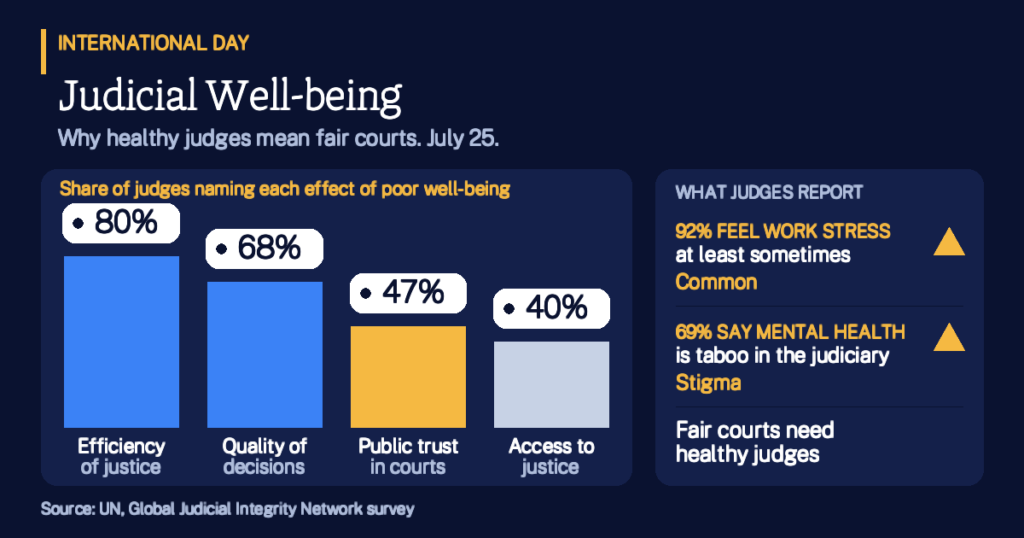
Judges decide who goes free, who keeps a home and who raises a child, often in a single afternoon and often alone. The people who carry that weight rarely feature in conversations about health at work. The International Day for Judicial Well-being, observed every year on July 25, asks the world to notice them. The reasoning is simple and serious: a judge who is exhausted, isolated or afraid has a harder time giving every person a fair hearing. That makes judicial well-being a concern for anyone who may one day need a court, not only for those who sit on the bench. It also sits beside other efforts to keep justice credible, such as the International Day to End Impunity for Crimes against Journalists.
From a Pacific island to the General Assembly
The day grew out of a small, determined gathering. In July 2024, judicial leaders and global experts met in Nauru for a regional conference on judicial integrity and well-being, organized by the UN Office on Drugs and Crime (UNODC) with the Nauru Judiciary. On July 25 they adopted the Nauru Declaration on Judicial Well-being, which sets out seven guiding principles.
Nauru then took the idea to New York. Its Minister for Foreign Affairs and Trade introduced a draft resolution at the General Assembly, and the Assembly adopted it by a recorded vote of 160 in favor, 1 against and 3 abstentions, according to the UN press release. The resolution, A/RES/79/266, proclaims July 25 of each year the International Day for Judicial Well-being. The date matches the day the Nauru Declaration was adopted, and the first observance took place on July 25, 2025. A global conference on judicial integrity and well-being followed in Port Moresby, Papua New Guinea, on August 20 to 22, 2025.
What judicial well-being means
Well-being here is broader than avoiding illness. It covers a judge’s physical health, mental health and sense of purpose, and also the conditions of the job: workload, safety, support and workplace culture. The UN observance page puts the link plainly, calling judicial well-being a prerequisite for judicial independence, integrity and efficiency. The page also cites Article 11 of the UN Convention against Corruption, which concerns judicial independence and integrity, and the Bangalore Principles of Judicial Conduct, the global reference for judicial ethics. The work rests on the Global Judicial Integrity Network, which UNODC established in 2018. A court cannot be impartial and diligent if its people are running on empty.
The numbers behind the day
Judges seldom speak publicly about strain, so data matter. A survey by the Global Judicial Integrity Network, covering judges in more than 100 countries and labeled 2021 on the UN observance page, found that 92 percent experience stress from judicial work at least sometimes. Some 89 percent know colleagues facing stress or anxiety, and 76 percent said they lack enough time to look after their physical and mental health. Stigma runs deep: 69 percent said talking about mental health is still taboo in the judiciary, and 83 percent said their court system gives too little well-being support. Almost everyone, 97 percent, agreed that judicial well-being needs more attention and visibility.
Why healthy judges mean fair courts
The same survey asked what suffers when judicial well-being is poor. Judges named the efficiency of justice most often, at 80 percent, then the quality of decisions at 68 percent, public trust at 47 percent and access to justice at 40 percent. The logic is easy to follow. Tired or overloaded judges decide more slowly and with less room for error, and people waiting on a ruling about a custody dispute, a contract or a sentence feel it first. When trust drops, people may think twice about using the courts at all.
Example 1: a court losing judges. Imagine a court of 100 judges that decides 400 cases per judge each year, 40,000 in all. If stress leads 10 judges to leave and none are replaced, their 4,000 cases fall to the remaining 90. Each of them takes on about 44 more cases, an 11 percent increase, which raises the pressure on the very people the court is trying to retain. The numbers are round and illustrative, but the cycle is what well-being programs try to break.
Example 2: the cost of silence. Suppose a court of 50 judges mirrors the survey, with about 70 percent saying mental health is taboo. That would be about 35 judges who hesitate to ask for help. If a confidential peer-support service opened and even 10 of them used it in the first year, the court would have 10 fewer people struggling alone. The figures are made up and rounded, yet they show why removing stigma comes first.
What the pressure looks like on the bench
Researchers have studied the topic for decades. Isaiah Zimmerman published an early analysis of judicial stress in 1981, pointing to caseloads, a lonely professional transition, image maintenance and isolation. A 2019 US National Judicial Stress and Resiliency Survey of 1,034 judges, reported in 2023 by Maroney and colleagues in Judicature, found nearly 80 percent citing the gravity of their decisions and 73.2 percent citing heavy caseloads as sources of stress. About 9.5 percent fell into higher-risk categories on an alcohol screening test. In England and Wales, the 2024 Judicial Attitude Survey, led by Professor Cheryl Thomas of University College London, found that 14 percent of salaried judges reported bullying over the previous two years and 39 percent were considering leaving the judiciary within five years.
- 1,034judges took part in the 2019 US stress and resiliency survey
- 67.6%of them cited unprepared attorneys as a source of stress
- 62.5%cited self-represented litigants as a source of stress
- 39%of salaried judges in England and Wales considered leaving within five years (2024)
Example 3: a growing backlog. Picture a court that closes 100 cases a week when fully staffed and 90 a week when short-handed. Over a 50-week year the gap is 500 cases, and each one is a family, a business or a defendant waiting longer for an answer. The numbers are illustrative, but they show how a human problem becomes a public one.
Seven principles and how the day is marked
The Nauru Declaration is the day’s working text. Its seven guiding principles, summarized below, stress that responsibility is shared, so well-being is not left to individual judges to solve alone.
- 1Judicial well-being is fundamental
- 2Stigma must be removed
- 3Responsibility is shared
- 4Culture matters
- 5Approaches should be holistic
- 6Solutions must fit local context
- 7Well-being is linked to human rights
On and around the day, judicial bodies and legal associations hold talks and events. The International Bar Association’s Professional Wellbeing Commission, for example, marked the inaugural day. Anyone, whether or not they work in a court, can ask a simple question: do the people who decide cases in our community have the time, support and safe conditions to do it well? If you are struggling yourself, a doctor, counselor or local crisis line is the right place to start.
Key Takeaways
- Fair courts need healthy judges. The UN frames judicial well-being as a prerequisite for independence, integrity and efficiency.
- The day is new and deliberate. Resolution A/RES/79/266 followed the 2024 Nauru Declaration, and the first observance was July 25, 2025.
- Stress is widespread. In the network survey, 92 percent of judges feel work stress at least sometimes.
- Stigma is the barrier. Some 69 percent call mental health a taboo and 83 percent say support is insufficient.
- Everyone pays when judges struggle. Judges name efficiency, decision quality and public trust as the first casualties.
- Solutions are shared. The seven principles point to workload, culture and open conversation, not to individual willpower alone.
How solid is this? The survey figures are self-reported views of judges, not clinical diagnoses. The UN page labels the Global Judicial Integrity Network survey as 2021, while the report it links is dated 2022, so treat the year as approximate. The US and UK surveys use different samples and are not directly comparable. The three worked examples use round, made-up numbers to show an idea. See also the International Days hub and the International Days Calendar.
More in Society
- United Nations. International Day for Judicial Well-being. Observance page.
- United Nations. General Assembly press release GA/12676 (2025), on draft resolution A/79/L.52.
- United Nations. International Day for Judicial Well-being, resolution record, UN Digital Library.
- UNODC. One year on: Reflecting on the Nauru Declaration and the inaugural International Day for Judicial Well-being (2025).
- UNODC. Mental health in the judiciary: new well-being declaration launched in Nauru (2024).