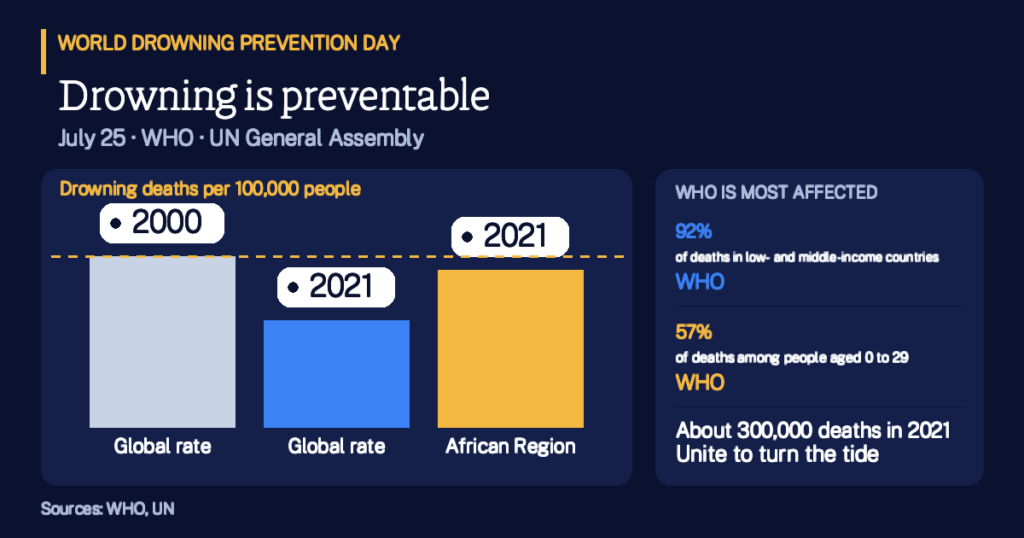
Drowning rarely makes headlines, yet it takes about 300,000 lives a year, which is more than 30 every hour. Many of those who die are small children who were out of sight for only a short time. World Drowning Prevention Day, observed every year on July 25, exists because drowning is largely preventable and still largely ignored. It asks governments, communities and families to put simple, proven protections in place before a tragedy, not after. It also shares a theme with World Water Day: the same water that sustains life can take it when it is unsafe or unguarded.
How a quiet problem got a day
The day is recent. In April 2021, the UN General Assembly adopted resolution A/RES/75/273 on global drowning prevention and declared July 25 World Drowning Prevention Day, to be held annually. The resolution invited WHO to coordinate drowning prevention actions within the UN system. It also invited governments, UN agencies, civil society, the private sector, academia and individuals to mark the day.
Momentum has built since. In May 2023, the World Health Assembly adopted resolution WHA76.18, titled “Accelerating action on global drowning prevention.” It was the first resolution on the subject, sponsored by Bangladesh and Ireland, and it asks governments and partners to accelerate action through 2029. It also asked WHO to set up a Global Alliance for Drowning Prevention and to prepare a global status report. WHO published that report in December 2024 and launched a Global Strategy for Drowning Prevention in 2025.
The numbers behind the day
WHO estimates that 300,000 people died by drowning in 2021 alone. An earlier UN figure put deaths at 236,000 in 2019. The two come from different rounds of WHO estimates, so compare them with care. What is clear is the pattern: drowning is the fourth leading cause of death for children aged 1 to 4 and the third for children aged 5 to 14. Young people carry the heaviest burden. Children and young adults aged 0 to 29 account for 57 percent of drowning deaths, and about a quarter of all deaths are children under 5. The drowning death rate among males is more than twice that among females.
Example 1: reading a rate. Suppose a country of 10 million people has a drowning rate of 6 per 100,000. That means about 600 deaths a year. If it met the Global Strategy goal of a 35 percent cut, about 210 fewer people would die each year. These numbers are round and illustrative, but the arithmetic shows how a small drop in a rate adds up to many lives.
A falling rate, an uneven picture
There is real progress. Since 2000, the global drowning death rate has fallen 38 percent, from 6.1 to 3.8 deaths per 100,000 people. But the gains are uneven. The WHO European Region cut its rate by 68 percent from 2000 to 2021, while the African Region managed only 3 percent and has the highest rate of any region, 5.6 deaths per 100,000. In total, 9 in 10 drowning deaths occur in low- and middle-income countries, and the fact sheet notes that death rates there are more than three times higher than in high-income countries.
Why drowning happens
WHO lists the main risk factors: unsupervised access to water, poverty and inequality, work around water such as fishing, unsafe water transport, migration on unsafe sea routes, and climate-related floods and heatwaves. Floods matter a great deal: drowning accounts for 75 percent of deaths in flood disasters. WHO also warns that, if current trends continue, more than 7.2 million people, mainly children, could die by drowning by 2050.
The common thread is that drowning is a failure of everyday systems. A child falls into an open well. A ferry sails overloaded. A family lacks any safe place to leave a toddler while the adults work. Each gap can be closed, which is why the experts treat drowning as a policy problem and not as bad luck.
What works
The UN observance page highlights six measures: barriers that control access to water, safe places away from water for young children, swimming and water safety skills, bystander rescue and resuscitation training, safe boating, shipping and ferry rules, and flood risk management. In July 2026, WHO packaged seven strategies under the acronym PROTECT: physical infrastructure, rescue and resuscitation capability, occupational safety, transport safety standards, education in swimming and water safety, child-care systems, and threat preparedness for floods and other emergencies.
Example 2: the village pond. Imagine a village where 100 preschool children play near an unfenced pond while adults farm. A low fence and a supervised child-care room for those hours mean the children are no longer near the water during the riskiest hours. The numbers here are made up for illustration, but this is the logic behind barriers and child care, the measures WHO stresses for the youngest children.
There is real-world evidence that organized action pays off. WHO’s 2026 campaign page reports that in 2006 drowning was the leading cause of death for children under 15 in Thailand, claiming around 1,500 lives every year. By 2022, child drowning deaths there were down by 57 percent.
Example 3: a ferry crossing. Picture a river ferry that carries 80 passengers but has only 30 life jackets. Enforcing a simple rule, one life jacket for every passenger and a cap on loads, costs little compared with the cost of a single accident. The scenario is invented, yet it shows why WHO lists safe boating and ferry regulations among its core measures.
How the day is marked
Each year WHO leads a campaign around a theme. The 2025 theme was “Your story can save a life,” built on shared experiences, with the slogan “Anyone can drown, no one should.” The 2026 theme is “Unite to turn the tide,” with the hashtag #UniteToTurnTheTide. It calls for coordinated action across health, transport, education, labor and disaster planning. Schools can teach water safety, local governments can fence hazards, and employers can protect workers on boats. Individuals can learn rescue and resuscitation skills and watch young children closely near any water.
Key Takeaways
- Drowning is a leading killer of the young. It is the fourth leading cause of death for children aged 1 to 4.
- The toll is large. WHO estimates 300,000 deaths in 2021, more than 30 every hour.
- The burden is unequal. About 9 in 10 deaths occur in low- and middle-income countries.
- Progress is real but uneven. The global rate fell 38 percent since 2000, yet the African Region fell only 3 percent.
- Solutions are simple and proven. Barriers, child care, swimming skills, rescue training, boat safety and flood planning all work.
- Climate raises the stakes. Drowning causes 75 percent of deaths in flood disasters.
- Action starts locally. Ask whether the water near your home, school or workplace is fenced, supervised and safe.
How solid is this? Death counts are modeled WHO estimates and are revised over time, so the 2019 and 2021 figures are not directly comparable. Regional rates and percentage changes cover 2000 to 2021. The three worked examples use round, made-up numbers to show an idea. See also the International Days hub and the International Days Calendar.
More in Health
- UN General Assembly. World Drowning Prevention Day, resolution A/RES/75/273 (April 2021).
- World Health Organization. Drowning fact sheet.
- World Health Organization. Drowning deaths decline globally but the most vulnerable remain at risk (13 December 2024).
- World Health Organization. 76th World Health Assembly adopts first ever resolution on drowning prevention (29 May 2023).
- World Health Organization. World Drowning Prevention Day 2025.
- World Health Organization. World Drowning Prevention Day 2026.
- World Health Organization. WHO launches seven strategies to prevent drowning (23 July 2026).