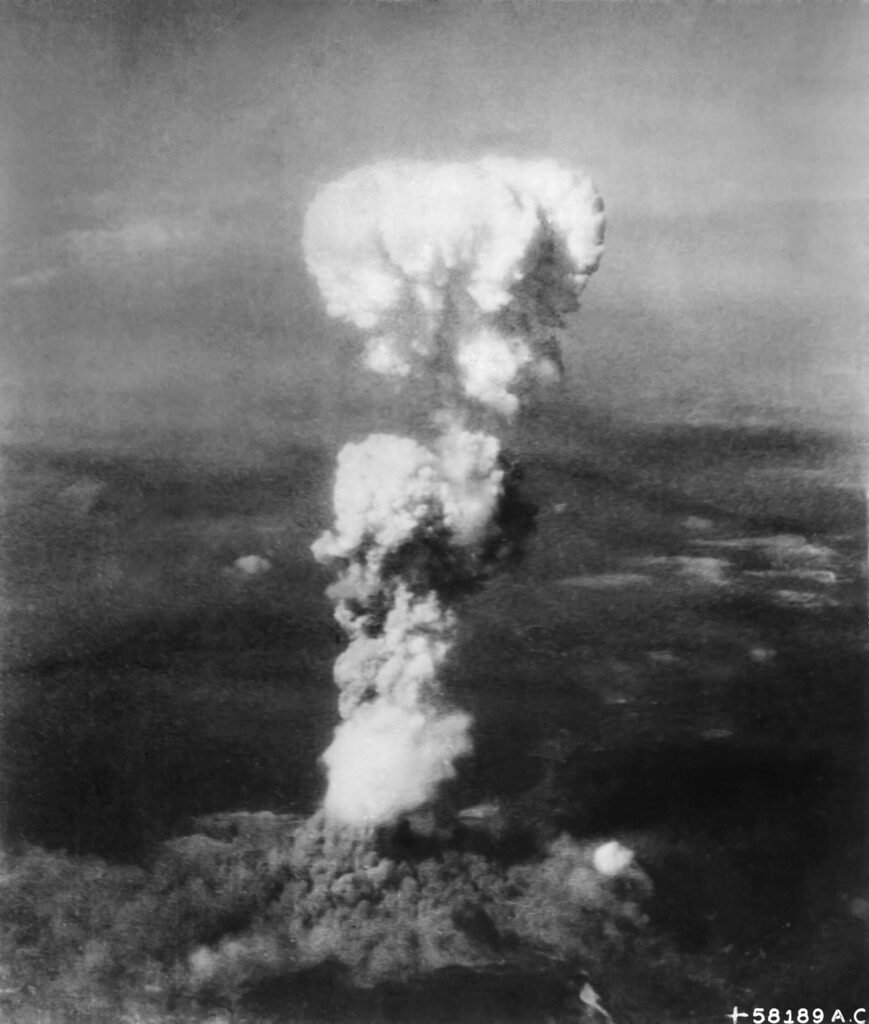
The atomic bombings of Hiroshima and Nagasaki were the first and only uses of nuclear weapons in war. The United States dropped a uranium bomb on Hiroshima on 6 August 1945 and a plutonium bomb on Nagasaki on 9 August 1945, killing tens of thousands of people at once and many more in the following months. Japan announced its surrender days later, ending World War II.
Background to the bombings
The bombs were the product of the Manhattan Project, the wartime American program to build an atomic weapon. On 16 July 1945 the United States tested a plutonium implosion device at Alamogordo, New Mexico, in the Trinity test. The result showed that the design later used at Nagasaki would work.
On 26 July 1945 the Allied leaders meeting at Potsdam issued a declaration that warned Japan of prompt and utter destruction and called for unconditional surrender. The Japanese government rejected the demand on 29 July. By then General Leslie Groves had drafted a directive authorizing the use of the bombs as soon as the weapons and the weather allowed. The target list, in order of priority, named Hiroshima, Kokura, Niigata and Nagasaki.
The uranium bomb, code-named Little Boy, reached Tinian Island in the Pacific aboard the cruiser USS Indianapolis. A typhoon delayed the first attack in early August, and the mission waited several days for the weather to clear.
Before the attacks, two groups had already shaped the plan. According to the Nuclear Museum, an Interim Committee decided that the bomb should be used, and a Target Committee then chose the cities to be hit. Hiroshima headed the list of targets.
Course of events at Hiroshima and Nagasaki
On 6 August 1945 the B-29 bomber Enola Gay took off from Tinian with a crew of 12 and Little Boy aboard. The bomb was released over Hiroshima at 8:15 a.m. local time from an altitude of 31,060 feet. It detonated 43 seconds later about 1,968 feet above the city, roughly 550 feet from the Aioi Bridge, the aiming point. Little Boy was a uranium gun-type bomb with an explosive force of about 13 kilotons.
At the time of the attack Hiroshima held an estimated 280,000 to 290,000 civilians and about 43,000 soldiers. The National Park Service reports that the blast wave and the resulting firestorm destroyed more than two-thirds of the city’s buildings.
Three days later, on 9 August, the B-29 Bockscar left Tinian carrying the plutonium bomb Fat Man. The primary target was Kokura, but haze over the city made it impossible to find the aiming point. The crew turned to the secondary target, Nagasaki, about 95 miles to the south. Cloud cover allowed only one drop point, several miles from the intended aiming point. Fat Man exploded at 11:02 a.m. local time about 1,650 feet above the city, with a force of about 21 kilotons.
An estimated 263,000 people were in Nagasaki that day, including about 240,000 Japanese residents, 9,000 Japanese soldiers and 400 prisoners of war. The surrounding hills limited the destruction compared with Hiroshima, though the Park Service says nearly half of the city was obliterated. The Nuclear Museum states that the decision to use the second bomb was made on 7 August on Guam.
Casualties and aftermath
Death tolls are uncertain, and sources give ranges because records were destroyed and deaths continued for months and years from injuries, burns, radiation sickness and later cancers. For Hiroshima, the Nuclear Museum reports that between 90,000 and 166,000 people are believed to have died within about four months. It adds that the U.S. Department of Energy has estimated 200,000 or more deaths after five years, while the city of Hiroshima has estimated 237,000 deaths, direct and indirect.
For Nagasaki, the same source says that between 40,000 and 75,000 people died immediately, that about 60,000 more were severely injured, and that total deaths by the end of 1945 may have reached 80,000. These figures come from different counting methods and time periods, so they should not be compared as if they measured the same thing.
Japan announced its surrender on 14 August 1945, and the formal surrender documents were signed aboard USS Missouri in Tokyo Bay on 2 September 1945. The National Archives describes the bombings as contributing to the end of the war. The aftermath also brought the first reports of radiation sickness, which the journalist George Weller described in Nagasaki, although his articles were not released until 2006.
Significance and legacy of the bombings
The bombings opened the nuclear age. They showed the destructive power of atomic weapons and shaped the postwar policies of nuclear deterrence that followed. The survivors, known in Japan as hibakusha, have become central witnesses in the global effort to prevent further use of nuclear weapons.
In Hiroshima the Genbaku Dome, formally the Hiroshima Peace Memorial, was the only structure left standing in the area where the first bomb exploded. UNESCO inscribed it as a World Heritage site, and it has been preserved in the state it was in immediately after the bombing. UNESCO calls it a powerful symbol of the most destructive force ever created and an expression of hope for world peace and the elimination of nuclear weapons.
The decision to use the bombs remains debated. Historians and commentators continue to discuss whether a demonstration should have been tried first, whether the second bomb was necessary, and how the bombings relate to the timing of the Japanese surrender. The National Archives holds many of the documents that trace the project, the decisions and the effects, including a letter that the physicist Luis Alvarez wrote on 6 August 1945 after the first bomb was dropped, and researchers continue to study them. This entry records the events and the figures sources give, and it does not settle those debates.
More in History
Key facts
- The United States dropped the uranium bomb Little Boy on Hiroshima on 6 August 1945 and the plutonium bomb Fat Man on Nagasaki on 9 August 1945.1
- Little Boy exploded about 1,968 feet above Hiroshima with a force of about 13 kilotons; Fat Man exploded about 1,650 feet above Nagasaki with about 21 kilotons.1
- Estimates of Hiroshima deaths within about four months range from 90,000 to 166,000; the city of Hiroshima estimates 237,000 direct and indirect deaths.2
- At Nagasaki, 40,000 to 75,000 people died immediately, and total deaths by the end of 1945 may have reached 80,000.2
- Japan announced its surrender on 14 August 1945, and the formal documents were signed on 2 September 1945.2
- The Hiroshima Peace Memorial (Genbaku Dome) is a UNESCO World Heritage site preserved as it stood after the bombing.4
Related concepts
Quick checkHow many people died in the bombings of Hiroshima and Nagasaki?Show answer
Sources give ranges: 90,000 to 166,000 deaths in Hiroshima within about four months, and up to about 80,000 in Nagasaki by the end of 1945, with more deaths in later years.
Sources
- National Park Service, Timeline of the Atomic Bombings of Hiroshima and Nagasaki, https://www.nps.gov/articles/000/the-atomic-bombings-of-hiroshima-and-nagasaki.htm
- Nuclear Museum (Atomic Heritage Foundation), Bombings of Hiroshima and Nagasaki, 1945, https://ahf.nuclearmuseum.org/ahf/history/bombings-hiroshima-and-nagasaki/
- National Archives, The Atomic Bombing of Hiroshima and Nagasaki, August 1945, https://www.archives.gov/news/topics/hiroshima-nagasaki-75
- UNESCO World Heritage Centre, Hiroshima Peace Memorial (Genbaku Dome), https://whc.unesco.org/en/list/775
- Nuclear Museum (Atomic Heritage Foundation), Hiroshima and Nagasaki Bombing Timeline, https://www.atomicheritage.org/history/hiroshima-and-nagasaki-bombing-timeline
- National Archives, Prologue: The Day of Infamy, https://www.archives.gov/publications/prologue/2016/winter/pearl-harbor
Editorially reviewed by Specialty Digest Editorial TeamLast reviewed November 4, 2026Researched and drafted with AI assistanceReport an issue