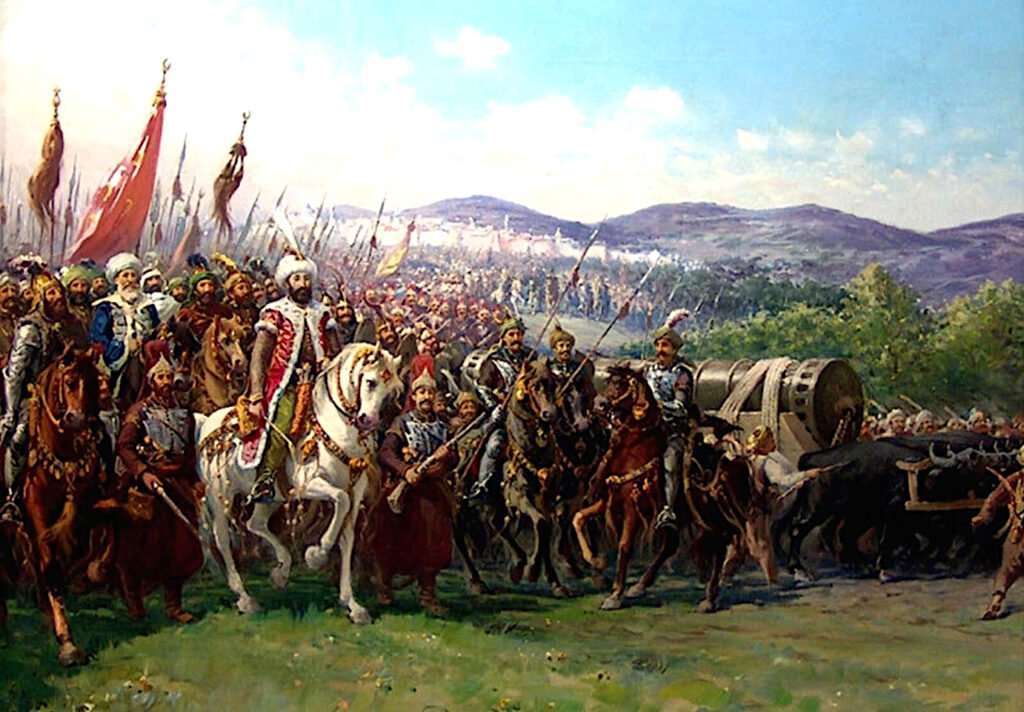
The Fall of Constantinople was the capture of the Byzantine capital by the Ottoman army of Sultan Mehmed II on 29 May 1453, after a siege that began on 6 April. The conquest ended the Byzantine Empire, the surviving eastern half of the Roman Empire, and turned the city into the capital of the Ottoman state. Christians have traditionally remembered the event as a fall, while Muslims have remembered it as a conquest.
Background of the Fall of Constantinople
Constantinople had been an imperial capital since its founding by the Roman emperor Constantine the Great in 330. For about a thousand years, its massive fifth-century walls held off one besieging army after another. By the fourteenth century, however, the Byzantine Empire had shrunk badly. In the 1300s the Ottoman Turks took control of Anatolia, crossed the Bosporus in 1352, and moved into Thrace in 1361. Soon, all the land around the city was Ottoman territory.
Mehmed II became sultan in 1444 and made the capture of Constantinople his goal. He planned carefully. His army included the Janissaries, an elite corps trained from Christian boys drafted in the Balkans, and a fleet that began to gather near the city in the winter of 1453. Most important were his cannons, including a huge bronze gun built by an engineer named Urban, which sources say was hauled overland by oxen and hundreds of men.
The defenders were far fewer. Emperor Constantine XI Palaiologos had only about 7,000 men, according to two modern summaries, made up of roughly 5,000 Greeks and fewer than 2,000 foreigners, mostly Genoese and Venetians. His second in command was a Genoese expert in siege warfare named Giovanni Giustiniani. On 2 April, the emperor ordered the gates closed and a great chain stretched across the Golden Horn, the city’s harbor.
Course of the siege
The Ottomans camped outside the walls by 5 April, and their great cannon opened fire the next day. On 11 April, the bombardment of the western land walls began and continued for 48 days. The sultan’s navy failed to break through the Byzantine fleet. Mehmed solved the problem by hauling ships overland into the Golden Horn, bypassing the chain.
Sources disagree about the size of the Ottoman army. A university library account puts it at about 80,000 men, while a research summary from EBSCO gives nearly 120,000 in its text and 160,000 in its summary box. The differences reflect the poor quality of medieval counts, so these figures are best read as rough estimates. Everyone agrees that the attackers vastly outnumbered the defenders.
Conditions inside the city worsened in May. Food ran short, and hope of a Venetian relief fleet faded. On 22 May, a lunar eclipse frightened the population, and a thunderstorm and fog followed. On the evening of 28 May, Greek Orthodox and Roman Catholic worshippers, usually bitterly divided, took part in a final service in the Hagia Sophia.
The last assault began in the early hours of 29 May. Ottoman troops attacked in three waves, and the Janissaries finally broke through the walls. The emperor, realizing that the city was lost, is said to have thrown off his imperial regalia and plunged into the fighting. His body was never found. The invaders killed many of those who had not fled, and the city was looted for three days. The siege had lasted 53 days.
Aftermath of the Fall of Constantinople
After the three days of plunder, Mehmed prayed in his new capital. The city, later known as Istanbul, remained the center of Ottoman power. The Hagia Sophia, the great church of Eastern Orthodox Christianity, became a mosque. The Ottomans extended their control over the Balkans during the following twenty years, and within about a century and a half of their first appearance in the region they had replaced the Byzantine Empire with an empire of their own.
The shock in Christian Europe was considerable. EBSCO describes the effect as devastating psychologically, as Christian peoples of the east were now under Muslim rule. Some scholars also connect the fall to the movement of Byzantine scholars, writers and artists to western Europe, which is often said to have helped spark interest in Greek and Roman learning. That claim concerns a long-term change, and historians treat it as one influence among several rather than a single cause of the Renaissance.
Significance and legacy of the Fall of Constantinople
Many historians count the fall of Constantinople as the official end of the Roman Empire, since the Byzantine state was its direct continuation. The event also shows how technology changed warfare. For a thousand years, walls had protected the city. Ottoman artillery, a product of the spread of gunpowder weapons, helped to end that protection in 1453, although numbers, planning and the weakness of the defense mattered too.
The city’s geography explains why it was so valuable. It sits on the Bosporus, between Europe and Asia, and whoever held it controlled a key land and sea crossing. That is why the Ottomans pursued it for so long and why its loss had such wide consequences for trade and politics in the eastern Mediterranean. The modern city of Istanbul in Turkey is home to the Hagia Sophia, which a university library account describes as an Islamic mosque today, a reminder of that layered history.
The way people name the event reveals their point of view. Greek and other Christian traditions emphasize the loss of a capital and a faith community. Ottoman and Turkish traditions emphasize the conquest, which they connect to the rise of the empire. Both accounts agree on the date, the city and the outcome, and the differences are of interpretation rather than fact.
More in History
Key facts
- The Ottoman siege of Constantinople began on 6 April 1453 and lasted 53 days.12
- The final assault and capture took place on 29 May 1453.12
- Sources put the Ottoman army at between about 80,000 and 160,000 men and the defenders at about 7,000 to 8,000.12
- Emperor Constantine XI Palaiologos died fighting and his body was never found.1
- The conquest ended the Byzantine Empire, and the Ottomans brought the Balkans under their rule over the next twenty years.2
Related concepts
In the news
Quick checkHow did Mehmed II get his ships past the chain across the Golden Horn?Show answer
He had ships hauled overland into the Golden Horn, which bypassed the chain.
Sources
- University of Cincinnati Libraries, On May 29, the Classics Library Remembers the Fall of Constantinople and the Byzantine Empire, https://libapps.libraries.uc.edu/liblog/2019/05/on-may-29-the-classics-library-remembers-the-fall-of-constantinople-and-the-byzantine-empire/
- EBSCO Research Starters, Siege of Constantinople (1453), https://www.ebsco.com/research-starters/history/siege-constantinople-1453/
Editorially reviewed by Specialty Digest Editorial TeamLast reviewed November 4, 2026Researched and drafted with AI assistanceReport an issue