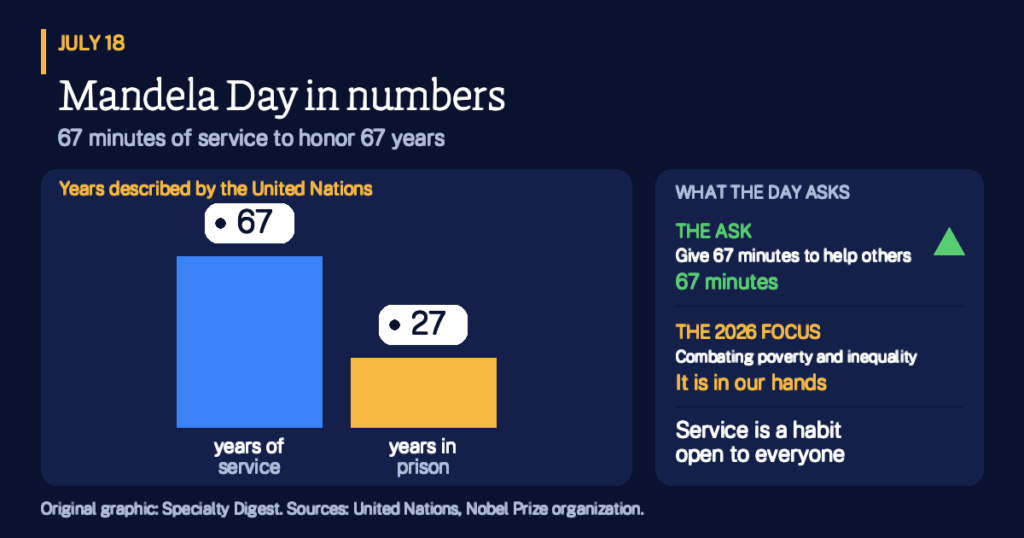
Most international days ask the world to notice a problem. Nelson Mandela International Day asks something more personal: that each of us do something about it. Every July 18, the birthday of Nelson Mandela, the United Nations invites people everywhere to give 67 minutes of their time to help others. The request is small enough for anyone to meet and large enough to add up, and it carries the idea at the center of Mandela’s life, that service is not a gift from the powerful but a habit open to all. Like World Day for International Justice, it ties remembrance to the daily work of fairness.
From a prison sentence to a global day
Nelson Mandela was born on July 18, 1918, in Transkei, South Africa. He joined the African National Congress in 1944 and was arrested in 1962. On June 12, 1964, he was sentenced to life imprisonment. He was held on Robben Island from 1964 to 1982 and then at Pollsmoor Prison. The United Nations describes him as having spent 27 years in prison. He was released on February 11, 1990, and later became the first democratically elected president of a free South Africa. In 1993 he and F. W. de Klerk received the Nobel Peace Prize at Oslo City Hall, on December 10. Mandela died on December 5, 2013.
On November 10, 2009, the General Assembly adopted resolution 64/13, which designated July 18 as Nelson Mandela International Day. The United Nations has observed it since 2010. The resolution recognized his values and his dedication to conflict resolution, human rights, democracy and the promotion of peace.
What the 67 minutes mean
The United Nations says Mandela devoted 67 years of his life to the service of humanity, and it asks the public to devote 67 minutes of their time to help others. The pairing is the heart of the day. It turns a long life into a short, doable act, and it sets a bar that is welcoming rather than heroic. You do not need to lead a movement. You can paint a classroom, read to a neighbor, clean a riverbank or mentor a student.
Example 1: a classroom. Imagine a class of 30 students who each give 67 minutes to a community cleanup. Together that is 2,010 minutes, or about 33.5 hours of work. The numbers are round and illustrative, but they show how a short act multiplies once a group joins in.
- July 18Mandela’s birthday, observed worldwide each year
- 67 minutesthe time the day asks people to give to others
- 2010year of the first UN observance
- Every 5 yearshow often the Nelson Mandela Prize is awarded
A prisoner who changed how prisons are judged
Mandela’s name is also attached to a set of global standards. The United Nations Standard Minimum Rules for the Treatment of Prisoners were first adopted by the First UN Congress on the Prevention of Crime and the Treatment of Offenders in 1955. In 2011 the General Assembly set up an open-ended expert group to revise them. The group reached consensus in March 2015, the Commission on Crime Prevention and Criminal Justice endorsed the revised rules in May 2015, and in December 2015 the General Assembly unanimously adopted them in resolution 70/175. They are now known as the Nelson Mandela Rules.
The choice of name reflects his own years behind bars. The United Nations says it honors his legacy and his commitment to humane conditions of imprisonment, and to the idea that people deprived of liberty keep their dignity and their rights. It is a reminder that a person can be shaped by hardship without being defined by it.
The prize that rewards service
The day also has a prize. The General Assembly created the United Nations Nelson Mandela Prize in resolution 68/275 of June 6, 2014, and approved its statute in resolution 69/269 on April 2, 2015. It is awarded once every five years, starting in 2015, to two laureates, one woman and one man, from different regions, for contributions to the service of humanity.
Example 2: a neighborhood. Suppose 200 residents each give 67 minutes. That makes 13,400 minutes, about 223 hours, which is more than five full 40-hour work weeks. The figures are illustrative, yet they show why the day treats small gifts of time as real power.
The 2026 message: it is in our hands
The 2026 observance is built around the theme of combating poverty and inequality, with the phrase “it is in our hands” at its core. In his message for July 18, 2026, the UN Secretary-General recalled Mandela as a clear-eyed champion of poverty eradication and equality, and said that ending poverty is not an act of charity but an act of justice. He warned that inequality is becoming entrenched, with progress stalled by conflict, economic shocks and climate disasters. He called for investment in decent work, universal health coverage, quality education and social protection, along with reform of the international financial architecture and debt relief.
The message makes a useful point about the day’s scope. Giving 67 minutes is a start, not a finish. Mandela’s own life joined personal service to structural change, and the day invites people to do both: help a neighbor this afternoon and support the policies that make help less necessary tomorrow.
Example 3: a workplace. A company with 500 employees offers each a paid 67-minute block to volunteer. The total is 33,500 minutes, or about 558 hours, close to 14 full work weeks of community service. The numbers are round and illustrative, but they show how an institution can turn a symbolic number into steady help.
How the day is marked
The United Nations holds events around the day, including an informal General Assembly plenary meeting and online events. The Nelson Mandela Foundation promotes the 67 minutes of service and publishes resources for individuals, schools and companies. Most of the action, though, happens locally, in clinics, classrooms, shelters, parks and kitchens.
Key Takeaways
- It is a day of action, not only memory. The UN asks people to give 67 minutes of service every July 18.
- The number has meaning. The United Nations links 67 minutes to the 67 years Mandela devoted to humanity.
- The day is official. Resolution 64/13 of November 10, 2009 created it, and it has been observed since 2010.
- His name protects prisoners. The Nelson Mandela Rules, adopted in December 2015, set UN standards for humane treatment.
- There is a prize. The Nelson Mandela Prize honors two laureates every five years, in 2015, 2020 and 2025.
- The 2026 focus is poverty and inequality. The Secretary-General called ending poverty an act of justice, not charity.
- Small gifts add up. Even a 30-person class giving 67 minutes each yields more than 33 hours of help.
How solid is this? Dates, resolution numbers and laureates come from United Nations pages and the Nobel Prize organization. The UN pages do not state outright that the 67 minutes stand for the 67 years, so that link is described as the UN presents it, side by side. The three worked examples use round, made-up numbers to show an idea. See also the International Days hub and the International Days Calendar.
More in Society
- United Nations, Nelson Mandela International Day, For Freedom, Justice and Democracy
- United Nations, The Nelson Mandela Rules
- United Nations, The Nelson Mandela Prize
- UN Secretary-General, Message on Nelson Mandela International Day, July 18, 2026
- Nelson Mandela Foundation, More than 67 minutes
- NobelPrize.org, Nelson Mandela, biographical