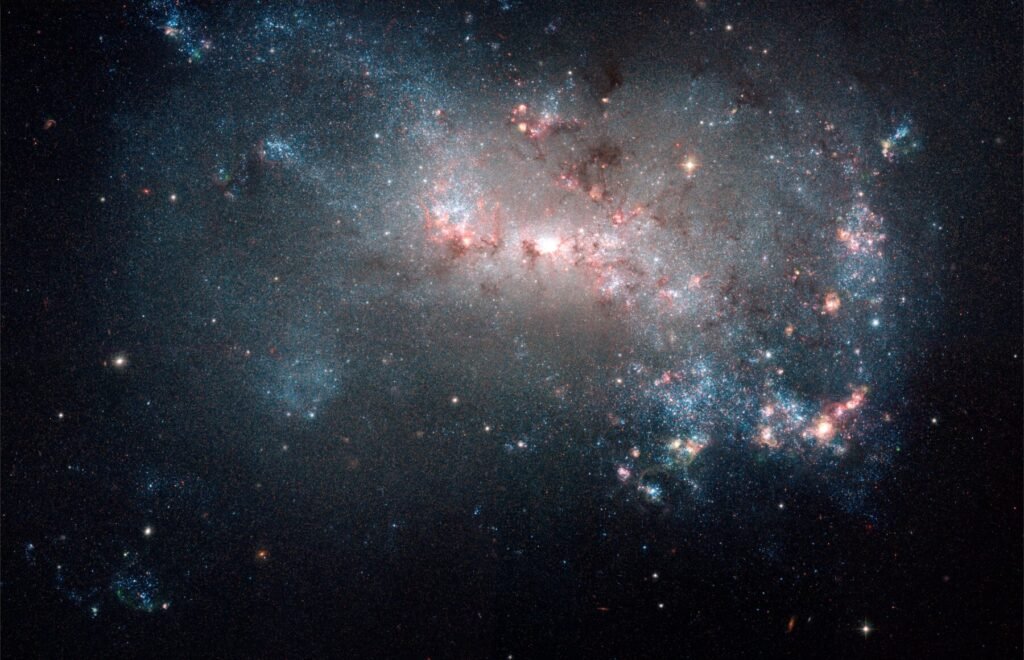
NASA says Hubble finds missing oxygen in 37 nearby dwarf galaxies. Computer simulations predict these small galaxies should hold more of the element than they do. This article summarizes NASA’s report, explains the proposed cause and notes what the agency’s article leaves out.
What did Hubble find?
NASA reports that much of the oxygen expected in 37 nearby dwarf galaxies is missing. Dwarf galaxies are small, and NASA describes them as having a few thousand to hundreds of millions of stars. The team compared what the stars should have produced with what the galaxies actually contain. The gap points to oxygen leaving the galaxies rather than staying inside them.
What is the GLOW project?
The sample belongs to the Galaxies Losing Oxygen via Winds project, known as GLOW, which NASA and the National Science Foundation fund. The name states the main idea: winds carry oxygen out of galaxies. NASA uses the dwarf galaxy NGC 4449 as its example image. The galaxies are close enough that Hubble can resolve their individual stars, which NASA says is not true for most known dwarf galaxies.
How did the team measure it?
NASA describes a combination of archives and instruments:
- Archival optical images from Hubble, used to resolve stellar populations and determine star-formation histories and compositions
- Data from the retired Spitzer Space Telescope
- Observations from the ground-based Very Large Array
- Observations from the Australia Telescope Compact Array
Together, these sources let the team trace the oxygen that the stars produced. NASA does not give numerical distances for the galaxies or a numerical fraction of oxygen lost, so we do not either.
Why would oxygen leave?
NASA’s explanation is that supernova-driven galactic winds remove oxygen from low-mass galaxies more effectively than current models predict. As a result, dwarf galaxies keep only a small fraction of the oxygen their stars make. Co-investigator Grace Telford notes that massive stars and supernovae supply the energy needed to push material out of host galaxies.
A general point helps here. Oxygen forms inside massive stars and is released when they explode. A small galaxy has weak gravity, so the hot gas from those explosions can escape more easily than from a large galaxy. That explanation is general and is not quoted from NASA.
How to read the result
The finding is a mismatch between simulations and measurements, and the proposed cause is stronger winds than models assume. That is an interpretation, and NASA’s wording is that winds appear to remove oxygen more effectively. We treat it as a leading explanation, not a settled fact. The sample of 37 galaxies is also small compared with the number of dwarf galaxies in the universe, so the result applies first to nearby systems that are close enough to resolve. By our own arithmetic, the sample is 37 galaxies and nothing more can be inferred from that count about the total population, so we do not extrapolate.
Why combine several telescopes?
Each instrument in NASA’s description sees a different part of the picture. Hubble’s optical images resolve individual stars, which lets the team work out how many stars formed and when. The Spitzer, Very Large Array and Australia Telescope Compact Array data cover other wavelengths, which NASA says helped trace oxygen produced by stars. The need to combine them explains why the project is a coordinated effort, not a single observation. It also means the result depends on how well the different datasets line up, a limit that NASA’s short article does not discuss.
What would strengthen the finding?
Scientists usually test a result like this by studying more galaxies, checking different models and looking for the lost gas directly. NASA’s article does not describe follow-up plans, so this section is our general reading of how such research proceeds, not a report of what the team intends. Readers should watch for the published study and any later work from the GLOW team.
A note on simulations
Simulations are computer models of how galaxies form and change. When they predict more oxygen than telescopes find, researchers adjust the physics in the models, such as how strongly exploding stars push gas outward. NASA’s report says current models underestimate the strength of that effect. That is the central message, and it is stated as an appearance, not a proof.
Why does it matter?
Models of galaxy evolution need to know how much of a galaxy’s heavy elements stay and how much leave. If winds are stronger than assumed, the models may need adjustment. NASA’s article is the basis for the finding, and the broader implications for simulations are our general reading, not something NASA quantifies. Readers who want the detailed analysis should consult the underlying study and NASA’s page.
How does it relate to other telescope coverage?
Hubble works alongside newer observatories. Our article on the James Webb Space Telescope explains how that infrared observatory complements Hubble, and our report on Euclid’s first data release covers a survey of galaxies and gravitational lenses. Our guides to NEO Surveyor and the Lucy mission cover two NASA projects closer to home. All of them depend on combining instruments, which is also the method behind this oxygen study.
Related reading: Second-Generation Planet Suspected Around White Dwarf as Hubble Data Reveal Niobium.
Glossary
- Dwarf galaxy: a small galaxy with far fewer stars than a large spiral galaxy
- Supernova: the explosion of a massive star at the end of its life
- Galactic wind: a flow of gas leaving a galaxy
- Stellar population: a group of stars that formed together or share properties
- Star-formation history: a record of when a galaxy made its stars
These definitions are general explanations and are not quoted from NASA.
What is not covered here?
NASA’s article does not give the distances to the galaxies, the percentage of oxygen missing, the paper’s title or the journal. We have not added any of these from memory. Readers who need exact values should look for the study cited by NASA.
Key facts at a glance
- Sample: 37 nearby dwarf galaxies
- Project: GLOW, funded by NASA and the National Science Foundation
- Main instrument: Hubble Space Telescope
- Supporting data: Spitzer, Very Large Array, Australia Telescope Compact Array
- Proposed cause: supernova-driven winds
Frequently asked questions
What does missing oxygen mean?
It means the galaxies hold less oxygen than simulations predict stars should have left behind.
Where did the oxygen go?
NASA says supernova-driven winds appear to push it out of the galaxies.
How many galaxies were studied?
Thirty-seven nearby dwarf galaxies.
More in Science