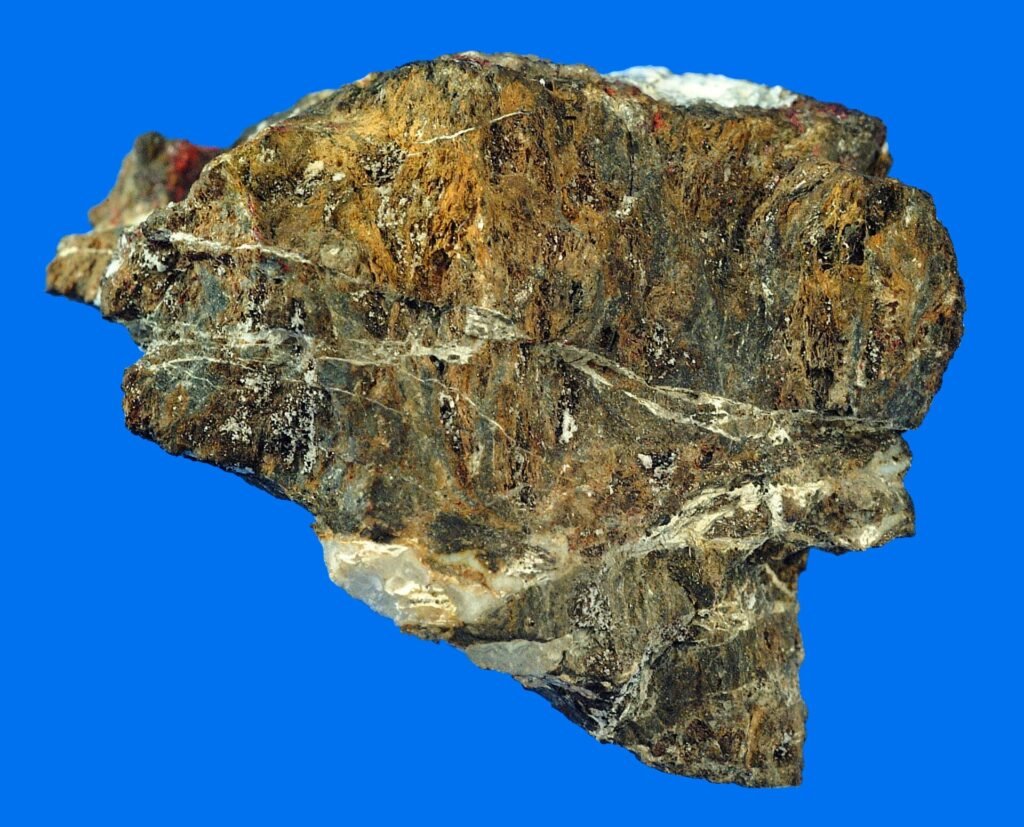
Mercury is the chemical element with atomic number 80 and the symbol Hg. It is a silvery metal that is liquid at room temperature. Because of its toxicity, many former uses of mercury, including thermometers and some lamps and batteries, have been phased out or are under review.
History of mercury
Cinnabar, also called vermilion or mercury sulfide (HgS), was used as a bright red pigment by Palaeolithic painters 30,000 years ago to decorate caves in Spain and France. When heated in a crucible, cinnabar yields its mercury, and the metal fascinated people because it was a liquid that would dissolve gold.
The ancients used this property on a large scale to extract alluvial gold from river sediment. The mercury dissolved the gold, and the gold could be reclaimed by distilling off the mercury. The Almaden deposit in Spain provided Europe with its mercury. In the Americas the Spanish conquerors exploited the large cinnabar deposits at Huancavelica to extract gold, and in 1848 the miners of the California Gold Rush used mercury from the New Almaden Mines of California.
PubChem lists the discovery date of mercury as ancient. Although highly toxic, mercury had many uses, such as in thermometers, but the Royal Society of Chemistry notes that these are now strictly curtailed.
Properties of mercury
PubChem, drawing on IUPAC data, gives mercury a standard atomic weight of 200.59. Its electron configuration is [Xe] 6s2 4f14 5d10. Mercury sits in group 12 and period 6 of the periodic table and is a transition metal. Its common oxidation states are +2 and +1.
Mercury is a liquid with a density of 13.5336 grams per cubic centimeter, roughly 13.5 times that of water. It melts at 234.32 kelvin, about minus 38.8 degrees Celsius, and boils at 629.88 kelvin, about 356.7 degrees Celsius. Because the melting point is far below ordinary temperatures, mercury is liquid across the whole range of everyday conditions.
Mercury has an electronegativity of 2.0 on the Pauling scale and a first ionization energy of 10.438 electronvolts, or about 1007 kilojoules per mole. The Royal Society of Chemistry describes it as a liquid, silvery metal. Mercury easily forms alloys with other metals such as gold, silver and tin, and these mercury alloys are called amalgams.
Occurrence and production of mercury
Mercury rarely occurs uncombined in nature, but it can be found as droplets in cinnabar ores. The metal is obtained by heating cinnabar in a current of air and condensing the vapor. The Royal Society of Chemistry names China and Kyrgyzstan as the main producers, although producer rankings change over time.
The World Health Organization notes that mercury occurs naturally in the Earth’s crust and is released into the environment from volcanic activity and the weathering of rocks. Human activity is the main cause of releases, particularly coal-fired power stations, residential coal burning for heating and cooking, industrial processes, waste incinerators, and the mining of mercury, gold and other metals.
Uses of mercury
Mercury is now mainly used in the chemical industry as a catalyst, and in some electrical switches and rectifiers. Its previous major use was in making sodium hydroxide and chlorine by the electrolysis of brine, and the Royal Society of Chemistry says those plants were due to be phased out by 2020. Mercury was also commonly used in batteries, fluorescent lights, felt production, thermometers and barometers, and these uses have been phased out.
The ease with which mercury amalgamates with gold made it useful in recovering gold from its ores, and mercury amalgams were also used in dental fillings. Mercuric sulfide, or vermilion, is a high-grade, bright-red paint pigment, but it is very toxic and is now used only with great care.
Isotopes of mercury
Mercury has seven naturally occurring isotopes. An isotope is a form of an element whose atoms have the same number of protons but different numbers of neutrons. The most abundant are mercury-202 at 29.86 percent, mercury-200 at 23.1 percent and mercury-199 at 16.87 percent. The others are mercury-201 (13.18 percent), mercury-198 (9.97 percent), mercury-204 (6.87 percent) and mercury-196 (0.15 percent).
The Royal Society of Chemistry lists mercury-196 as radioactive, decaying by alpha emission with a half-life of more than 2.5 times 10 to the 18th years. That is so long that natural mercury is effectively stable.
Health and environmental effects of mercury
The Royal Society of Chemistry states that mercury has no known biological role but is present in every living thing and widespread in the environment. Every mouthful of food contains a little mercury, and the daily intake is less than 0.01 milligrams, which the body can cope with easily. In much higher doses it is toxic, and one form, methylmercury, is particularly dangerous because it can accumulate in the flesh of fish.
The World Health Organization considers mercury one of the top ten chemicals of major public health concern. Exposure to even small amounts may cause serious health problems and is a threat to the development of the child in the womb and early in life. Mercury may have toxic effects on the nervous, digestive and immune systems, and on the lungs, kidneys, skin and eyes.
People are mainly exposed to methylmercury when they eat fish and shellfish that contain it. Bacteria in the environment can transform mercury into methylmercury, which then bioaccumulates, meaning that organisms hold higher concentrations than their surroundings. Large predatory fish are more likely to have high levels because they eat many smaller fish. The World Health Organization distinguishes methylmercury from ethylmercury, which is contained in thiomersal, a preservative in some vaccines, and which it says does not pose a health risk. This entry gives general background drawn from reference sources and is not advice.
Key facts
- Mercury has atomic number 80, symbol Hg, and sits in group 12 and period 6 of the periodic table.2
- Mercury is a liquid at room temperature, melting at about minus 38.8 degrees Celsius.2
- Mercury is obtained by heating cinnabar in a current of air and condensing the vapor.1
- Mercury has seven naturally occurring isotopes, the most abundant being mercury-202 at about 29.9 percent.1
- The World Health Organization considers mercury one of the top ten chemicals of major public health concern.3
This entry explains a medical term. It is not medical advice. If you are concerned about your health, speak with a qualified health professional.
Related concepts
In the news
- ScienceSecond-Generation Planet Suspected Around White Dwarf as Hubble Data Reveal Niobium
- ScienceBepiColombo Reaches Mercury: ESA’s Orbit Insertion Plan for November 21, 2026
- BusinessLithium in 2025: Production, Prices and Uses From the USGS
- SocietyWhy Do Some Countries Use Fahrenheit Instead of Celsius?
Quick checkWhy is methylmercury a concern for people who eat fish?Show answer
Bacteria can turn mercury into methylmercury, which builds up in fish and shellfish. Large predatory fish tend to hold the most, and eating them is the main way people are exposed.
Sources
- Royal Society of Chemistry, Periodic Table: Mercury, https://periodic-table.rsc.org/element/80/mercury
- National Center for Biotechnology Information, PubChem Periodic Table: Mercury (element 80, including IUPAC-sourced atomic weight data), https://pubchem.ncbi.nlm.nih.gov/element/80
- World Health Organization, Mercury and health (fact sheet), https://www.who.int/news-room/fact-sheets/detail/mercury-and-health
Editorially reviewed by Specialty Digest Editorial TeamLast reviewed November 4, 2026Researched and drafted with AI assistanceReport an issue