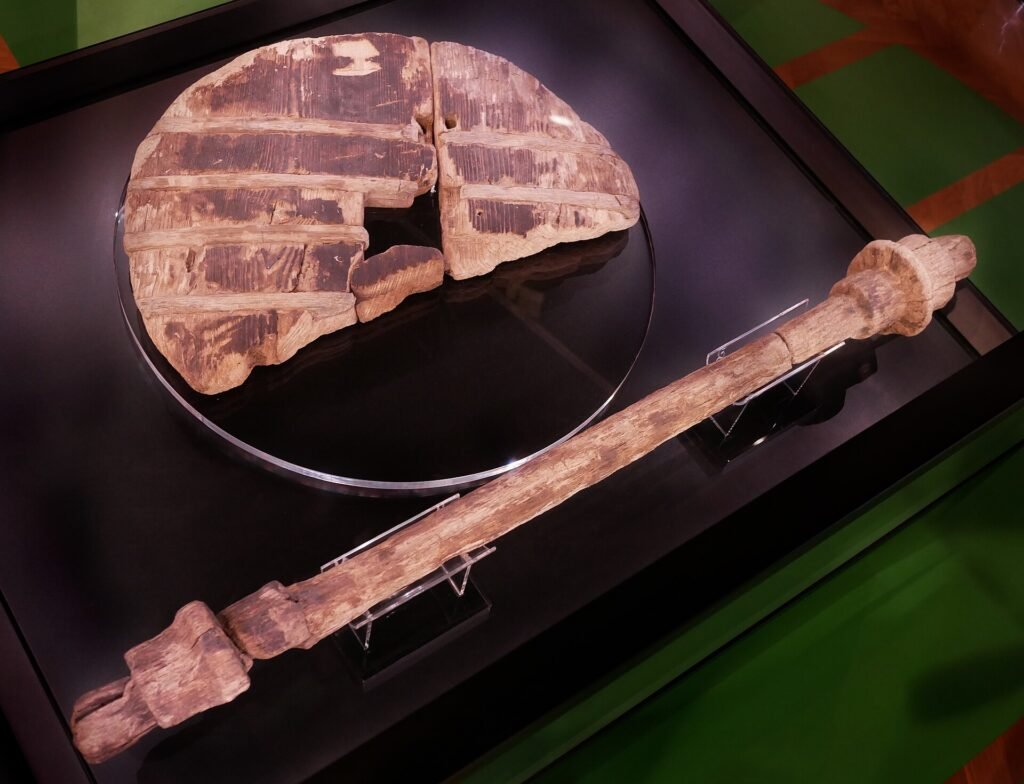
The wheel is a circular object that turns around a central axle, which lets people move heavy loads with much less effort than dragging them. The oldest wooden wheel found so far is about 5,100 to 5,350 years old, and no individual inventor of the wheel is known.
History of the wheel
Many historians think the wheel grew out of older tools. Round logs used as rollers under heavy loads and the potter’s wheel, which spins clay while a craftsperson shapes it, are both likely ancestors of the wheel on a cart.
The oldest wooden wheel yet discovered was uncovered in 2002 in the Ljubljana Marshes, about 20 kilometers southeast of Ljubljana, Slovenia. Radiocarbon dating placed it between 5,100 and 5,350 years old, at least a century older than wheels from Switzerland and southern Germany that had been thought to be the oldest.
The wheel lay in the remains of a pile-dwelling settlement, a village built on stilts at the edge of a wetland. It is part of a wider story told by the prehistoric pile dwellings around the Alps, a UNESCO World Heritage property of 111 small sites built from about 5000 to 500 BCE.
Spoked wheels, which are lighter than solid disks, appear in the archaeological record by about 2000 BCE. They made faster vehicles such as war chariots possible, and rims of iron followed later.
Who invented the wheel?
Nobody knows who built the first wheel, and the question may have no single answer. Wood rots, so the oldest wheel that survives is not necessarily the first one ever made.
Evidence for wheeled vehicles, including models, pictures and wheel tracks, comes from several regions of Europe and the Near East around the same period. Some scholars think the idea spread from one region to the others, while others think it arose in more than one place, and the evidence does not settle the matter.
The Slovenian wheel does show that early makers were skilled. It was built from two ash panels cut from the same tree, and its maker seems to have understood how wood behaves. The wheel and its oak axle, which is about 120 centimeters long, were probably scorched to protect them against pests.
What the Ljubljana Marshes wheel shows
The Slovenian find has a radius of 70 centimeters and is 5 centimeters thick, and it is made of ash and oak. Archaeologists think it belonged to a prehistoric two-wheeled pushcart, and the way it was put together suggests its makers knew more about wood than scientists had expected.
The square opening for the axle shows that the wheel and axle turned as one piece. On rough ground such a cart probably had a single axle, though the cart itself is unknown and can only be guessed at.
The wheel was shown to the public for the first time in 2013, at an exhibition in the City Museum of Ljubljana titled The Wheel: 5,200 years. The marshes were added to UNESCO’s World Heritage List in 2011.
How the wheel works
A wheel works by replacing sliding with rolling. When a sled is dragged, its whole underside rubs on the ground. When a load rides on a wheel, only a small patch of the rim touches the ground at any moment, so far less force is needed to keep it moving.
Together with its axle, the wheel forms one of the six classical simple machines. A force applied at the rim turns the axle, and a force on the axle can turn the wheel, which is why the same idea appears in cart wheels, steering wheels and windlasses.
There are two basic ways to mount a wheel. In the Slovenian design the axle passes through a square hole, so the wheel and axle turn together. In the other design the wheel turns freely on a fixed axle, which allows the two wheels of a vehicle to spin at different speeds in a bend. Modern machines add bearings and lubricants at the axle to cut friction further.
Types of wheels
Solid wheels, made from planks or a single disk, are the oldest form. Spoked wheels, in which a rim is joined to a hub by slender rods, cut weight while keeping strength, and they remain common on bicycles.
Many devices that are not vehicle wheels use the same shape. A potter’s wheel spins clay, a flywheel stores rotational energy in an engine, and a water wheel turns flowing water into rotation. A gear is a wheel with teeth that passes motion and force to another toothed part.
Tires added another layer. Rims of iron protected wooden wheels from wear, and rubber tires filled with air, introduced in the late 19th century, softened the ride.
Impact of the wheel
Wheeled carts and wagons allowed farmers and traders to carry heavier loads over land, which changed how far goods and people could travel. Wheels also entered production. Potters could shape vessels faster, and water wheels and mills later drove grinding, sawing and spinning.
The wheel’s reach extends into nearly every machine. Clocks, mills, turbines and steam engines all depend on rotating parts, and the idea of turning motion into controlled rotation underlies much of engineering.
Uses of the wheel today
Wheels carry cars, trucks, trains, aircraft on the ground, wheelchairs, suitcases and shopping carts. Steel wheels on rails move trains with low rolling resistance, and electric vehicles use wheels driven directly by electric motors.
Inside machines, gears, pulleys, rollers and turbine rotors apply the same principle. Whenever a design calls for steady rotation under load, some form of wheel is usually involved.
FAQs about the wheel
Is the Ljubljana wheel the first wheel ever made? It is the oldest wooden wheel found so far, but wood decays, so earlier wheels may have been lost.
What did people use before the wheel? Heavy loads were dragged on sleds or moved over log rollers, which are likely ancestors of the wheel.
Are wheels and gears the same thing? A gear is a wheel with teeth that mesh with another toothed part to pass on motion and force. A plain wheel simply rolls on a surface.
More in Mechanical Engineering
Key facts
- The oldest wooden wheel yet found was uncovered in 2002 in the Ljubljana Marshes, Slovenia.1
- Radiocarbon dating puts it at 5,100 to 5,350 years old.1
- The wheel has a radius of 70 centimeters and is made of ash, and its axle is oak.1
- The wheel and axle turned together because the axle hole is square.1
- The pile-dwelling sites around the Alps were built from about 5000 to 500 BCE.2
Related concepts
Quick checkWho invented the wheel?Show answer
No inventor is known. The oldest surviving wooden wheel, from the Ljubljana Marshes in Slovenia, is 5,100 to 5,350 years old, but wooden wheels rot, so earlier ones may have existed.
Sources
- Slovenia.si, World's oldest wheel found in Slovenia (6 January 2020), https://slovenia.si/art-and-cultural-heritage/worlds-oldest-wheel-found-in-slovenia
- UNESCO World Heritage Centre, Prehistoric Pile Dwellings around the Alps, https://whc.unesco.org/en/list/1363
Editorially reviewed by Specialty Digest Editorial TeamLast reviewed November 4, 2026Researched and drafted with AI assistanceReport an issue