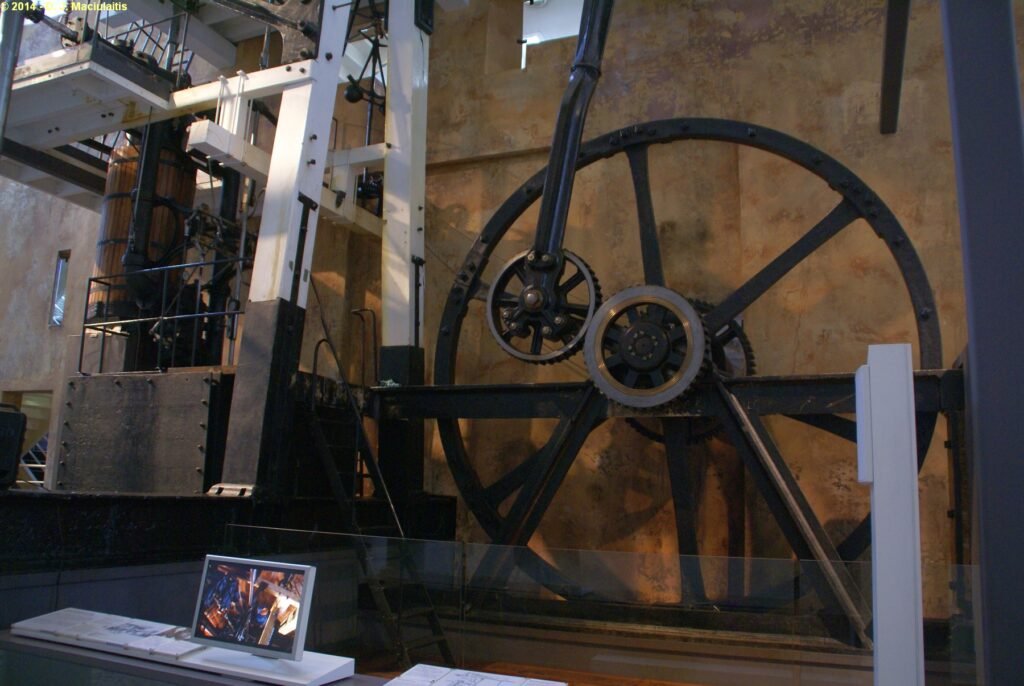
A steam engine is a heat engine that turns the energy in steam into mechanical motion, usually by pushing a piston inside a cylinder. The first practical machine of this kind was built by Thomas Newcomen in 1712 to pump water out of mines, and James Watt’s separate condenser later made steam power efficient enough for factories.
History of the steam engine
Early steam devices did not solve the mining problem. Thomas Savery built a steam-powered pump, but it could lift water only about 30 feet and used fuel inefficiently. Denis Papin had shown on a model that the weight of the atmosphere could drive a piston if the air on the other side were removed, yet he never built a practical engine.
Thomas Newcomen and his partner John Calley combined those ideas. In 1712 they installed the first working piston-driven steam engine at a mine near Dudley Castle in the West Midlands. Within 20 years more than 120 Newcomen engines were working in England and Europe, and by 1800 there were over 1,400.
The Newcomen engine was reliable but burned large amounts of coal, because the same cylinder was heated and then cooled on every stroke. James Watt, working at Glasgow University in the 1760s, devised a fix. His patent of 5 January 1769 covered a separate condenser, and engines fitted with it burned about two thirds less coal.
In the 1770s Watt joined the Birmingham manufacturer Matthew Boulton. They also made the engine double-acting, so the piston produced power on both strokes, and added a mechanism to convert the piston’s up-and-down motion into rotation. By 1800 the firm had built hundreds of engines.
Who invented the steam engine?
No single person invented the steam engine. Savery supplied the steam pump, Papin the idea of a piston driven by atmospheric pressure, Newcomen the first practical engine, and Watt the improvement that made it economical.
The Science Museum Group calls Newcomen the first person to design a practical steam engine, and it describes Watt’s separate condenser as the greatest single improvement ever made to it. A tin model of the condenser from 1765 was long overlooked among items in Watt’s workshop, and a curator identified it as the original only in the 1960s.
How a steam engine works
In a Newcomen engine, a boiler made steam at little more than atmospheric pressure. Steam entered the cylinder under the piston, and then a spray of cold water condensed it. The condensing steam left a partial vacuum, and the pressure of the air pushed the piston down.
The piston was linked to a rocking beam, and the other end of the beam lifted the heavy pump rods hanging in the mine shaft. The first engine moved its piston about 12 times a minute and raised roughly 120 gallons of water in that time.
Watt’s engine moved the condensing step into a separate vessel kept permanently cool. The working cylinder could then stay hot, which saved the energy previously wasted in reheating it. The design reflects thermodynamics: an engine converts part of the heat it receives into work and must discard the rest.
Types of steam engines
The atmospheric engine of Newcomen used steam mainly to create a vacuum. The beam engine of Boulton and Watt used steam pressure as well, and its rotary versions drove mills and machinery by turning a shaft.
Engineers in the 19th century raised steam pressure, which allowed compact engines for locomotives and ships. In the 20th century, steam turbines, which spin bladed rotors with a jet of steam instead of pushing a piston, replaced piston engines in power stations.
Advantages and disadvantages of early steam engines
The Newcomen engine was designed around the materials and skills of its day. Its cylinders were cast by cannon founders, and because the air pressed on the piston from outside, the risk of the cylinder bursting was eliminated, according to the Science Museum Group.
Its weakness was fuel use. The cylinder was cooled and reheated on every stroke, so the engine was costly to run. It stayed in service at collieries well into the 19th century, where cheap waste coal was plentiful.
Watt’s engine cut fuel use, but it was more complex, and turning a small model into an industrial machine took him years of work.
Impact of the steam engine
The Science Museum Group credits Newcomen’s engine with making a copious artificial power source available to replace the uncertain power of wind, water and animals. It allowed deep mines to be drained and the mineral wealth of western Europe to be used fully.
Watt’s version spread the effect further. Because it burned far less coal, steam power could work not only in mines but in factories, mills and workshops. That shift is closely tied to the Industrial Revolution.
Steam engines today
Piston steam engines are now mostly museum pieces and heritage railway locomotives. A Newcomen engine built in 1791 stands in the Science Museum’s Energy Hall in London, and a working replica runs at the Black Country Living Museum in Dudley.
The steam principle itself remains widespread. Steam turbines drive generators in coal, gas, geothermal and solar thermal plants, and the heat from a nuclear reactor is also used to raise steam. In vehicles, the internal combustion engine took over the work that piston steam engines once did.
FAQs about the steam engine
Did James Watt invent the steam engine? No. Watt greatly improved an existing engine by adding a separate condenser, which made it far cheaper to run.
Why is Newcomen’s design called an atmospheric engine? After the steam condensed, the pressure of the atmosphere, not of the steam, pushed the piston down.
What fuel did early steam engines burn? They burned coal, including low-grade waste coal at the mines where many of them worked.
More in Mechanical Engineering
Key facts
- Thomas Newcomen and John Calley installed the first working piston steam engine near Dudley Castle in 1712.2
- Over 120 Newcomen engines were installed within 20 years and over 1,400 by 1800.2
- Watt's separate condenser was patented on 5 January 1769.3
- Engines with the separate condenser burned about two thirds less coal.3
- The Newcomen engine used steam at scarcely more than atmospheric pressure.1
Related concepts
Quick checkWho invented the steam engine?Show answer
No single person did. Savery built an early steam pump, Newcomen made the first practical piston engine in 1712, and James Watt's separate condenser, patented in 1769, made it far more efficient.
Sources
- Science Museum Group Collection, Newcomen Atmospheric Engine, https://collection.sciencemuseumgroup.org.uk/objects/co50900/newcomen-atmospheric-engine
- Linda Hall Library, Scientist of the Day: Thomas Newcomen, https://www.lindahall.org/about/news/scientist-of-the-day/thomas-newcomen/
- Science Museum Blog, James Watt and the separate condenser (5 January 2019), https://blog.sciencemuseum.org.uk/james-watt-and-the-separate-condenser
- Linda Hall Library, Scientist of the Day: James Watt, https://www.lindahall.org/about/news/scientist-of-the-day/james-watt/
Editorially reviewed by Specialty Digest Editorial TeamLast reviewed November 4, 2026Researched and drafted with AI assistanceReport an issue