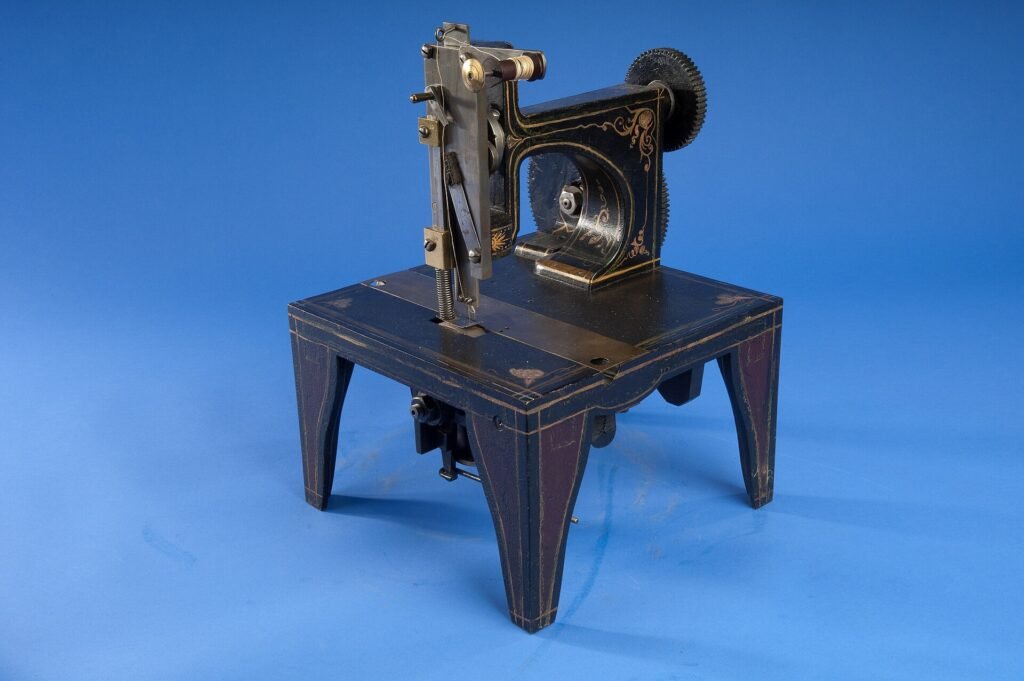
A sewing machine is a machine that stitches fabric with a needle and thread, replacing slow hand sewing. No single person invented it. Many inventors contributed over roughly half a century, and the first practical machines appeared in the 1840s and 1850s, with Elias Howe’s patent of 1846 and Isaac Singer’s patent of 1851 among the best known.
History of the sewing machine
For thousands of years the only way to join two pieces of cloth was a needle and a length of thread, held by hand. According to Grace Rogers Cooper, a Smithsonian Institution historian of textiles, the needle might be bone, silver, bronze or steel, but its design never changed.
An early attempt appears in British patent 1,764, issued to the cabinetmaker Thomas Saint on July 17, 1790. The patent describes three machines, one of them for stitching, quilting or sewing. Cooper writes that it was far from practical, but it included features of a modern sewing machine: a horizontal cloth plate, an overhanging arm carrying a straight needle, a continuous supply of thread from a spool and a hand crank.
Other attempts followed. A tailor in Vienna, Josef Madersperger, invented a machine that is illustrated in a pamphlet published about 1816. An engraving shows the sewing machine that Thimonnier built in 1830. A story about a back-stitching machine made in Monkton, Vermont, around 1818 or 1819 is also told, but the earliest record Cooper found of it dates from 1867.
Elias Howe made a prepatent model in 1845, and the United States issued him patent No. 4,750 on September 10, 1846, the fifth for a sewing machine. His machine used a curved, grooved needle with the eye at the point, carried on a vibrating arm and supplied with thread from a spool. A loop of that thread was locked by a second thread carried by a shuttle. The cloth was held upright on pins on a baster plate, so the length of a seam depended on the length of the plate.
Isaac Merritt Singer, who had been an actor and had sold the rights to a miners’ drill, arrived in Boston in 1849 and entered the field. His machine used a straight needle that moved vertically over a horizontal surface, and he received a patent on August 12, 1851. By then dozens of machines were on the market.
Inventor and origins of the sewing machine
The credit is divided. Cooper states plainly that Howe did not invent the sewing machine and says history is too quick to name one or two men and forget the work that came before. Howe’s contribution was a lock-stitch mechanism, which the Linda Hall Library says every machine needed, but in 1850 there were dozens of variations in the shape of the needle, how it moved, how the thread tension was kept, how the cloth was fed and how the machine was powered.
Cooper lists what a practical machine required: a support for the cloth, a needle to carry the thread and a device to form the stitch, a feed to move the cloth between stitches, control of thread tension, and a mechanism that timed every operation in order. Earlier inventors had supplied pieces of this. Saint supported the fabric on a horizontal plane, and an inventor named Weisenthal had put a point at the eye end of a needle, although his needle was to pass completely through the cloth.
How a sewing machine works
A sewing machine moves a needle carrying thread through the cloth, forms a stitch with a second thread or by looping the first, and advances the cloth by one stitch length before repeating. The result is a row of interlocked loops. In a lock stitch, as in Howe’s design, a loop of needle thread is locked by a thread from a shuttle beneath the cloth.
Power came from a hand crank or from a foot treadle. On some early machines the needle moved down when the treadle was pressed and rose by spring action. Singer’s design placed a vertical needle above a flat table.
Types and variants of the sewing machine
Early sewing machines varied widely. Needles could be straight or curved, and they could move vertically or in an arc. Some held the cloth upright on a baster plate, as in Howe’s design, and others laid it flat on a table, as in Saint’s. Machines made chainstitches or lock stitches. Inventors also built patent models, small versions submitted with applications, and the Smithsonian holds many from the period.
Cooper devotes a chapter to the less expensive machines that followed the first wave.
Impact of the sewing machine
Cooper describes the sewing machine as one of the most important inventions of 19th-century America in the view of some writers. Its sales methods were also new. The Linda Hall Library notes that Singer’s partner Edward Cabot Clark, a lawyer, came up with door-to-door selling and installment payments, which were novelties in American business, and opened showrooms in New York City where customers could be shown the machines.
By the 1870s, salesrooms such as the Wheeler and Wilson showroom on Fourteenth Street in New York were fashionable places, a sign of how far the industry had grown in a few decades. The business also touched other trades. James Starley, the English engineer behind the Ariel, worked at a sewing machine factory in Coventry before he turned to high-wheel cycles, and Singer made a high-wheel design of its own in 1878, a story told in the entry on the bicycle. Related textile and clothing inventions are covered in the entries on the power loom and the zipper.
Patent wars and the Sewing Machine Combination
As soon as Singer began to manufacture machines, Howe sued him. Singer took a lawyer, Clark, as a partner, and Clark had helped win the patent in the first place. In 1856 Orlando Potter, head of a rival maker, suggested that the main companies pool their patents into what was called the Sewing Machine Combination so they could stop suing each other at great expense. Howe accepted a small payment for each machine sold.
This litigious period has parallels in the history of other machines, including the legal fight over Whitney’s patent described in the entry on the cotton gin.
More in Mechanical Engineering
Key facts
- Thomas Saint received British patent 1,764 for a stitching machine on July 17, 1790.1
- Elias Howe received U.S. patent No. 4,750 on September 10, 1846, the fifth for a sewing machine.1
- Isaac Singer received his patent on August 12, 1851.2
- A historian at the Smithsonian wrote that Howe did not invent the sewing machine.1
- Makers pooled patents in the Sewing Machine Combination in 1856 and Howe accepted a payment on each machine.2
Related concepts
Quick checkWho invented the sewing machine?Show answer
No single person did. Thomas Saint patented an early design in 1790, Elias Howe patented a lock-stitch machine in 1846, and Isaac Singer's 1851 design became the best known.
Sources
- Cooper GR, The Invention of the Sewing Machine, Smithsonian Institution, United States National Museum Bulletin 254 (1968), via Project Gutenberg, https://gutenberg.org/cache/epub/32677/pg32677-images.html
- Ashworth WB Jr, Scientist of the Day: Isaac M. Singer, Linda Hall Library, https://www.lindahall.org/about/news/scientist-of-the-day/isaac-m-singer/
Editorially reviewed by Specialty Digest Editorial TeamLast reviewed November 4, 2026Researched and drafted with AI assistanceReport an issue