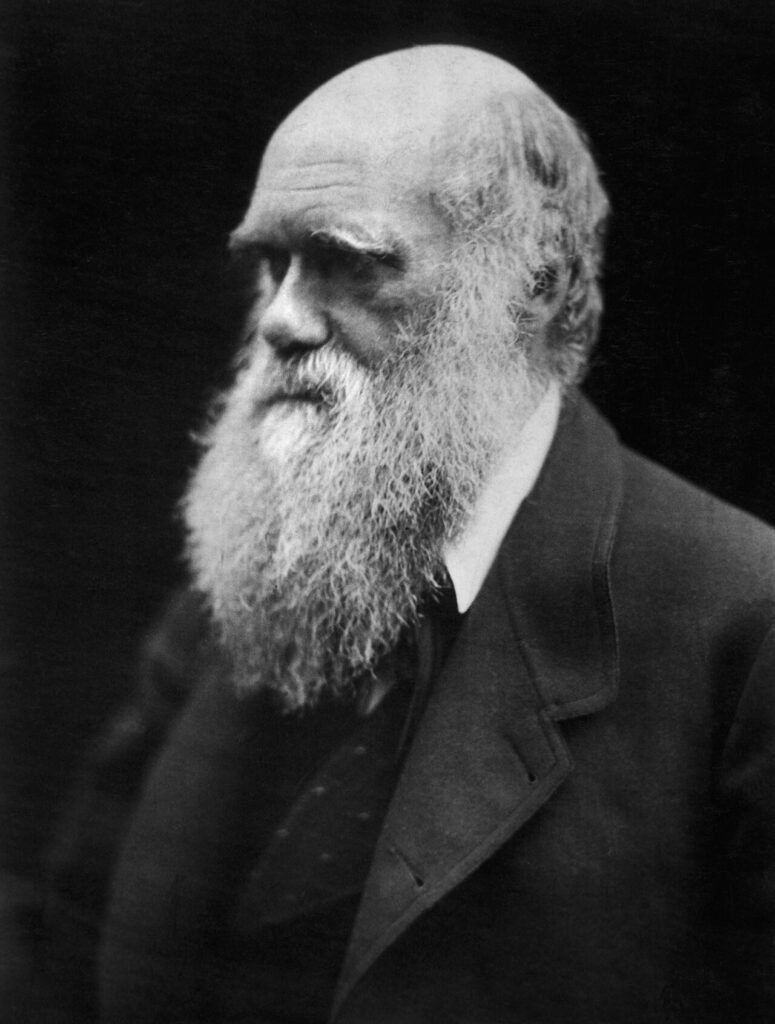
Charles Darwin (1809 to 1882) was an English naturalist who explained how species change over time through natural selection. His book On the Origin of Species, published in November 1859, made the case for evolution by this mechanism and became one of the most influential works in the history of science. Alfred Russel Wallace reached a similar idea independently, and the two men’s theories were first announced together at the Linnean Society of London in July 1858.
Early life and education
Darwin was born in Shrewsbury, England, on 12 February 1809. His father, Robert Waring Darwin, was a successful doctor and investor. His mother, Susannah, was a daughter of the pottery manufacturer Josiah Wedgwood. His grandfather Erasmus Darwin was a physician, poet and natural philosopher who had published his own ideas about evolution. Charles grew up with an older brother and four sisters. His mother died in 1817, when he was eight, and his father raised the family.
In 1825 Darwin went to Edinburgh University to study medicine, but he disliked the prospect of following his father into the profession and left after two years. In 1827 he matriculated at Christ’s College, Cambridge, where he studied theology and natural science and took his degree in 1831. He spent many hours on beetles, marine invertebrates and geology. His friendship with the botany professor John Stevens Henslow led to the opportunity that shaped his career.
Voyage of HMS Beagle
Henslow recommended Darwin as a gentleman companion to Robert FitzRoy, captain of the survey ship HMS Beagle. The ship sailed in 1831, when Darwin was 22, and the voyage lasted nearly five years. It visited South America and the Galapagos Islands and circled the globe. Darwin later wrote that it “has determined my whole career.”
By the time he returned to England in 1836, Darwin had unearthed enormous fossil mammals in South America and developed a new explanation for how coral reefs form. He had also observed the lives of indigenous peoples from Tierra del Fuego to Tahiti and collected animals, plants and rocks that fueled his research for decades. These results won him a place in London’s leading scientific circles and a friendship with the geologist Charles Lyell. His published account of the trip became the book known as Voyage of the Beagle.
Major contributions
Darwin’s central contribution was a mechanism for evolution. Individuals within a species vary, many of those variations are inherited, and more offspring are born than can survive. Individuals whose traits suit their surroundings tend to leave more descendants, so those traits become more common over generations. Darwin called this process natural selection. The practical meaning is that species are not fixed. Living things share common ancestors, and the variety of life, or biodiversity, grows through gradual divergence.
Darwin developed the idea privately for years. He moved to publish in 1858, after he learned by letter that Wallace had developed a similar theory while collecting specimens in the Malay Archipelago. His friends Lyell and the botanist Joseph Hooker urged him to act, and the joint announcement at the Linnean Society followed that July. On the Origin of Species by Means of Natural Selection appeared in November 1859. Writing to Lyell soon afterward, Darwin said the book’s reception had “infinitely exceeded my wildest hopes.”
Darwin had no accurate account of how traits are passed on. Modern genetics, built on the study of the gene, later supplied one, and the combination of the two remains a foundation of present-day biology.
His other work was broad. He studied barnacles, orchids, climbing plants, insect-eating plants, the movements of plants, and the breeding of domestic animals and plants. He wrote about instinct, the evolution of mind and human nature, including The Descent of Man in 1871. Late in life he turned to earthworms. Each project shows the same habit of patient observation and experiment, often carried out in his own garden and greenhouse.
Later life and death
In 1839 Darwin married his cousin Emma Wedgwood and was elected a Fellow of the Royal Society. After six productive years in London, the couple moved in 1842 to the village of Downe in Kent, where he lived for the rest of his life. They had ten children, and three of them died young. The death of his daughter Anne, at the age of ten in 1851, affected him deeply.
Illness troubled Darwin for much of his life, so he took part in scientific debate mainly through letters to friends such as Lyell and Hooker. He died at Down House on 19 April 1882. Although he was an agnostic, he was buried in Westminster Abbey on 26 April, in the north aisle of the nave beside the astronomer Sir John Herschel and a few feet from Isaac Newton. His pallbearers included Hooker and Wallace. A later rumor that he converted to Christianity on his deathbed was denied by his daughter, who was present.
Legacy
Darwin’s theory gave the life sciences a single explanation for both the diversity of organisms and their relatedness. Natural selection now underlies research on how populations adapt, why species go extinct, and how living things are related. Few scientists have shaped so many fields from one idea.
His records survive in unusual detail. His journals are preserved at the Down House museum, and the Darwin Correspondence Project at the University of Cambridge studies and publishes his letters. In 1888 friends and scientists funded a bronze memorial near his grave in Westminster Abbey.
FAQs
Did Darwin invent the theory of evolution? No. Others, including his grandfather Erasmus, had suggested that species change. Darwin supplied the mechanism of natural selection and a large body of supporting evidence, and Wallace independently proposed a similar mechanism.
What did Darwin do on the Beagle? He worked as a naturalist and companion to the captain. He collected fossils, plants, animals and rocks, kept detailed journals and studied geology, including how coral reefs form.
When was On the Origin of Species published? It was published in November 1859, about sixteen months after the first joint announcement of the theory.
Where is Charles Darwin buried? He is buried in the north aisle of the nave of Westminster Abbey in London, near Isaac Newton.
Key facts
- Charles Darwin was born in Shrewsbury on 12 February 1809 and died at Down House in Kent on 19 April 1882.1
- He sailed on HMS Beagle in 1831 and returned to England in 1836.2
- Darwin and Alfred Russel Wallace first announced their theories at the Linnean Society of London in July 1858.3
- On the Origin of Species by Means of Natural Selection was published in November 1859.3
- Darwin was buried in Westminster Abbey on 26 April 1882, near Isaac Newton.1
Quick checkWhat is Charles Darwin best known for?Show answer
Charles Darwin and Alfred Russel Wallace independently proposed natural selection, and Darwin published the fullest case for it in On the Origin of Species in November 1859.
Sources
- Westminster Abbey, Charles Darwin, https://www.westminster-abbey.org/abbey-commemorations/commemorations/charles-darwin/
- Darwin Correspondence Project, University of Cambridge, About Darwin, https://www.darwinproject.ac.uk/about-darwin
- Darwin Correspondence Project, University of Cambridge, On the Origin of Species, https://www.darwinproject.ac.uk/about-darwin/origin-species
Editorially reviewed by Specialty Digest Editorial TeamLast reviewed November 4, 2026Researched and drafted with AI assistanceReport an issue