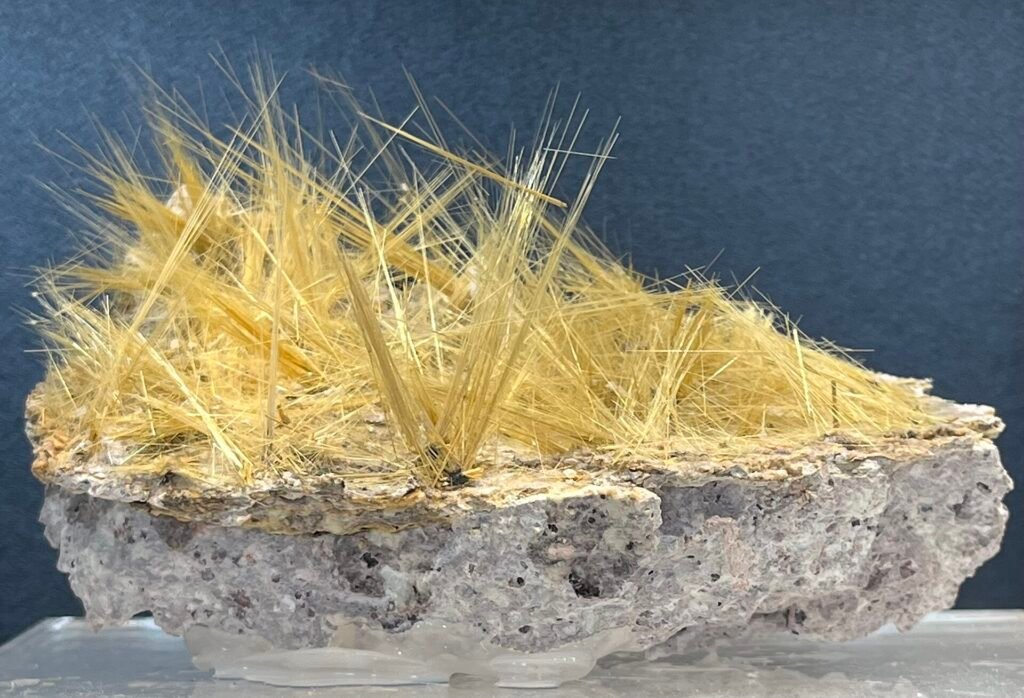
Titanium minerals in 2025 were mined at an estimated 9.8 million metric tons worldwide, counting ilmenite and rutile together, according to the U.S. Geological Survey’s Mineral Commodity Summaries 2026. China mined about a third of the ilmenite. The United States imports nearly nine tenths of what it uses. This article summarizes the USGS chapter on titanium mineral concentrates, explains the main numbers and flags what it does not say.
Who mines ilmenite?
Ilmenite is the main titanium ore. The USGS lists estimated 2025 mine production, in thousand metric tons:
- China: 3,200
- Mozambique: 1,900
- South Africa: 1,300
- Australia: 780
- Norway: 390
- Senegal: 370
- Canada: 360
- Madagascar: 300
- India: 240
- Ukraine: 200
- United States: 100
The world total is 9,400, up from 9,210 in 2024. By our own arithmetic, China’s share is about 34%, which matches the USGS statement that China accounts for about one third. Australia rose from 600 to 780, about 30%, while Ukraine fell from 286 to 200. The USGS says ilmenite makes up about 90% of world titanium mineral consumption.
Who mines rutile?
Rutile is a rarer, higher-grade ore. World output was 450 thousand tons in 2025, down from 460. Australia mined 200, Sierra Leone 110 and South Africa 100, with India, Mozambique and Ukraine each at 10 to 13. Kenya, which mined 41 in 2024, is shown with no output in 2025. By our arithmetic, Australia alone mines about 44% of rutile, and Sierra Leone’s output rose about 38% from 80 thousand tons.
How much titanium ore is left?
The USGS puts ilmenite reserves above 490,000 thousand tons and rutile reserves above 49,000 thousand tons. China holds 110,000 thousand tons of ilmenite reserves, Canada 50,000, Norway 37,000, Madagascar 30,000 and South Africa 28,000. World resources of anatase, ilmenite and rutile exceed 2 billion tons. The Australian reserve lines carried merged footnote marks in the copy we read, so we do not report them.
What are titanium minerals used for?
The USGS says the main use is titanium dioxide pigment, found in paint, paper and plastics. More than 95% of titanium mineral concentrates used in the United States went to domestic pigment producers. The rest goes to welding rod coatings, carbides, chemicals and titanium metal. Mining also yields coproducts, including zircon, monazite and abrasive sands. Our report on rare earth elements explains why monazite draws interest.
How dependent is the United States on imports?
Net import reliance was an estimated 88% of apparent consumption in 2025, against 87% in 2024 and 90% in 2021. Imports rose from 658 thousand tons to an estimated 730, about 11% by our own arithmetic, close to the 12% the chapter states. Apparent consumption rose from 800 to 900, which is 12.5% from the table but 10% in the chapter text, a gap that may reflect rounding. Imported concentrates were worth about $720 million. For 2021 to 2024, imports came from South Africa (26%), Canada (16%), Madagascar (16%) and Mozambique (13%).
Where does each product come from?
The USGS gives import shares as of July 2025 by product. Titanium slag came from South Africa (65%), Norway (24%) and Canada (10%). Ilmenite came from Mozambique (44%), Madagascar (35%), Ukraine (11%) and Senegal (9%). Rutile came from Australia (51%), South Africa (20%), Sierra Leone (18%) and Canada (11%). Synthetic rutile came from Sierra Leone (78%) and China (21%). Each product therefore has a different set of suppliers, which matters if one source is disrupted.
How did prices move?
Bulk rutile, free on board Australia, averaged $1,140 per ton in 2025, down from $1,300 in 2024 and $1,470 in 2022. Ilmenite and leucoxene averaged $400 per ton against $497. The average import value of ilmenite was $300 against $330, and of slag $880 against $970. By our arithmetic, rutile fell about 12% and Australian ilmenite about 20% in a year. All four series fell, and the chapter gives no single cause in the copy we read.
What is China doing?
The USGS says China imported 3.8 million tons of titanium mineral concentrates in the first nine months of 2025, gross weight, up 5% from the same period of 2024. Mozambique supplied 47%, Australia 17% and Norway 7%. China is therefore both the largest ilmenite miner and a large importer. The chapter does not explain the pattern.
How has U.S. demand changed since 2021?
Apparent consumption in the United States was 1,000 thousand tons in 2021 and 2022, fell to 700 in 2023, then recovered to 800 in 2024 and an estimated 900 in 2025. Imports followed the same shape, from 969 in 2021 to 638 in 2023 and 730 in 2025. Domestic production stayed near 100 thousand tons. Employment at the mine and mill rose from 340 to 490 people, about 44% by our own arithmetic. Output did not grow, so the USGS data do not say why employment rose.
How to read the numbers
Production and reserves are shown by ore type, and the combined row adds ilmenite and rutile. Trade figures mix concentrates, slag and synthetic rutile. Estimates for 2025 are first reads that the USGS may revise.
How does titanium connect to other coverage?
Titanium ore shares supply chains with other industrial minerals. See our reports on aluminum in 2025, tungsten in 2025 and the USGS summary of U.S. mineral production.
What should readers watch for next?
Readers can watch African supply, Chinese import demand and the next USGS edition, which replaces estimates with reported data.
Glossary
- Ilmenite: the main titanium ore, an iron titanium oxide
- Rutile: a high-grade titanium dioxide ore
- Slag: a titanium-rich product left after smelting ilmenite
- Pigment: a fine powder that gives color or whiteness
- Net import reliance: imports minus exports, as a share of apparent consumption
These definitions are general explanations and are not quoted from the USGS.
What is not covered here?
We omit the Australian reserve lines, the tariff schedule and any price forecast.
Key facts at a glance
- World ilmenite and rutile, 2025: about 9.8 million tons
- China: 3.2 million tons of ilmenite, about 34%
- U.S. net import reliance: 88%
- Pigment: over 95% of U.S. use
- World resources: over 2 billion tons
Frequently asked questions
Which country mines the most ilmenite?
China, at an estimated 3.2 million tons in 2025.
What is titanium ore used for?
Mostly white pigment for paint, paper and plastics.
Does the United States import titanium minerals?
Yes. The USGS puts net import reliance at about 88%.
More in Business
- Magnesium Compounds in 2025: USGS Shows China Mines 60 Percent of Magnesite
- Antimony in 2025: USGS Shows a $25 Price as U.S. Import Reliance Hits 91 Percent
- Molybdenum in 2025: USGS Shows China Mines 37 Percent as U.S. Output Rises 18 Percent
- Niobium in 2025: USGS Shows Brazil Mines 93 Percent and the U.S. Imports All It Uses