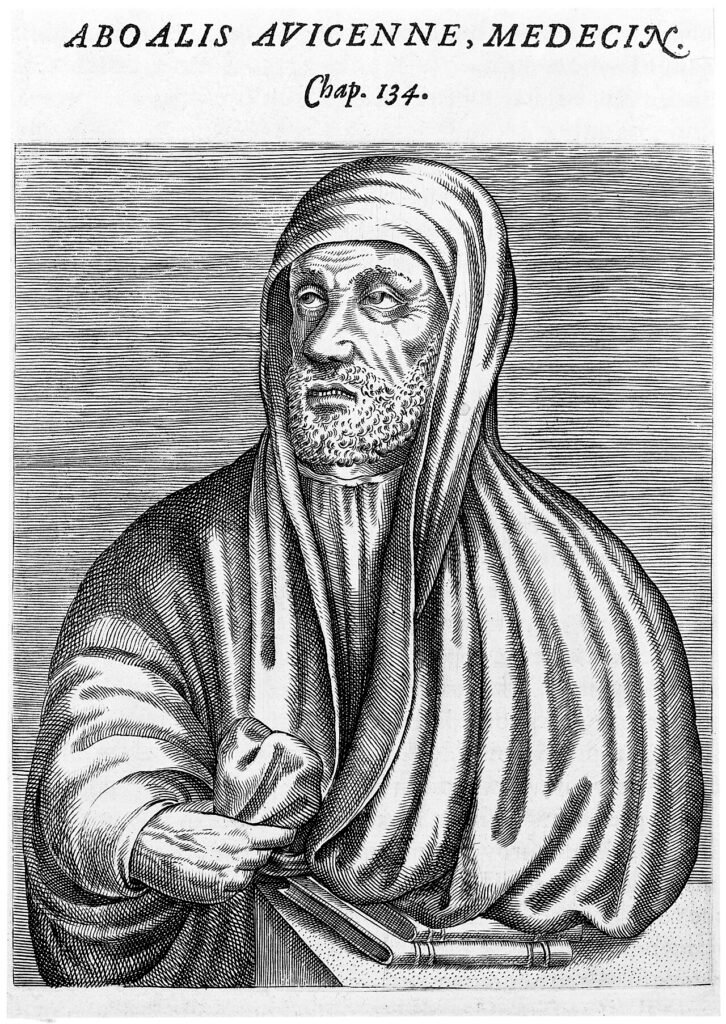
Ibn Sina (c. 980 to 1037), known in Europe as Avicenna, was a Persian physician and philosopher who worked at the courts of several rulers in Central Asia and Iran. His Canon of Medicine and Book of Healing became standard reference works across the Islamic world and in medieval Europe.
Early life of Ibn Sina
Ibn Sina means son of Sina, and Avicenna is the Latinized form of that name. He was born in Afshana, a village near Bukhara, the capital of the Samanid dynasty. The exact year is uncertain. Many accounts give about 980, while one scholarly summary places his birth in the 970s and notes that it might have been as early as 964.
His father came from Balkh and served the Samanid state as governor of a nearby district. The family moved to Bukhara while Ibn Sina was a boy. The city lay on a main Silk Road route and was a busy center of learning. He studied the Quran and literature, then arithmetic, Islamic law, logic, and the geometry and astronomy of the Greeks, and he took up medicine as a young man.
The Samanids followed a deliberate policy of reviving Persian culture while promoting the Arabic-Islamic learning that radiated from Baghdad. Greek works had been translated into Arabic there since the Abbasid dynasty took power in 750, and these translations reached Bukhara. The city was full of resident and visiting scholars, which gave the young Ibn Sina an unusually rich setting for study.
He later wrote an autobiography covering his early and middle years. His student and secretary, al-Juzjani, finished the account after the master’s death. It is the fullest source on his life. In it Ibn Sina says he taught himself most of the philosophical curriculum, working through logic, natural science, mathematics and metaphysics in order.
Career and major work
According to the autobiography, Ibn Sina treated an ailing Samanid ruler as a teenager, and as a reward he was allowed to use the palace library. It held Greek works in Arabic translation on every subject. Later accounts say he was serving as a court physician by the age of 17.
The Samanid state collapsed around 999, and Ibn Sina spent much of his adult life moving between courts. He worked for rulers in Gurganj, the capital of Khwarazm, and then in Gorgan, Rayy, Hamadan and Isfahan, serving as a physician and adviser while he continued to write. He died in Hamadan on 22 June 1037. His tomb there is now a mausoleum and museum.
He wrote mostly in Arabic and a few key works in Persian. Scholars believe he produced around 450 works, of which roughly 240 survive. They cover medicine, philosophy, logic, mathematics, astronomy, psychology, theology and poetry. The best known are two large works:
The Book of Healing is a philosophical and scientific encyclopedia that treats logic, the natural sciences, mathematics and metaphysics. The Canon of Medicine is a medical encyclopedia that organized the knowledge of his day into a single systematic work. It became a standard medical text at many European universities and stayed in use into the 17th century.
Ideas and contributions
Ibn Sina worked within the tradition of Aristotle, whom he called the First Teacher. He read the Greek philosophers in Arabic translation and reworked their ideas rather than only repeating them. A scholarly summary of his thought highlights his logic, his interest in how knowledge begins in experience, and his account of the rational soul. A well-known thought experiment attributed to him, often called the floating man, asks whether a person deprived of all sensation would still be aware of existing.
In medicine, his admirers stress that he combined observation with reasoning, and the Canon was valued for its clear arrangement. He is often described as a founder of early modern medicine, a title that reflects his reputation more than a single discovery. The Canon is a historical source, and it is not a guide for treating illness today.
His most lasting philosophical contribution may be the way he reshaped Islamic philosophy. He followed the earlier philosopher al-Farabi but treated questions about prophecy, revelation, religious law and theology directly, in the context of Islam itself. According to the Encyclopaedia Iranica, this approach made philosophy understandable to a wide range of educated Muslims, and for later thinkers philosophy came to mean Avicenna’s philosophy.
Legacy of Ibn Sina
In the Islamic world he was known as al-shaykh al-ra’is, the Preeminent Master. One scholarly account ranks his influence on the intellectual history of the lands west of India as second only to that of Aristotle. Jewish and Christian scholars who wrote in Arabic took up many of his ideas, and the Latin scholastics of medieval Europe were especially receptive to his work.
His name is attached to many modern places and institutions, among them a lunar crater, a university in Hamadan and a hospital in France. A pavilion at the United Nations offices in Vienna, donated by Iran, includes statues of Ibn Sina and the scholar al-Biruni. His work is a central subject in the study of the Islamic Golden Age, the period when scholars in cities from Baghdad to Bukhara translated, tested and extended earlier knowledge.
Criticism of Ibn Sina
Ibn Sina was influential, but he was never without critics. The theologian al-Ghazali, who lived two generations later, first wrote a summary of the philosophers’ views, drawing mainly on Avicenna, and later a refutation of their doctrines. Al-Ghazali accepted that no serious Muslim thinker could ignore philosophy.
Philosophers in the Islamic West also criticized him. They argued that he had weakened philosophy by making concessions to theology and mysticism, and that his writing leaned too much on rhetoric and popular opinion. His reputation among general readers outlasted this criticism, and he is still read in Iran and across the world.
More in Medicine
Key facts
- Ibn Sina was born near Bukhara around 980, though the exact year is uncertain.1
- He died in Hamadan on 22 June 1037.1
- His main works include the Canon of Medicine and the Book of Healing.1
- Scholars believe he wrote about 450 works, of which roughly 240 survive.1
- His philosophy shaped later Islamic thought and drew criticism from al-Ghazali.2
Related concepts
Quick checkWhy is Ibn Sina called Avicenna?Show answer
Avicenna is the Latinized form of Ibn Sina, which means son of Sina. Medieval European translators used that form, and it became his usual name in the West.
Sources
- Stanford Encyclopedia of Philosophy, Ibn Sina (Avicenna), https://plato.stanford.edu/entries/ibn-sina/
- Encyclopaedia Iranica, Avicenna i. Introductory note, https://iranicaonline.org/articles/avicenna-i
Editorially reviewed by Specialty Digest Editorial TeamLast reviewed November 4, 2026Researched and drafted with AI assistanceReport an issue